






Sieving analysis is a method for determining the particle size distribution of various bulk materials, described in a multitude of international standards. Sieve analysis is one of the most established methods in quality assurance and can be performed as either dry or wet sieving.
Manual sieving is also possible, but due to the individual influences of the operator like speed and strength, it is to be disregarded in a professional context.
Sieving analysis allows the characterization of particle size distributions of bulk materials of various shapes and sizes, enabling the determination and comparison of specific product properties such as solubility, flow behavior, and reactivity of different materials.
Sieve analysis
Sieve analyses are indispensable for production and quality control of powdery and granular bulk materials in many industries (including food, pharmaceutical, and chemical). Advantages of sieve analysis include:
- easy handling
- low investment costs
- rapid delivery of precise and reproducible results
- the ability to obtain individual particle size fractions
Therefore, this method can certainly compete with modern analytical techniques such as laser light scattering or image analysis methods.
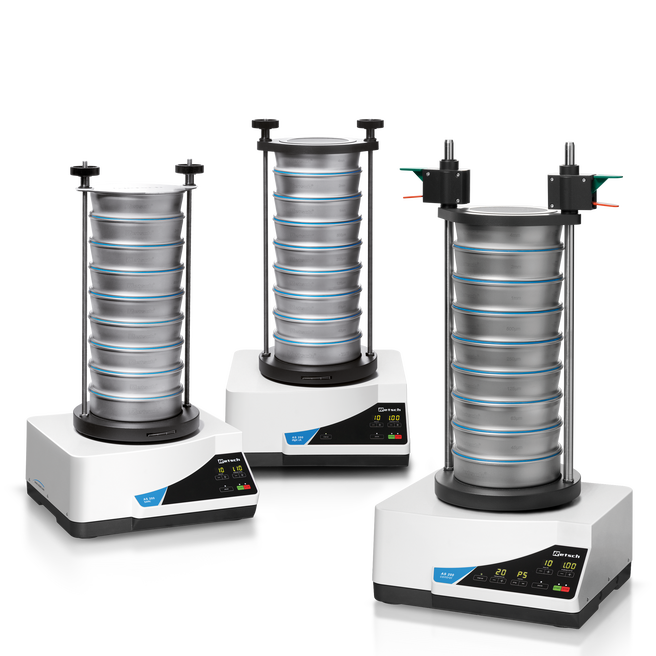
To ensure high reproducibility and reliability, the sieve shaker and accessories must meet stringent requirements that comply with (inter)national standards. RETSCH analytical sieves and sieve shakers, as well as all other measuring equipment (e.g., balances) needed for characterizing particle size distribution, are therefore calibratable and are subject to test equipment monitoring as part of quality management systems. For comprehensive process reliability, careful sample preparation is also essential. Only in combination can sieving results be achieved that enable reliable characterization of your products.
Overview of Sieving Principles
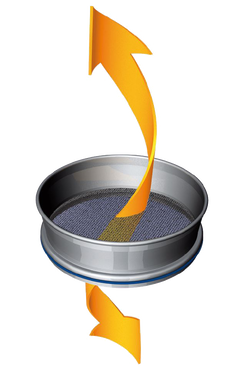
샘플은 시트 바닥의 진동에 의해 위로 던져지고 중력의 힘으로 인해 다시 내려갑니다. amplitude는 시트 바닥의 수직 진동 높이를 나타냅니다.
진동 시트의 경우, 샘플은 3 차원 움직임에 직면합니다. 즉, 둥근 움직임이 수직 던진 움직임을 초월합니다. 이 결합된 움직임으로 인해 샘플 소재는 전체 시트 영역에 균일하게 분산됩니다. 입자들은 수직 방향으로 가속되고 자유롭게 회전하여 통계적으로 방향으로 다시 떨어집니다. Retsch 분체기 경우, 전기 마스 시스템을 움직이게하고 진동을 시트 스택으로 전송합니다. amplitude는 몇 밀리미터로 지속적으로 조정될 수 있습니다.
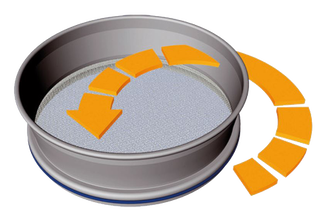
수평 분체기의 분체는 평면 상에서 원형으로 움직입니다. 수평 분체기는 침상형, 평형 또는 섬유질 시료에 사용됩니다. 분체의 수평 운동으로 대부분의 입자가 체에서 방향을 변경하지 않습니다.
분체기 탭 시브 흔들기 탭 시브 흔들기 탭 시브 흔들기 탭 시브 흔들기 탭 분체기 흔들기 탭 시브 흔들기 탭 시브 흔들기 탭 시브 흔들기 탭 시브 흔들기 탭 분체기 탭 시브 분체기 탭 시브 흔들기 탭 시브 흔들기 탭 시브 흔들기 탭 시브 흔들기 탭 시브 흔들기 탭 시브 흔들기 탭 시브 흔들기 탭 시브 흔들기 탭 시브 흔들기 탭 시브 흔들기 탭 시브 흔들기 탭 시브 흔들기 탭 시브 흔들기 탭 시브 흔들기 흔들기

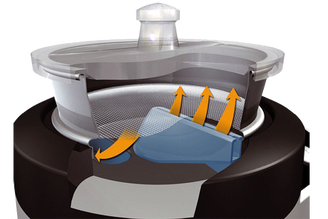
공기 방사선 시프는 단일 시프를 위한 시프 기계입니다. 즉, 각 시프 프로세스에 한 개의 시프만 사용됩니다. 시프 자체는 프로세스 중에 이동되지 않습니다.
시프 위의 재료는 회전하는 공기 시프에 의해 이동됩니다. 시프 기계에 연결된 진공 청소기는 시프 챔버 내부에 진공을 생성하고 회전하는 슬릿 메시를 통해 신선한 공기를 흡수합니다. 따라서 시프의 좁은 슬릿을 통과하면 공기 흐름이 가속화되고 진공 청소기 또는, 선택적으로, 주사체로 분산됩니다.
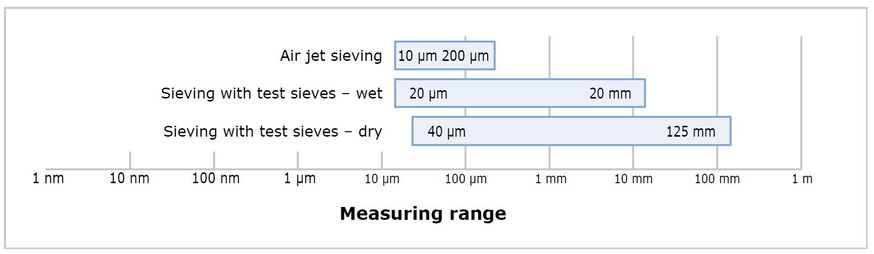
In air jet sieving, only a single sieve is used at a time, and it is not moved during the sieving process. A rotating nozzle below the sieve directs a jet of air onto the material to be sieved, causing particles to deagglomerate and then be sucked through the sieve. Air jet sieving is suitable for size ranges from 10 µm to 4 mm.
Dry sieving is the most popular method of reproducible sieve analysis, including vibration, horizontal and tap sieving. Air jet sieving is also considered a dry sieving method, but it is a special process (see below). If necessary, the sample is dried in advance to avoid clumping. Before sieving, the sample is weighed, then placed in the sieving system and weighed again at a later point in time.
Sieving is used to determine the percentage of the sample that remains on the sieve or is smaller than the selected mesh size. If a particle size determination of the various fractions is to be carried out (set sieving), a sieve stack is used that contains several sieves with different mesh sizes (40 µm – 125 mm).
However, to ensure that the results are reproducible beyond doubt, the machine should be set up completely digitally. Furthermore, the integrated control unit should be constantly monitored to avoid unintentional changes and deviations during the test.
Wet sieving is used to determine particle sizes in moist, greasy or oily samples. It is also the method of choice when the material to be analyzed is already present as a suspension and cannot be dried, as well as for particles that tend to agglomerate (usually < 45 µm), which would otherwise clog the sieve openings.
The material to be sieved is suspended and, as with dry sieving, applied to the uppermost sieve and then rinsed with water under vibration until the liquid emerging from below the sieve stack is unclouded. Wet sieving is carried out in the range 20 µm - 20 mm.
Different Requirements, Different Sieving Parameters
The optimal parameter settings depend on the respective material. Depending on the chosen sieve shaker, interval, speed, sieving time, amplitude, or even negative pressure may come into play. Although numerous (inter)national standards and guidelines exist for product-specific sieve analysis parameters, for some materials, suitable parameters must be determined experimentally. We are happy to assist you.
Take advantage of our offer for a free test sieving!
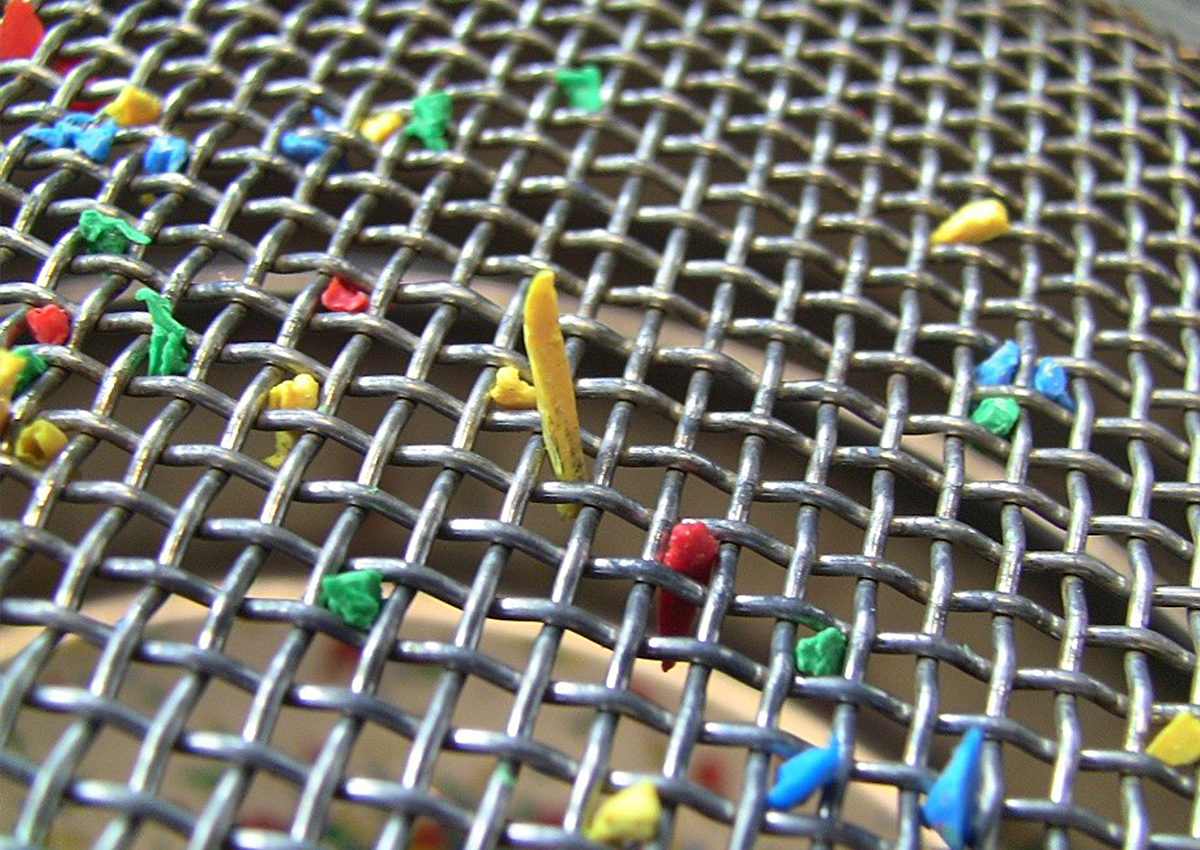
Horizontal sieving:
For flakes, sticks...
-> Long particles stay on the sieve
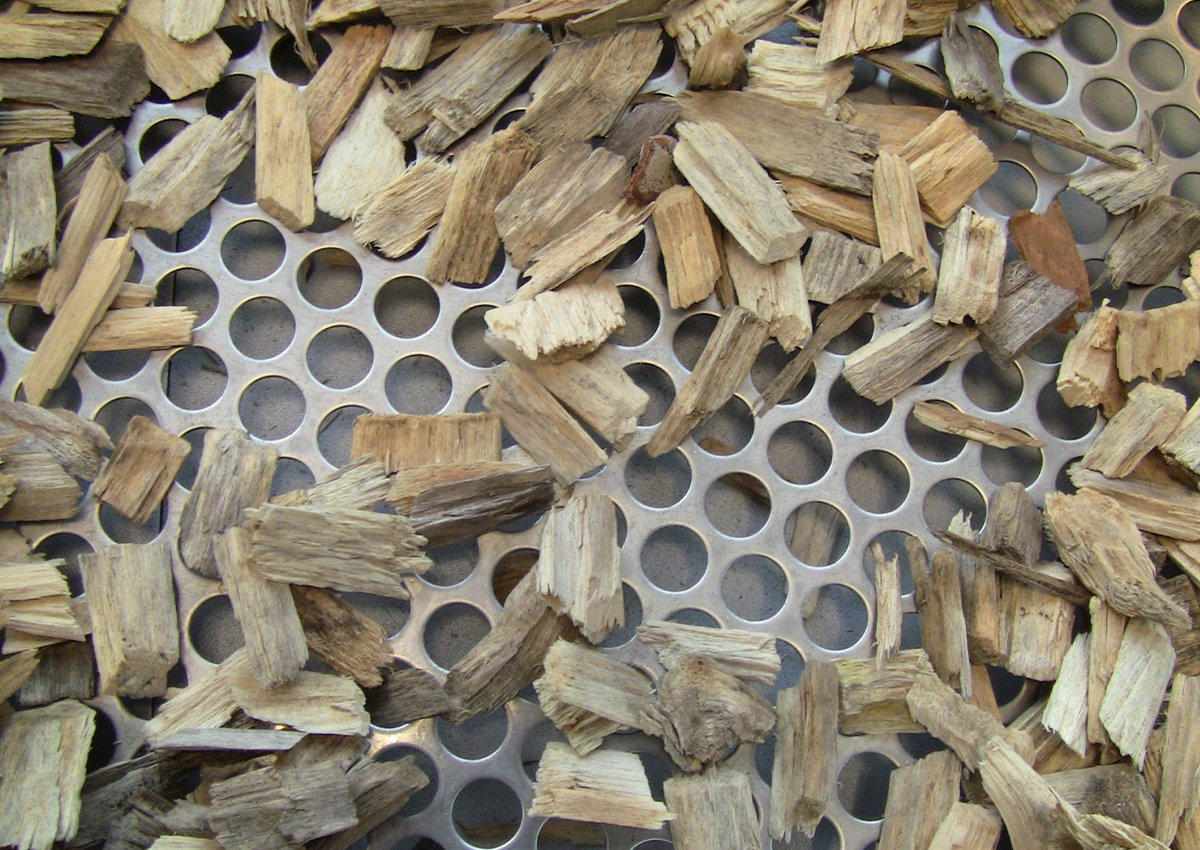
Vibratory sieving:
Lenghtwise passing of the particles through the pores.
-> Sample seems to be finer
Different sieving methods lead to different sieving results, which can be reflected in the particle size distribution. The diagrams illustrate how the horizontal sieving method and the vibratory sieving method each affect the particle size fractions. While the horizontal method achieves specific sorting through uniform movements, the vibratory sieving method utilizes 3D throwing motions for alternative separation. This results in different particle distributions, clearly shown in the diagrams.
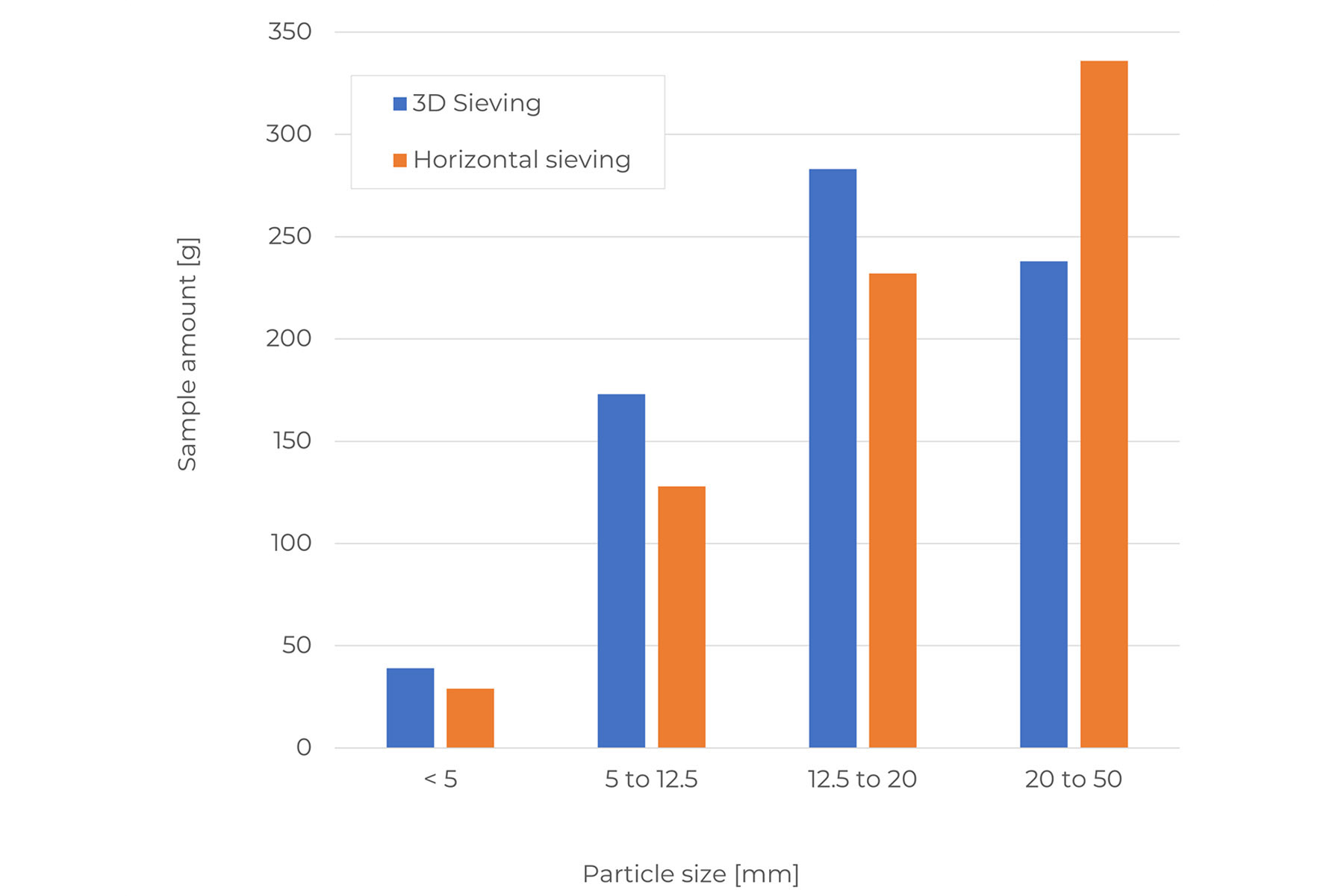
AS 450 control: 5 min, amplitude 1mm
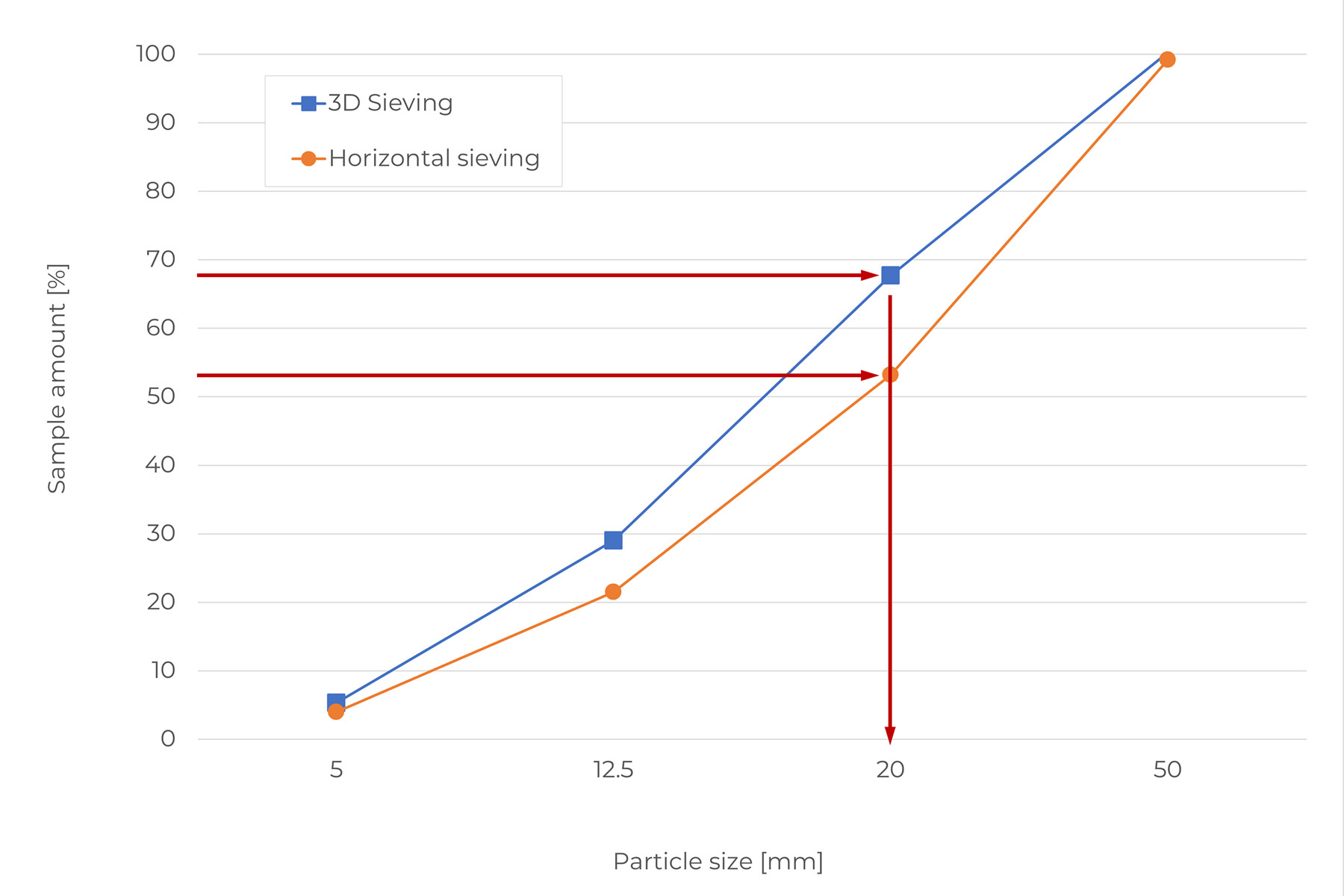
AS 400 control: 5 min, 170 rpm
Both times an identical sample of wood pieces was sieved
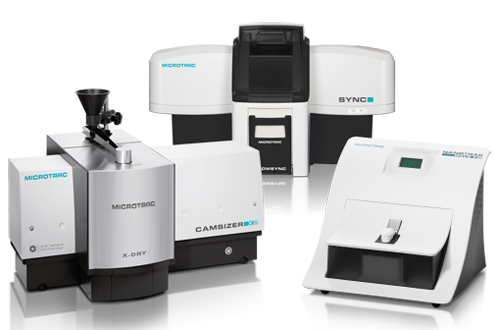
Sieving is a comparative method. Every particle that can pass through the mesh is accordingly smaller than the mesh size. Sieving usually considers the volume or mass fractions of a sample. Number (Q0), length (Q1), or area (Q2) are usually determined by optical methods (e.g., Camsizer). The problem: Camsizers only capture the measurement parameters without being able to fractionate the sample.
In most cases, the Q3 dimension (volume) is suitable as a parameter for reliable quantification of particle size distribution. This is because volume is directly proportional to mass and thus the simplest property to use to reliably determine particle size distribution with minimal effort.
Only optical instruments provide information about particle shape
- Dependening on the falling orientation of the particles, it can be detected in different ways.
- Sticks might be detected as spheres or coins.
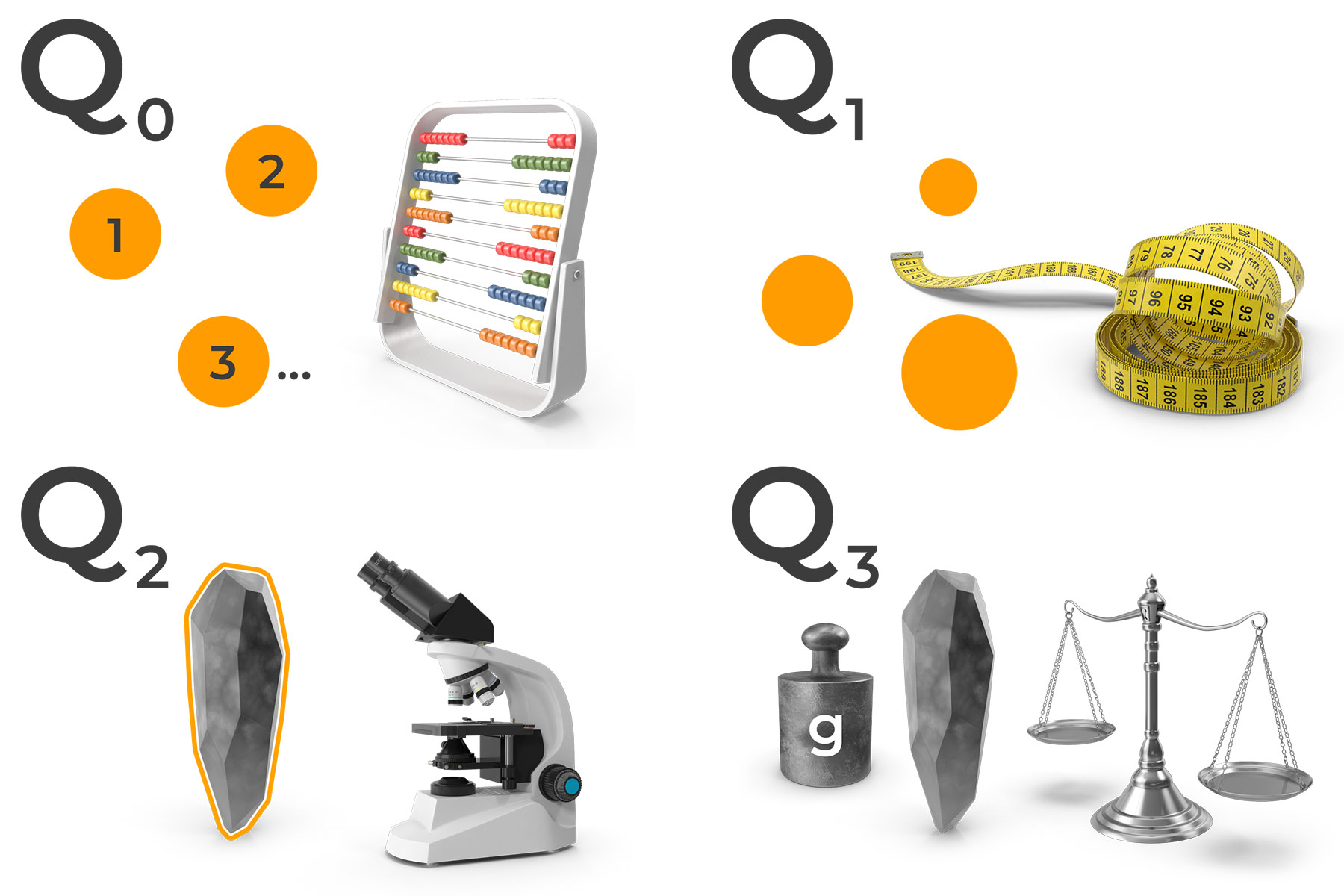
Quantification
Q0 number
Q1 length
Q2 area (surface or projection surface)
Q3 mass or volume

Comparability
Distribution of volume, surface and number, e.g. of cubes which have the same total volume.
| Q0 number | 1 | 103 | 106 number |
| Q1 length | 10 | 1 | 0.1 [mm1] |
| Q2 surface | 600 | 6,000 | 60,000 [mm2] |
| Q3 volume | 103 | 103 | 103 [mm3] |
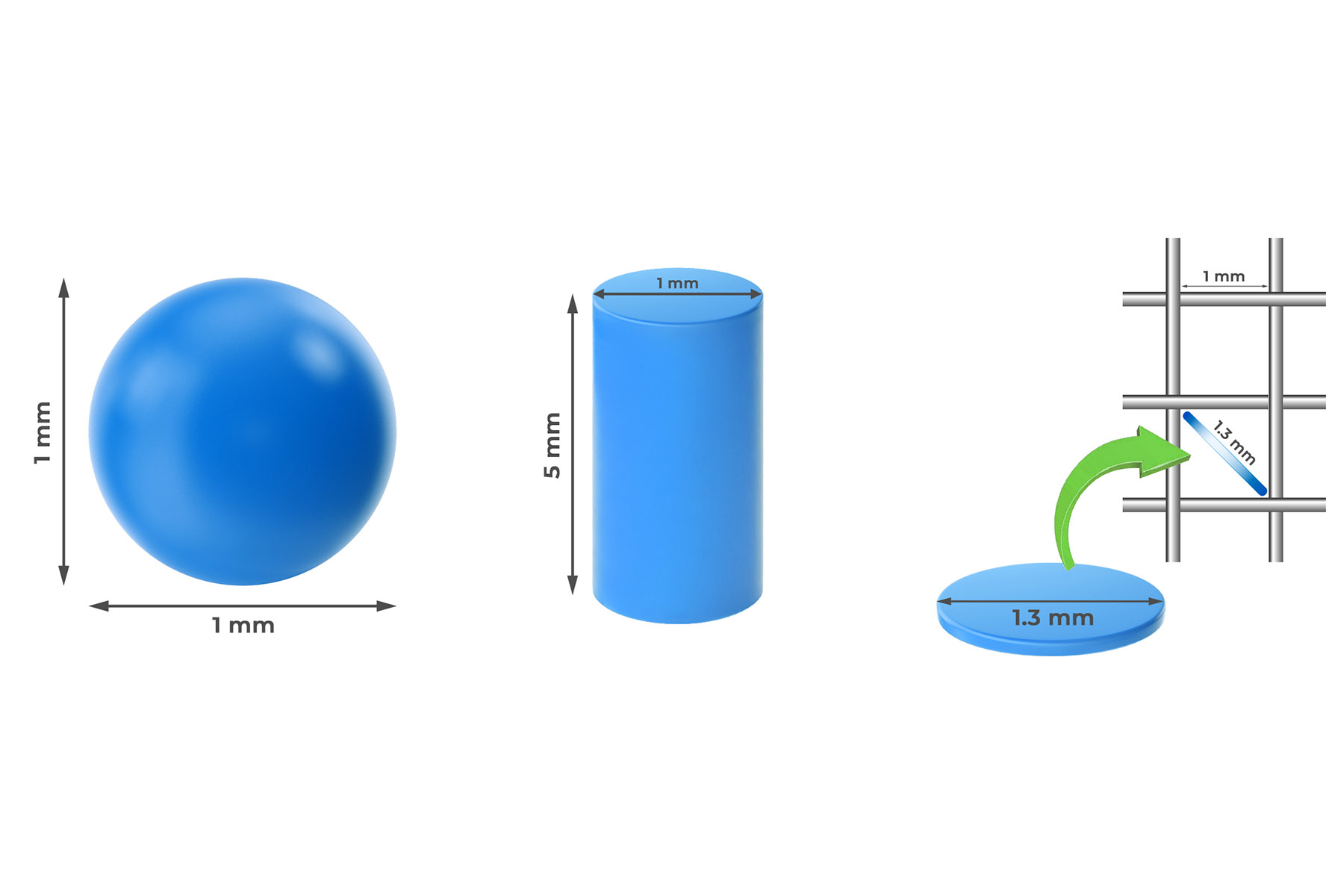
Equivalent Diameter
- Sphere: Diameter independant from site of view - 1 mm real size
- Stick: Particle can pass mesh lengthwise - particle is longer than 1 mm equivalent diameter.
- Coin: Has also equivalent diameter of 1 mm, but can be up to 1.3 mm in real.
Grain size analysis
The formal size of individual particles in a mixture is referred to as the “grain size”, and grain size analysis is used to determine this size. The subsequent size distribution of the particles has a significant influence on the properties of a material, both scientifically and technically.
Due to numerous differentiations and even different methods of determination, grain size analysis is considered an independent discipline of granulometry.
Methods of grain size analysis
Although there are different methods for analyzing and determining grain sizes, the equivalent diameter is always determined in all variants. Which method is ultimately used depends heavily on the question, possible regulations and the grain size range itself.
Larger particles, from a size of about 40 mm, are usually measured by hand or on the basis of photos, while sieving is often used for the particle size analysis of very small particles, down to a size of 10 µm. For sieving, sieves of different sizes are first stacked on top of each other and clamped in a sieving machine. The sample is then placed in the top sieve (with the largest hole size) and subjected to a defined sieving motion for a certain period of time to ensure precise sieving.
The particles of the sample are separated according to their size on the sieves. After that, the percentage of the individual fractions remaining on the sieves with different hole sizes is determined. The percentage mass fractions of the individual fractions are referred to as p3. The cumulative distribution curve Q3 provides information about the added masses of the individual fractions. It is common to provide information about the size of the sample smaller than 90%, 50% and 10%.
Optical particle characterization
The particle size analysis can also be carried out using optical measurement technology. Depending on the measurement variant, statements can also be made about the particle shape. The measuring range is between 0.3 nm and 30 mm, depending on the system. The particle characterization can be carried out in suspensions, emulsions, colloidal systems, powders, granules and bulk materials.
Our sister company MICROTRAC is a technology leader, with an extensive global network and an unrivaled offering in particle characterization.
품질 제어를 위한 치브 분석
우리는 모두 "품질"이라는 용어를 알고 있습니다. 그것은 특히 높은 가치의 제품을 설명하는 데 널리 사용됩니다. 그러나, 품질의 정확한 정의는 다음과 같습니다: 품질은 테스트를 수행하여 결정한 제품의 검출 된 특성과 정의 된 특성의 준수입니다. 테스트 측정이 원하는 특성이 주어진 수용량 내에 있음을 확인하면 제품은 높은 품질로 설명 할 수 있습니다. 측정된 값이 너무 많이 편차하면, 품질은 낮습니다. 많은 재료, 자연 또는 인공, 분산 형태로 발생합니다 (일체를 형성하지 않는 재료는 일관되지만 물리적 및 화학적 특성에 중요한 영향을 미칩니다).
입도 분포에 의해 영향을 받을 수 있는 몇 가지 특성의 예:
- 콘크리트의 강도
- 초콜릿의 맛
- 정제의 용해 특성
- 세척 분말의 유출성 (pourability) 및 용해성 (solubility)
- 여과 물질의 계면 활성
이러한 예들은 특히 생산 공정을 위한 벌크 제품들의 품질 보증과 관련하여 입도 분포를 아는 것이 얼마나 중요한지 명확하게 보여줍니다. 생산 과정 중 입도 분포가 변하게 될 경우 제품의 품질 또한 변동될 것입니다.
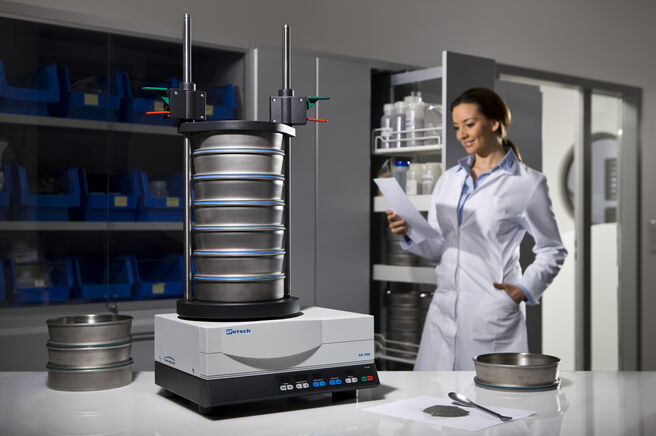
RETSCH Sieve Shakers for Reproducible Results
RETSCH sieve shakers cover a comprehensive measurement and application range for your requirements. Different sieving movements and sieve sizes enable you to use the appropriate RETSCH sieve shaker for every material that can be sieved. This ensures you always obtain exact and reproducible results – naturally in accordance with test equipment monitoring (DIN EN ISO 9001ff).
무료 상담 문의하기
RETSCH 제품과 서비스는 자회사와 완벽하게 교육된 유통업체의 글로벌 네트워크를 통해 제공됩니다. 당사의 모든 직원들이 고객님의 문의 사항을 기꺼이 도와드리겠습니다.