






기계화학 볼 밀 사용하여 용액이없는 기계 화학 반응을 수행
기계화학은 충격과 마찰력을 사용하여 화학 반응을 시작하는 화학 분야입니다. 일반적으로 볼 밀 사용을 통해 화학 반응은 환경 혜택에 대한 관심을 얻고 있습니다. 기계화학은 증가하는 환경 문제에 따라 솔루션이없는 대안을 찾고있을 때 유망한 경로를 제시합니다. 이 방법은 전통적인 솔루션 기반 접근 방식에 비해 더 빠른 반응을 촉진하고 에너지를 절약 할뿐만 아니라 반응의 나쁜 용해성과 같은 과제를 해결합니다. 그것은 Retsch 가장 포괄적인 볼 밀 액세스를 제공하고 중간 물질의 안정화 및 정화를 최적화 할 수있는 방법을 제공합니다.
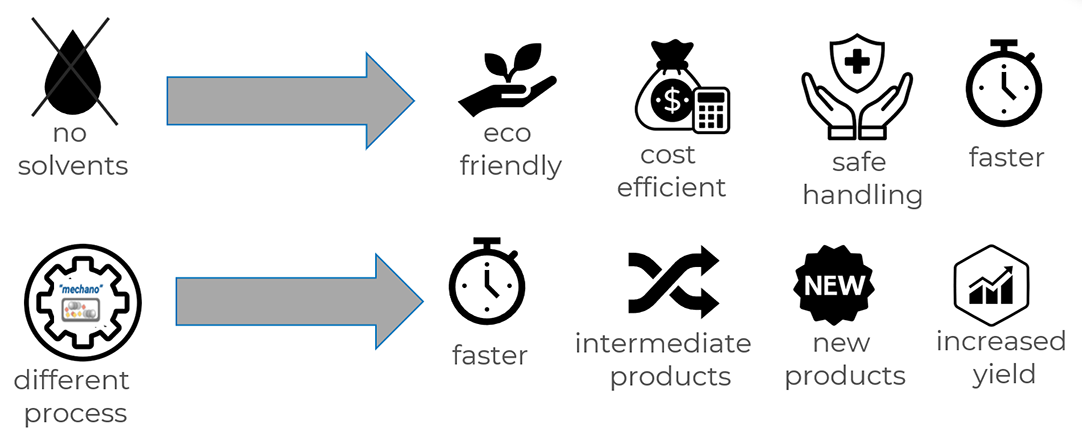
솔루션 기반 프로세스에 비해 기계화학 반응의 장점은 무엇입니까?
- 솔루션이없는 프로세스는 반응 질량의 최대 90%를 제거하여 비용 효율성과 환경 안전을 향상시키고 반응을 위한 최적의 솔루션을 식별하는 데 필요한 시간을 줄입니다.
- 새로운 반응 경로를 탐구하는 것은 기계화학으로 실현 가능하게되며, 불해성 반응체를 수용하고, 중간 물질을 안정화하며, 용제 기반의 방법에 비해 분명한 반응을 제공합니다.
- 이 접근 방식은 시간을 절약합니다, 반응은 일반적으로 분에서 몇 시간 이내에 완료되며, 용액으로 필요한 일과는 달리.
- 더 높은 수출은 적절한 조건이 발견될 때 달성될 수 있습니다.
기계화학은 어떻게 작동합니까?
기계화학에서 에너지 적용과 혼합의 방법은 결정적입니다. 행성 볼 밀 주로 크기를 줄이기 위해 마찰을 사용하지만, 믹서 블린은 충격에 의존합니다. 특정 반응은 행성 볼 밀 더 효과적으로 수행되며, 다른 사람들은 믹서 블린의 충격 모드에서 이익을 얻습니다. 현재, 온도와 혼합이 기계화학 반응에 미치는 변화하는 영향은 정확한 메커니즘이 이러한 반응을 주도하는 것이 완전히 이해되지 않기 때문에 조사되고 있습니다.
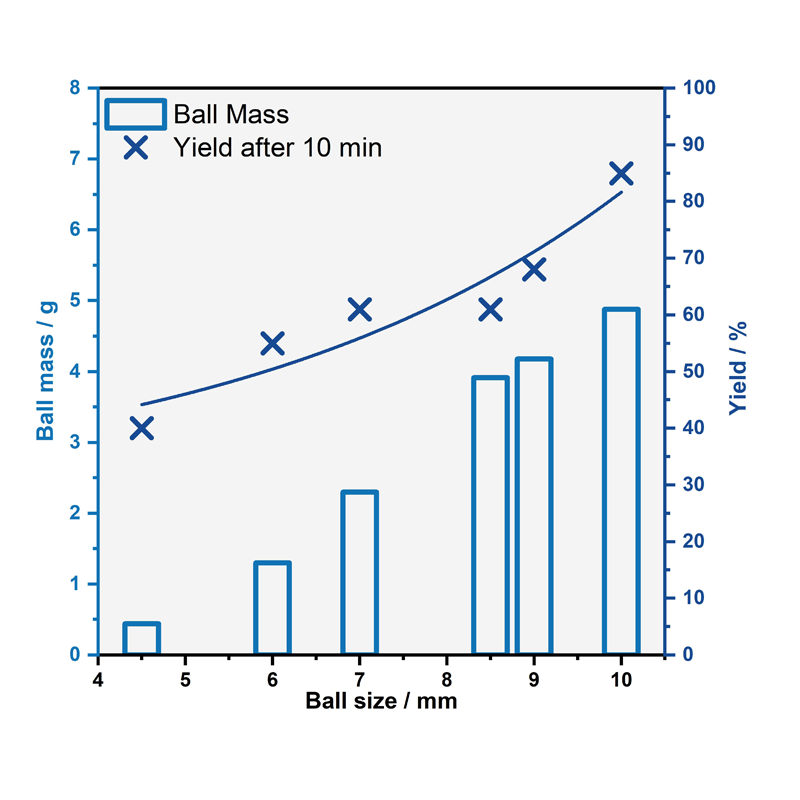
기계화학적 반응의 효율성은 몇 가지 질문을 제기합니다. 이러한 반응을 주도하는 것은 충격의 에너지이고, 더 많은 에너지는 항상 결과를 향상시킬 수 있습니까? 볼은 신선한 반응 표면을 생성 할뿐만 아니라 혼합을 향상시킬 수 있습니까? 또는 솔루블 시스템에 비해 상대적으로 높은 에드쿠트 농도는 중요한 역할을합니까? 또한, 볼 충돌 중 발생하는 높은 온도는 기여합니까, 또는이 요인들의 조합이 있습니까? 최적의 볼 크기는 또 다른 고려 사항입니다. 너무 작은 볼은 반응 요소 혼합과 부적절한 혼합을 유발할 수 있습니다. 물질은 화학 반응에 저항해야하며, 과정을 방해하지 않으며, 기계적 안정성을 유지해야합니다.
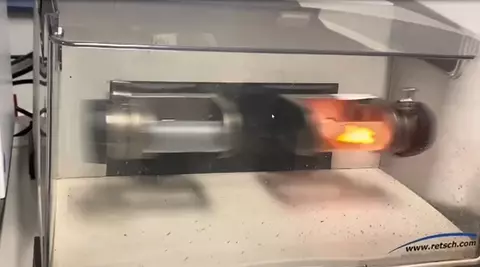
Mechanically-induced Self-propagating Reactions (MSR) are rapid, exothermic chemical reactions initiated by mechanical energy, as provided in ball mills, that propagate through a material without external heating. The video shows a mechanochemical reaction between nickel and sulfur that, under some circumstances, can run as MSR. Towards the end of the video, a flash of light can be seen which documents the MSR ignition. Permission to use this video by Matej Baláž. [11]
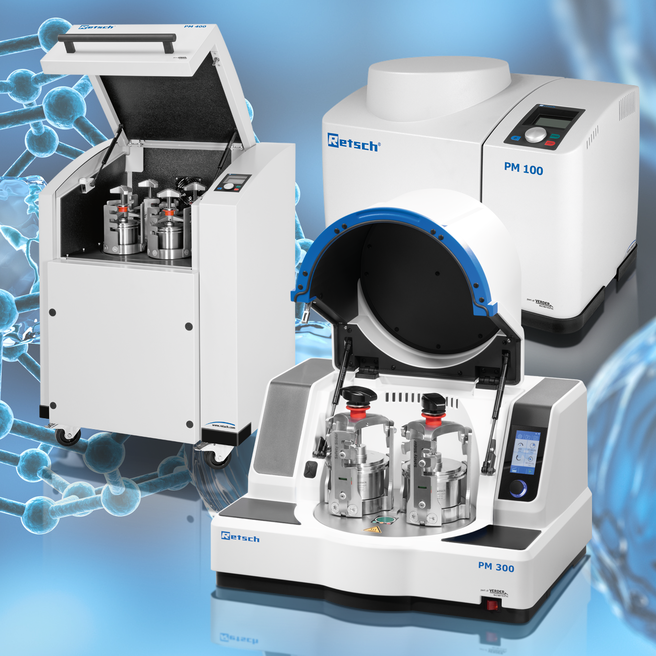
기계 합성에 사용되는 볼 밀
볼 밀 반응 조건의 정확한 제어를 허용, 광범위한 에너지 입력 및 폐쇄 용기에서 반응을 수행 할 수있는 가능성. 행성 볼 밀 믹서 블린은 일반적으로 기계 화학 반응에 사용됩니다. 이러한 두 유형의 기능 원칙은 일부 영역에서 다릅니다.
행성 볼 밀
태양 볼 밀의 움직임 방향은 1:-2, 1:-2.5 또는 1:-3의 비율로 파우더 밀의 움직임 방향은 태양 볼 밀의 태양 바퀴에 초점적으로 배치됩니다. 행성 볼 밀의 움직임 방향은 파우더 밀의 움직임 방향과 반대입니다. 이들 힘의 상호 작용은 행성 볼 밀의 회전 움직임을 초과합니다.
RETSCH는 볼과 볼 밀 사이의 속도 차이를 생성하여 열렬한 에너지와 충격력의 상호 작용을 제공합니다. 이들 힘 사이의 상호 작용은 태양용 볼 브라더의 크기가 12ml에서 500ml까지 매우 효과적입니다.
고 에너지 볼 밀 Emax
고 에너지 볼 밀은 전체 행성 볼 밀의 특별한 유형이지만, 그것은 고 주파수 충격, 강렬한 마찰과 제어 된 원형 밀 움직임을 결합하여 최대 2000 rpm의 속도로 고 효율적인 크기 감소 메커니즘으로, 높은 에너지 입력의 결과입니다.
그것은 크게 향상됩니다 입자의 혼합은 더 작은 밀 크기와 샘플 물질과 밀 밀 벽 사이의 강력한 마찰을 일으키는 움직임, 뿐만 아니라 다른 볼 밀 벽 사이의 강력한 가속으로 공격 할 수 있습니다.
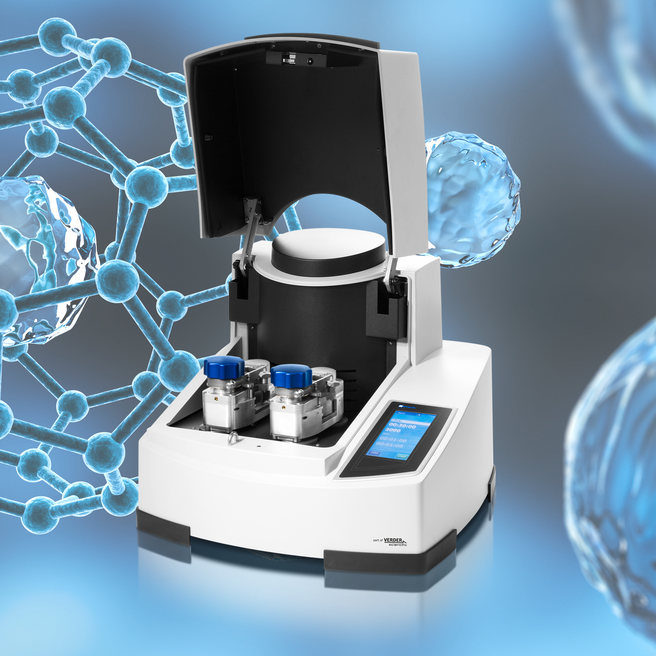
혼합 분쇄기
MM의 입력 범위는 믹서 밀의 작동 방식은 주로 충격을 기반으로합니다. 믹서 밀은 수평 위치에서 방사선 진동을 수행합니다. 믹서 밀의 에너지는 믹서 밀에 높은 에너지로 충돌하고 밀을 분쇄합니다. 또한, 믹서의 움직임은 볼의 움직임과 결합하여 샘플의 강렬한 혼합 및 작은 컴팩트의 옵션으로 인해 발생합니다.
500
RETSCH는 5 개의 믹서 밀 모델을 제공합니다.

속도 또는 주파수가 기계화학에서 수출에 미치는 영향
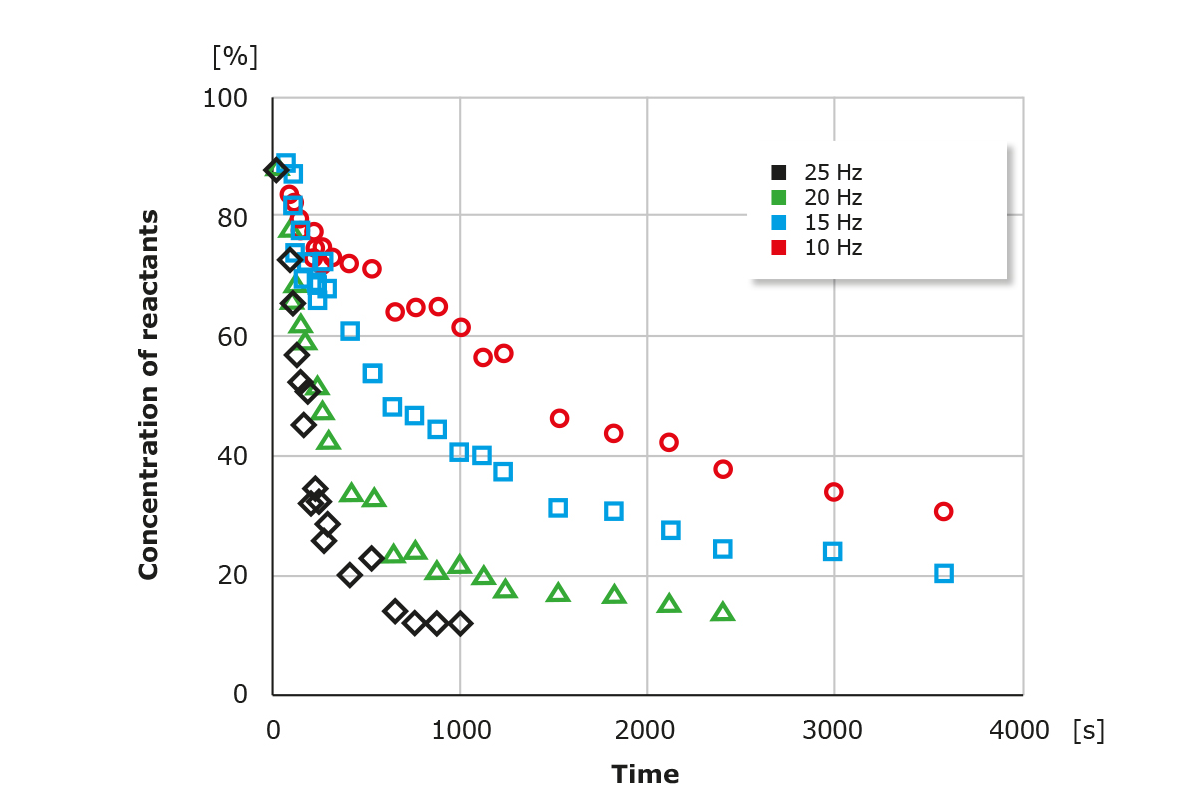
기계화학에서 에너지 적용과 혼합의 방법은 결정적입니다. 행성 볼 밀 주로 크기를 줄이기 위해 마찰을 사용하지만, 믹서 블린은 충격에 의존합니다. 특정 반응은 행성 볼 밀 더 효과적으로 수행되며, 다른 사람들은 믹서 블린의 충격 모드에서 이익을 얻습니다. 현재, 온도와 혼합이 기계화학 반응에 미치는 변화하는 영향은 정확한 메커니즘이 이러한 반응을 주도하는 것이 완전히 이해되지 않기 때문에 조사되고 있습니다.
기계화학적 반응의 효율성은 몇 가지 질문을 제기합니다. 이러한 반응을 주도하는 것은 충격의 에너지이고, 더 많은 에너지는 항상 결과를 향상시킬 수 있습니까? 볼은 신선한 반응 표면을 생성 할뿐만 아니라 혼합을 향상시킬 수 있습니까? 또는 솔루블 시스템에 비해 상대적으로 높은 에드쿠트 농도는 중요한 역할을합니까? 또한, 볼 충돌 중 발생하는 높은 온도는 기여합니까, 또는이 요인들의 조합이 있습니까? 최적의 볼 크기는 또 다른 고려 사항입니다. 너무 작은 볼은 반응 요소 혼합과 부적절한 혼합을 유발할 수 있습니다. 물질은 화학 반응에 저항해야하며, 과정을 방해하지 않으며, 기계적 안정성을 유지해야합니다.
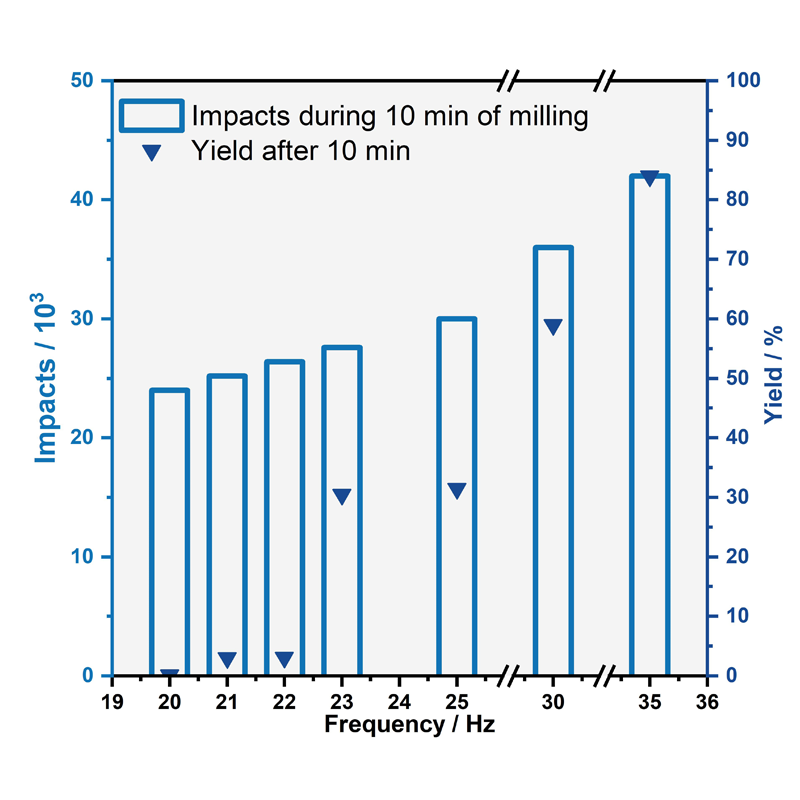
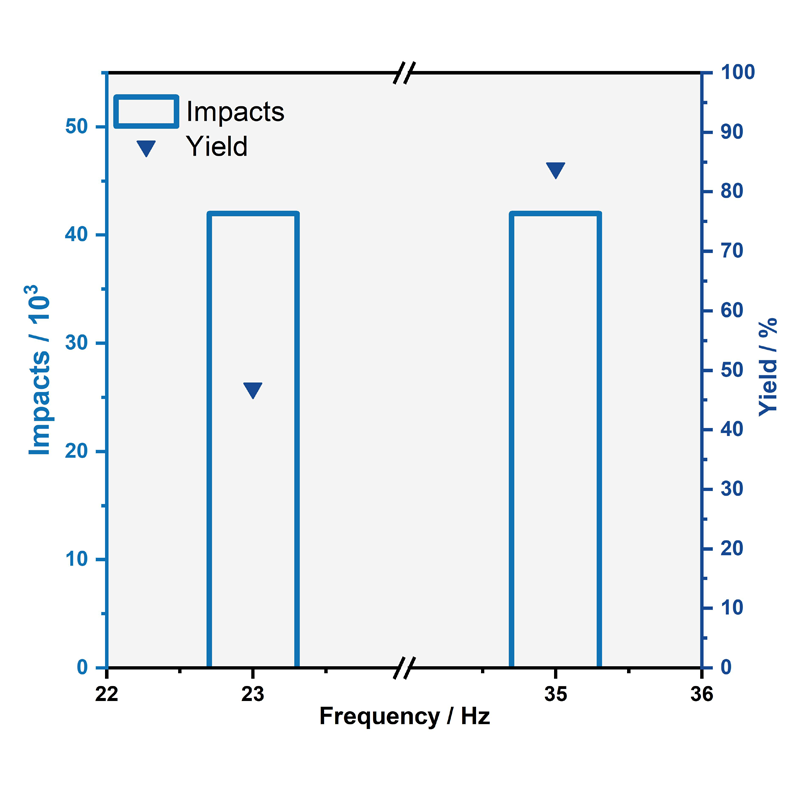
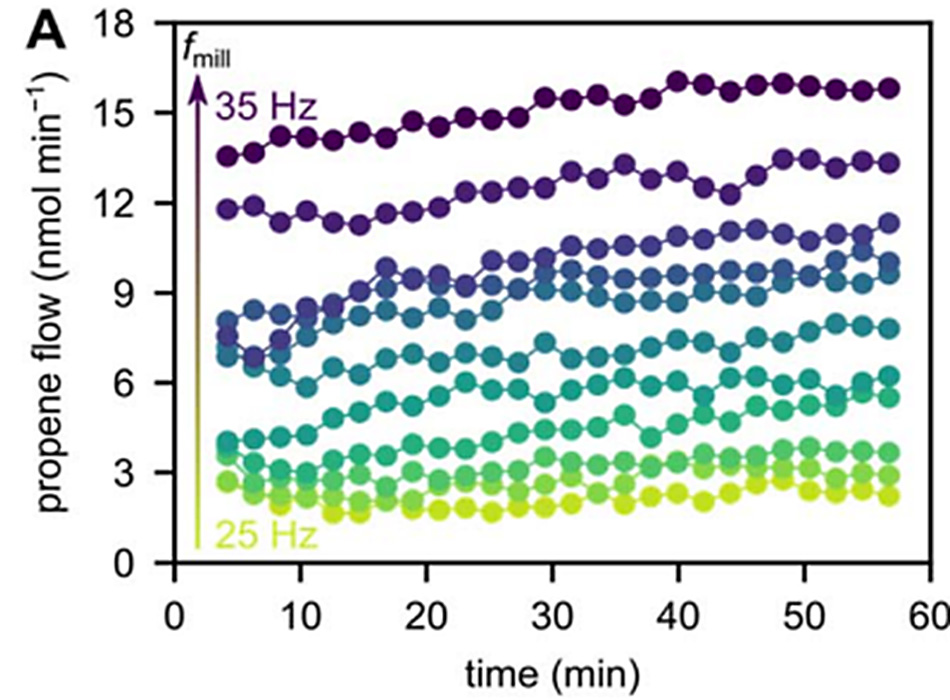
Recent research at the University Utrecht has demonstrated that the efficiency of polypropylene (PP) depolymerization via ball milling in the Mixer Mill MM 500 vario can be dramatically enhanced by optimizing mechanical parameters. When the milling frequency is increased, the rate at which valuable monomers like propene are produced rises sharply. This is because higher frequencies generate more frequent and energetic impacts, which accelerate the cleavage of polymer chains. The effect is highly nonlinear: even modest increases in frequency can lead to exponential gains in product yield, making the process both powerful and tunable. The highest yield was achieved at maximum frequency of 35 Hz. [13]
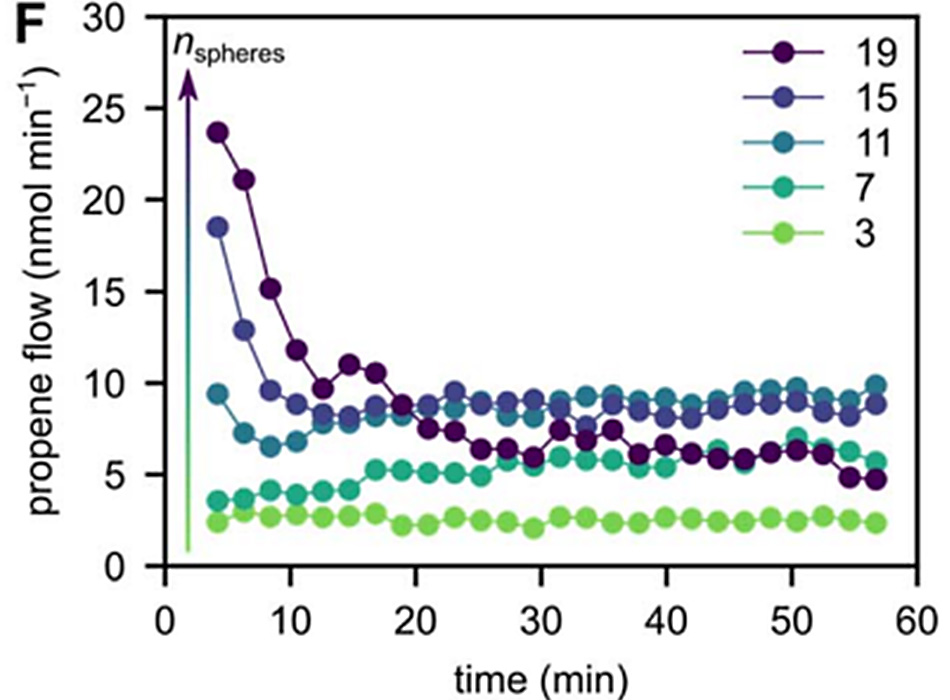
In addition to frequency, the number and size of grinding balls within the grinding jar play a crucial role. Using more balls increases the number of collision events, which in turn boosts the formation of small hydrocarbon molecules. However, there is an optimal range, where the process is most efficient. Beyond this point, adding more balls actually reduces the effectiveness, as it restricts their movement and limits energy transfer. This approach offers a flexible, energy-efficient solution towards the circular economy of plastics.
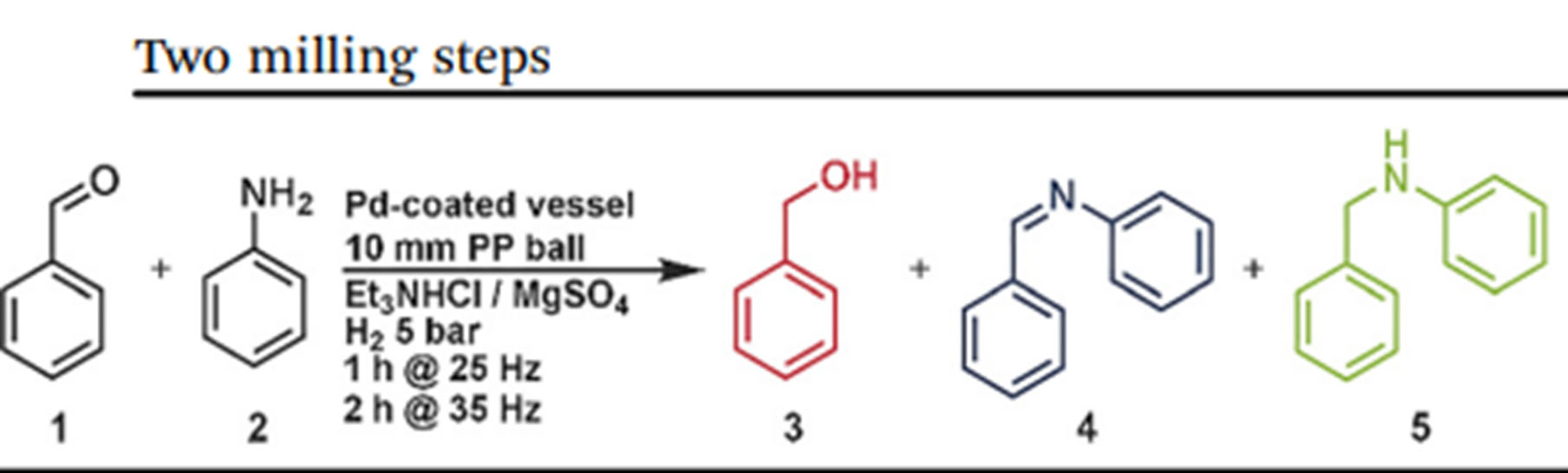
Programming two different frequencies can improve reactions
Sequential milling at 25 Hz followed by 35 Hz greatly enhances amine formation compared to using a single frequency. In the first step at 25 Hz, benzaldehyde reacts with aniline to form the imine intermediate through condensation. In the second step at 35 Hz, this imine is hydrogenated to produce the desired amine. If only a high frequency is used, benzaldehyde is directly hydrogenated to benzyl alcohol, resulting in unwanted side products. Conversely, using only a low frequency does not provide enough energy for hydrogenation, so the imine does not convert to the amine. The two-step protocol suppresses side reactions and enables a true one-pot process without intermediate handling. Overall, this approach yields higher amounts and purity of the target amine, demonstrating a robust and sustainable method for reductive amination. [12]
고 에너지 볼 밀
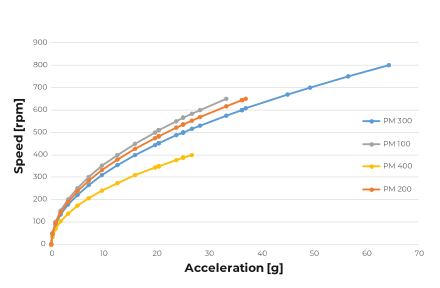
고 에너지 입력은 현저하게 밀링 효율성을 향상시켜 더 세련되고 더 균일한 입자 크기 분포로 이어집니다. 이것은 최종 제품의 품질이 입자 크기와 분포에 의존하는 응용 프로그램에서 결정적입니다. 기계화학에서, 에너지 입력은 작동 모드, 온도, 볼 밀링 크기 및 혼합 효과와 함께 반응 결과에 영향을 미칠 수 있습니다. 속도 스펙트럼을 통해 실험을 촉진하기 위해, 중간에서 높은 에너지까지, 네 개의 Retsch 모델은 특히 주목할 가치가 있습니다: PM 300, Emax, MM 500 nano, 및 MM 500 vario. 이러한 밀링의 가속은 확실히 태양 바퀴 크기와 최대 속도 (행성 볼 밀) 또는 폭도와 주파도 (믹싱 밀)에 달려 있습니다.
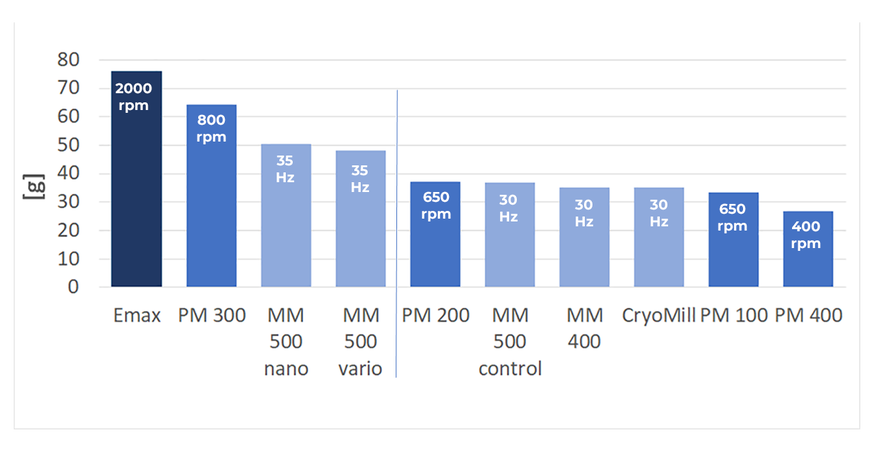
고 에너지 볼 MM MM Emax, RETSCH 포트폴리오에서 가장 강력한 작동 장치, 최대 에너지 입력 속도 최대 2000 rpm, 즉 76 g의 가속을 달성합니다. 이것은 독특한 기능 원리와 grinding 잔 디자인과 결합하여, 매우 좁은 입자 크기 분포를 생성합니다. 행성 볼 밀 500 PM 300은 최대 밀링 또는 반응 시간을 최소화하고 초소한 입자 에너지를 생성합니다. 또한, 그것의 디자인은 동시에 충격과 마찰을 가진 볼 움직임을 보장합니다.
Mechanochemical destruction of forever chemicals in PM 100
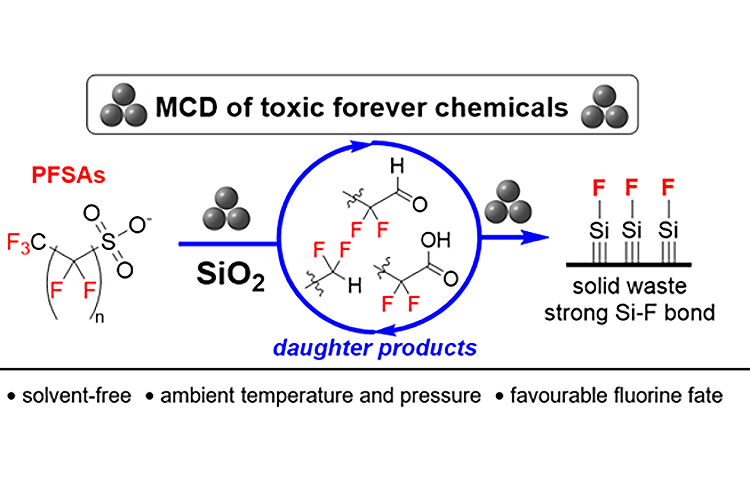
In a detailed study, Gobindlal et al. (2022) [10] investigated the mechanochemical destruction (MCD) of perfluorosulfonic acids (PFSAs), a subclass of persistent per- and polyfluoroalkyl substances (PFASs), using the PM 100.
- Milling Setup: 0.05 g of PFAS standards were mixed with 5 g of quartz sand in a 50 ml stainless steel jar with ten 10 mm stainless steel balls.
- Milling was performed at ambient temperature and pressure, without solvents or chemical additives. Samples were milled for up to 720 minutes, under relatively mild conditions, to assess degradation kinetics and establish the underlying degradation mechanisms.
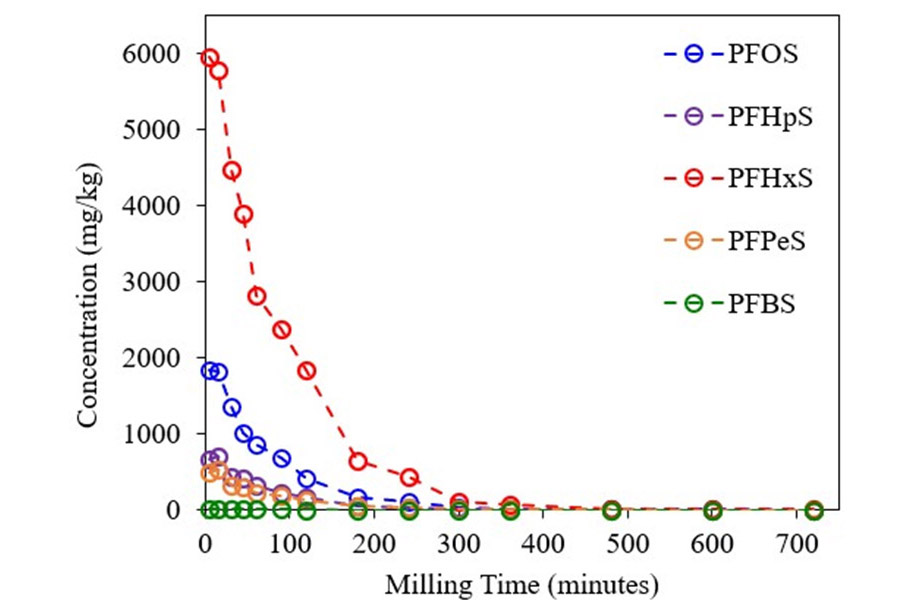
- The PM 100 achieved 99.99% degradation of total PFSA content after 720 minutes. Individual compounds like PFOS, PFHpS, PFHxS, PFPeS, and PFBS showed rapid degradation, with PFBS reaching complete destruction by 180 minutes.
Mechanism of Action:
Quartz sand, when ground in the PM 100, generates reactive surface radicals that initiate PFAS breakdown. These radicals facilitate C–F bond cleavage, one of the strongest in organic chemistry, leading to the mineralization of fluorine into stable Si–F bonds. Another study by the same group highlights the scalability and effectiveness of MCD using the Retsch PM 100 planetary ball mill for the remediation of PFAS-contaminated land and the destruction of stockpiled AFFFs.
Functionalizing biomass for pharma applications via mechanochemistry
Mechanochemistry is transforming how functional biomaterials are made, and cationic cellulose is a prime example. Using a solvent-free process, cotton fibers are combined with a catalytic base and a minimal additive, then milled together with the cationic reagent to activate the reaction using the Mixer Mill MM 400. This solid-state approach eliminates water and bulk solvents, dramatically reducing chemical use and waste compared to conventional methods. After milling, a short aging step completes the reaction, delivering highly charged cellulose fibers with exceptional performance. [14]
Optimal reaction conditions: Cotton fibers were milled in a 50 ml stainless steel jar with 3 x 10 mm balls for 5 min at 25 Hz, then EPTMAC was added, and the mixture was milled for additional 30 min. The subsequent aging of the reaction mixture at 50 °C for 24 h, followed by Soxhlet extraction (48 h) and freeze drying, resulted in the isolation of pure cCF material.
Why is this exciting for pharma?
These cationic fibers show strong electrostatic binding to viruses, enabling efficient removal of pathogens from water and process streams—critical for sterile manufacturing and clean water applications. Beyond filtration, the material offers potential in drug delivery, antimicrobial surfaces, and bioprocessing aids. The process achieves outstanding sustainability metrics aligning with green chemistry principles and industry goals. It also allows precise control over charge density for tailored performance.
This innovation demonstrates how mechanochemistry can deliver high-value, eco-friendly solutions for pharmaceutical production—combining safety, efficiency, and sustainability in one breakthrough approach.
기계화학에서 온도의 영향
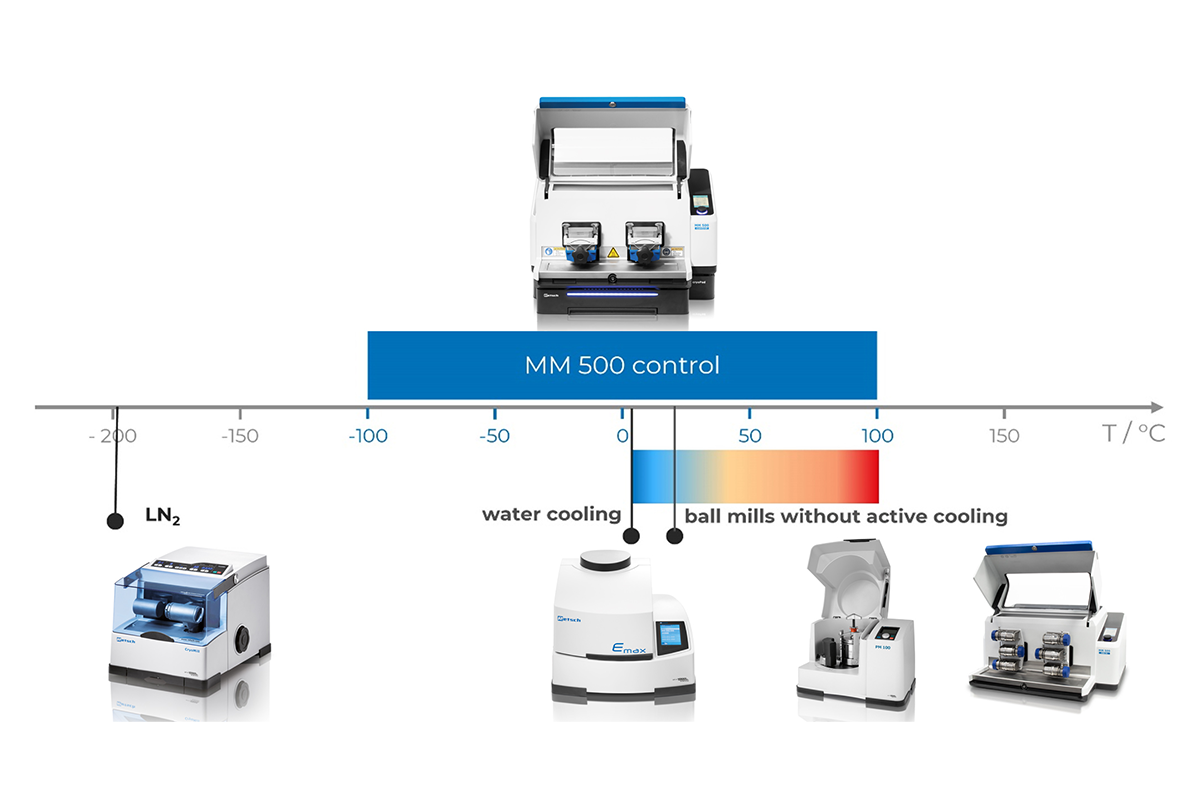
기계화학에서, 온도는 반응 효율성에 상당한 영향을 미치며 반응 유형을 지정할 수도 있습니다. "비트와 열" 개념을 구현하기 위해 히터 밀에 대한 관심이 커지고 있지만, 냉각도 반응 결과에 역할을합니다. 일부 경우에는 온도는 분명한 영향을 미치지 않을 수 있습니다. 차트는 Retsch 볼 밀 의해 덮인 온도 범위를 보여줍니다. 다음의 예제는 온도의 화학 반응에 대한 잠재적 영향을 보여줍니다.
냉각은 기계화학에서 중간 제품 (원료)의 안정화를 가능하게
MM 500 Control의 외부 냉각제는 -5°C로 설정되며, 온도적으로 불안정한 중간 물질을 합성하여 반응을 정확하게 제어할 수 있습니다. 이 프로세스는 온도적으로 불안정한 중간 물질을 동시에 냉각하면서, 예를 들어 -5°C로 냉각합니다. 이 프로세스는 온도적으로 불안정한 중간 물질을 안정화합니다.
MM 500 control의 synise ultimately enhances their yield.
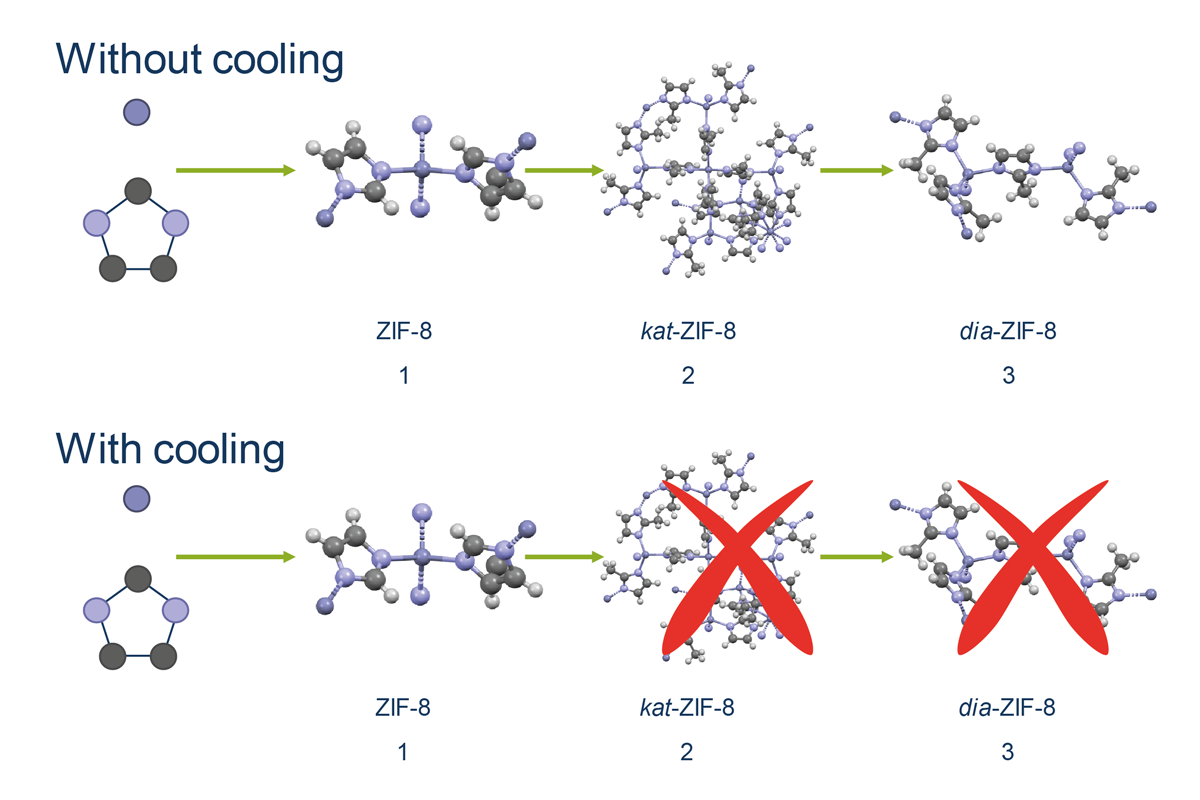
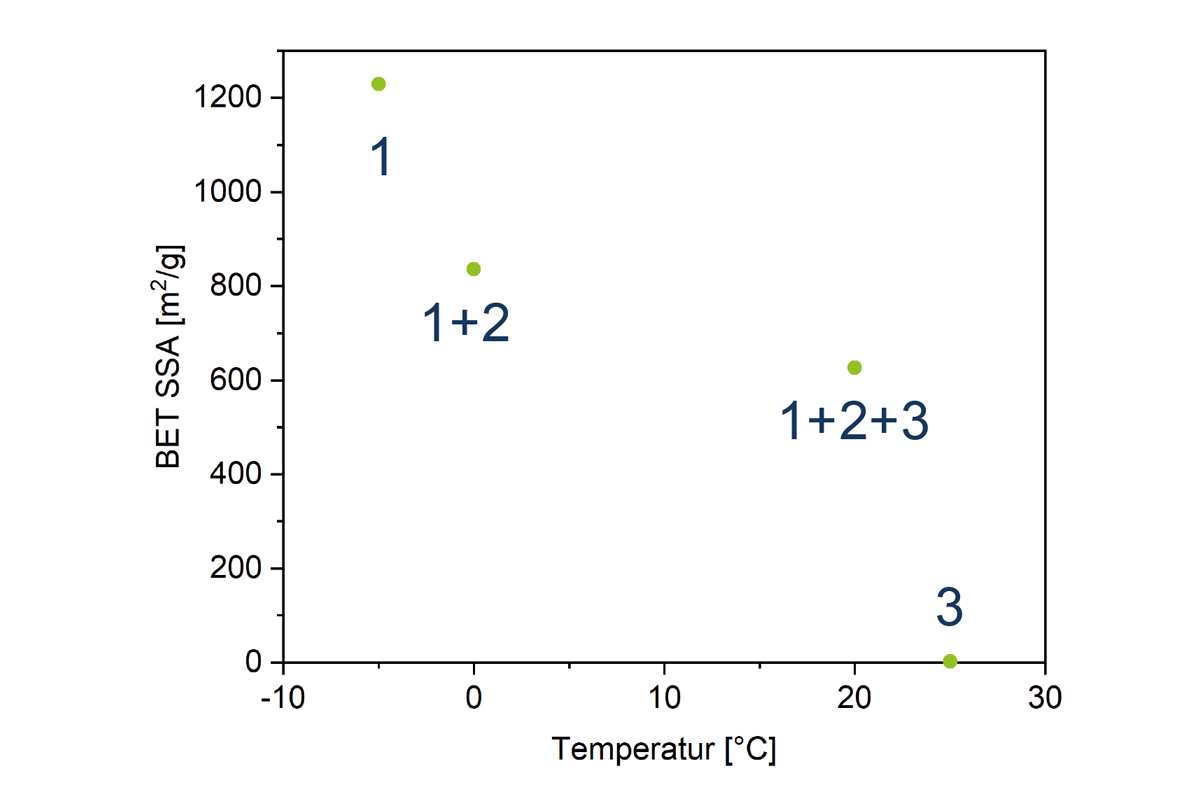
kat-Zif-8 및 dia-ZIF-8에 대한 추가 반응은 냉각기 를 통해 열판의 온도를 -5 °C로 설정하면 즉시 중지될 수 있습니다. 5 °C의 증가는 여전히 두 번째 중간 kat-ZIF-8의 형성으로 이어졌습니다. 20 °C의 열판에서 세 가지 모두가 발견되었습니다. 냉각없이 합성하면 실제 반응이 완료되었습니다. 단지 dia-ZIF-8입니다. Lars Borchardt의 그룹에 의해 발표 된 결과 [3]
가열은 기계화학에서 더 높은 수출과 다른 결과 또는 더 빠른 반응으로 이어집니다.
기계화학에서, 열을 통한 에너지 입력은 또한 반응에 유익하고 더 나은 수출 또는 다른 반응 유형으로 이어질 수 있습니다. 반응 경로가 있습니다. 더 높은 온도가 반응을 가속화하는 Suzuki Miyaura 크리오스타트와 같은 반응 경로가 있습니다. 고전적인 화학은 Bunsen 연료를 사용하는 것과 유사합니다. [3] 한 예에서는, 뜨거운 총을 사용하여 MMcontrol 기계화학 반응에서 더 통제 된 따뜻한 방법이 가능합니다. 이 설비는 초기 아미네의 반응을 사용하여 열판을 100°C까지 따뜻하게합니다. MM 500 varMM 500 controlM500 control 효율적으로 전달하여 반응의 결과는 원하는 온도에서 단지 80°C에서 75%를 제어합니다.
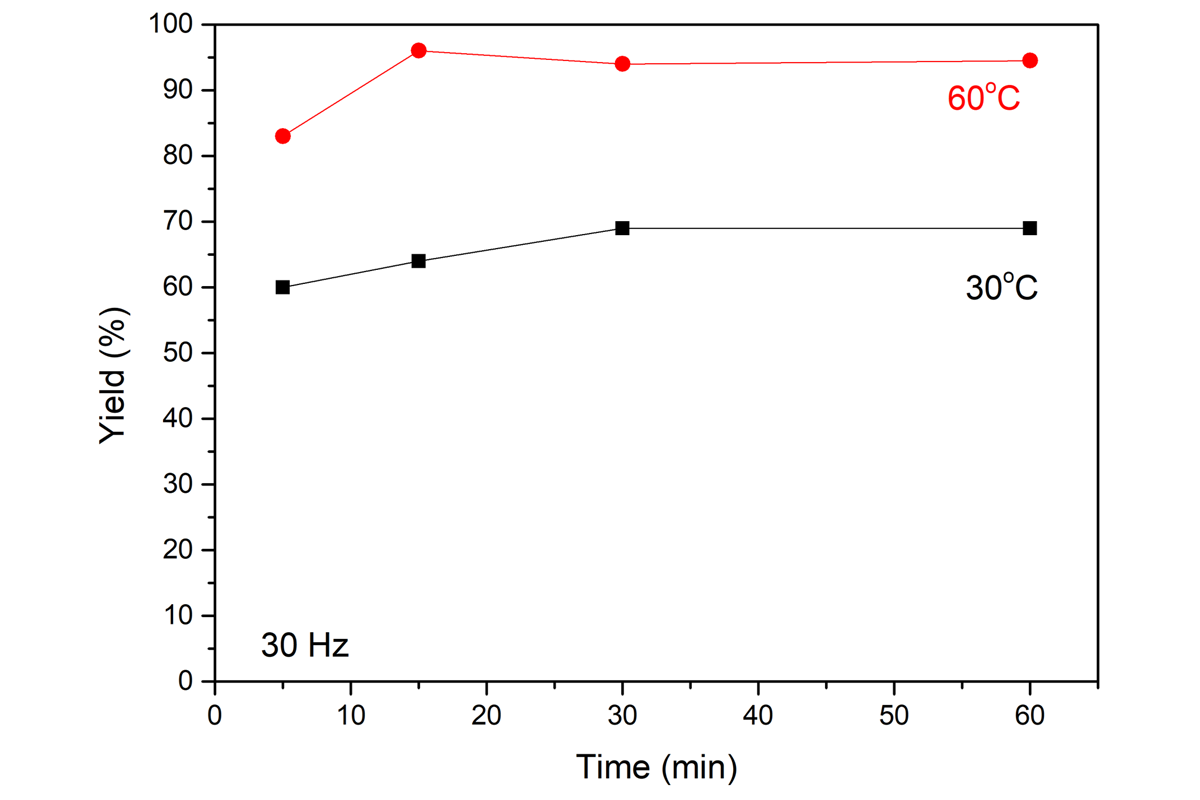
온도는 볼 밀의 기계화학 반응 수출에 영향을 미치는 방법에 대한 또 다른 설명은 MM 500 control에서 금속 유기 화합물을 합성하여 보여집니다. 30°C에서, 약 70 %의 최대 수출은 30 분 후에 달성되었으며, 밀리기 시간을 연장하는 것보다 개선이 없었습니다. 그러나, 온도는 60°C에서 유지되었을 때 열계를 사용하면 거의 완전한 반응이 15 분 이내에 발생했습니다.
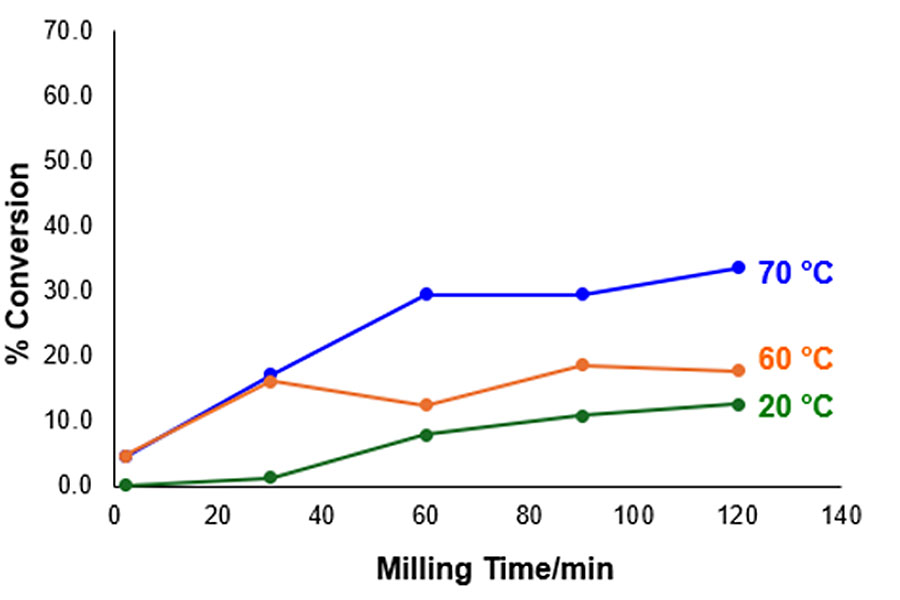
A second example shows the degree of conversion during an organic reaction conducted in the MM 500 control. Simply milling the reactants without heating only gives 10 % yield after 2 hours. However, heating at 70 °C increases this to 35 %. Further improvements are also possible with optimisation of scale, milling speed etc., but heating is critical to achieving a good yield.
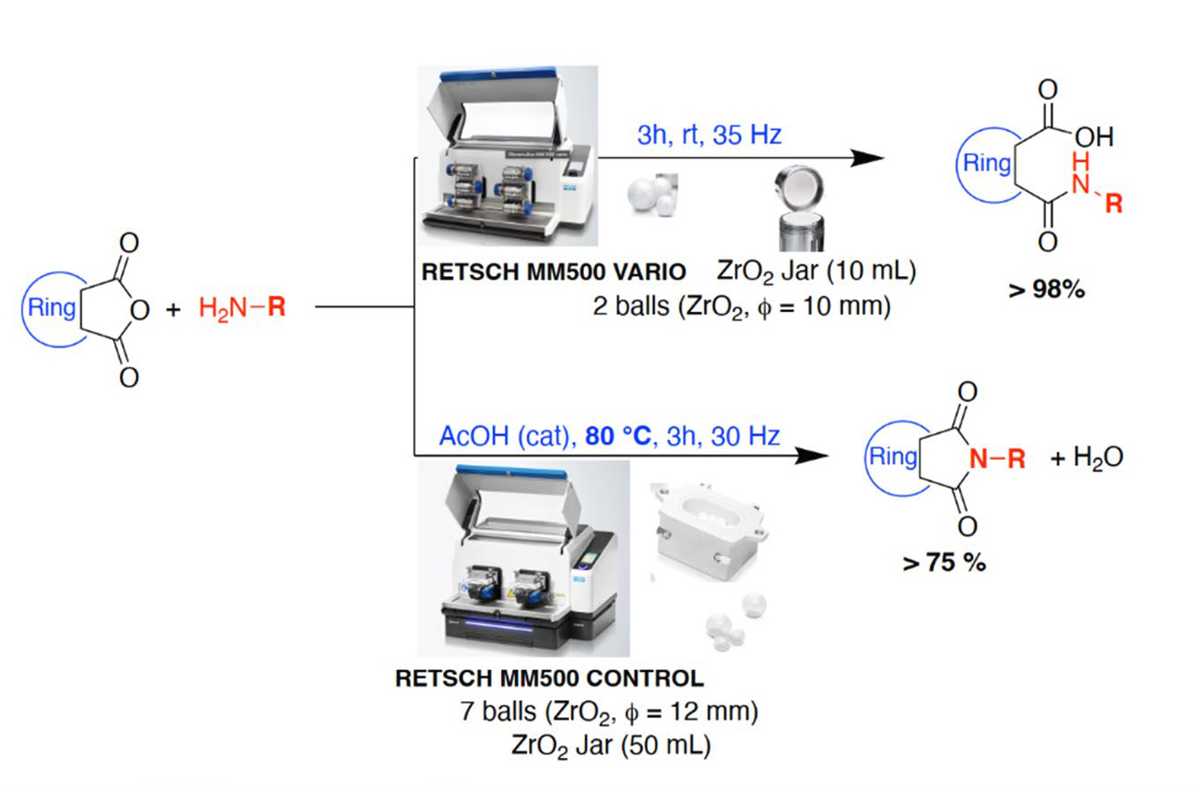
이 예에서 보여진 바와 같이, 온도는 볼 밀의 반응 유형을 결정할 수 있습니다. 온도 수준을 조절함으로써 반응을 정확하게 제어할 수 있습니다.Andrea Porcheddu의 그룹이 발표한 결과 [4]
측정 시스템 GrindControl GrindControl shows what’s happening inside the grinding jar – in real time
GrindControl provides real-time visibility into processes inside the grinding jar. Pressure and temperature are continuously monitored—ensuring safe, precise control, even with sensitive or reactive materials. Respond promptly to unexpected pressure spikes, and keep a close eye on temperature-sensitive samples and even mechanochemical reactions at all times.
GrindControl at a glance
- Real-time data on pressure & temperature
- Early detection of critical conditions
- Precise process control
- Protection of sensitive materials
- Reproducible results
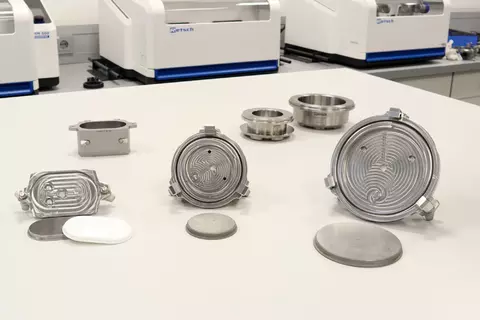
작은 샘플 볼륨 및 검사 목적으로 높은 샘플 처리량
기계화학, 제약, 또는 일반적으로 R&D에서, 테스트 반응은 일반적으로 물질의 높은 비용 또는 제한된 가용성으로 인해 작은 샘플 볼륨을 포함합니다. 따라서 소형 밀링 포트를 활용하는 것이 유익합니다. 믹서 밀링 포트의 최소 밀링 포트 볼륨은 1.5 또는 2 ml의 스테인레스 스틸로, 5 ml 또는 10 ml의 포트가 더 일반적으로 사용됩니다. zirconium oxide 또는 wolfram carbide 포트를 필요로하는 애플리케이션의 경우, 가장 작은 유효한 크기는 10 ml입니다.
- MM 400, MM 500 vario 및 CryoMill에는 4 x 5 ml의 스테인레스 스틸 분쇄 용기를 포함하는 어댑터가 제공되며, 8, 24 또는 4 개의 샘플을 동시에 처리할 수 있습니다.
- 2 ml의 스테인레스 스틸 튜브는 MM 400 (20 샘플), MM 500 vario 또는 500 MM control (50 샘플) 또는 CryoMill (18 샘플) (6 샘플)에 어댑터와 함께 사용할 수 있습니다.
- 이 2 ml 튜브는 플라스틱 튜브와 마찬가지로 다른 유형의 어댑터와 함께 사용할 수 있습니다.
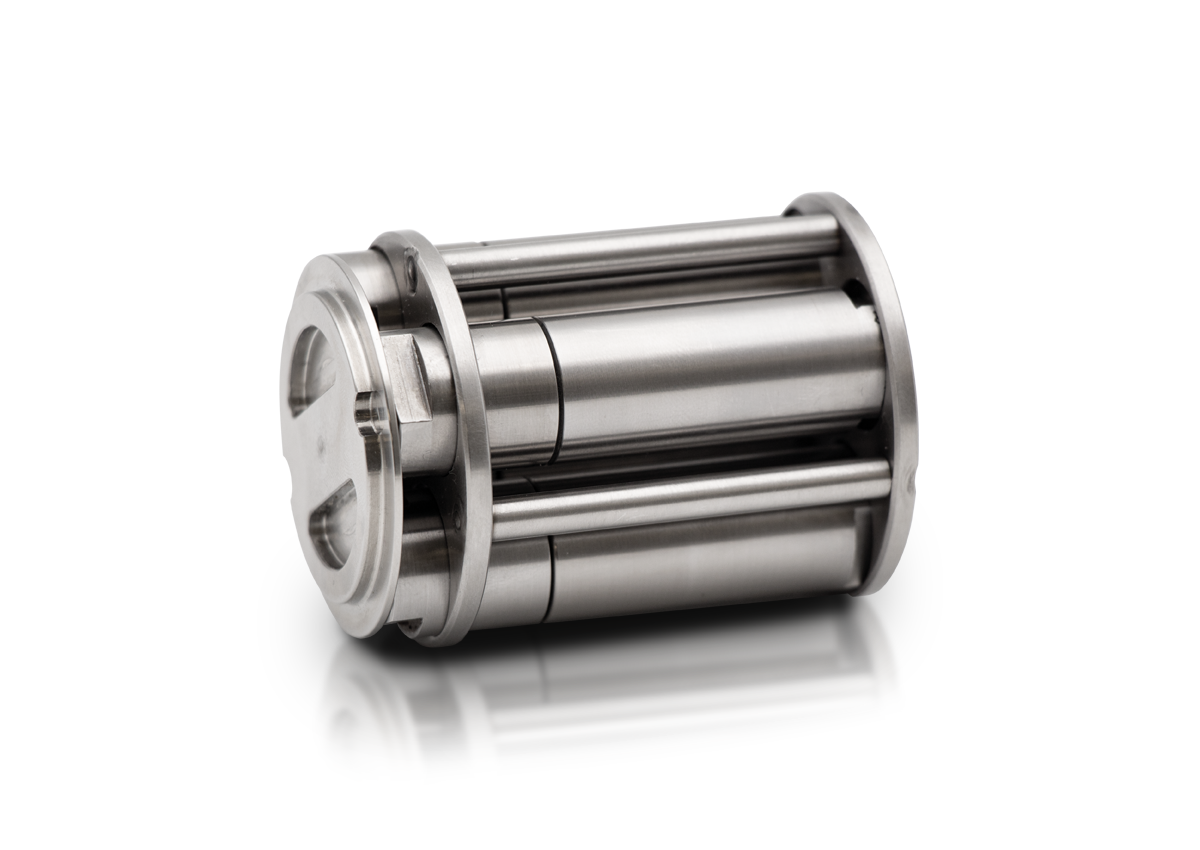
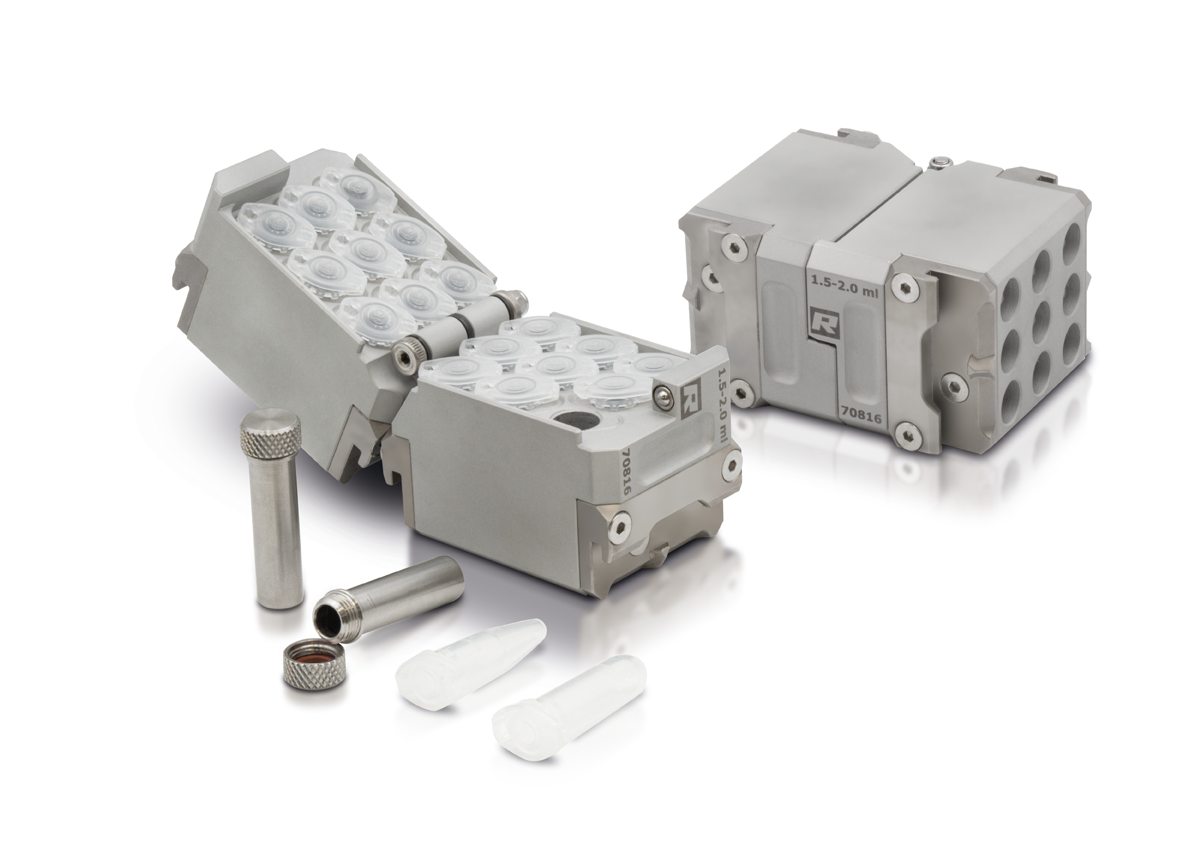
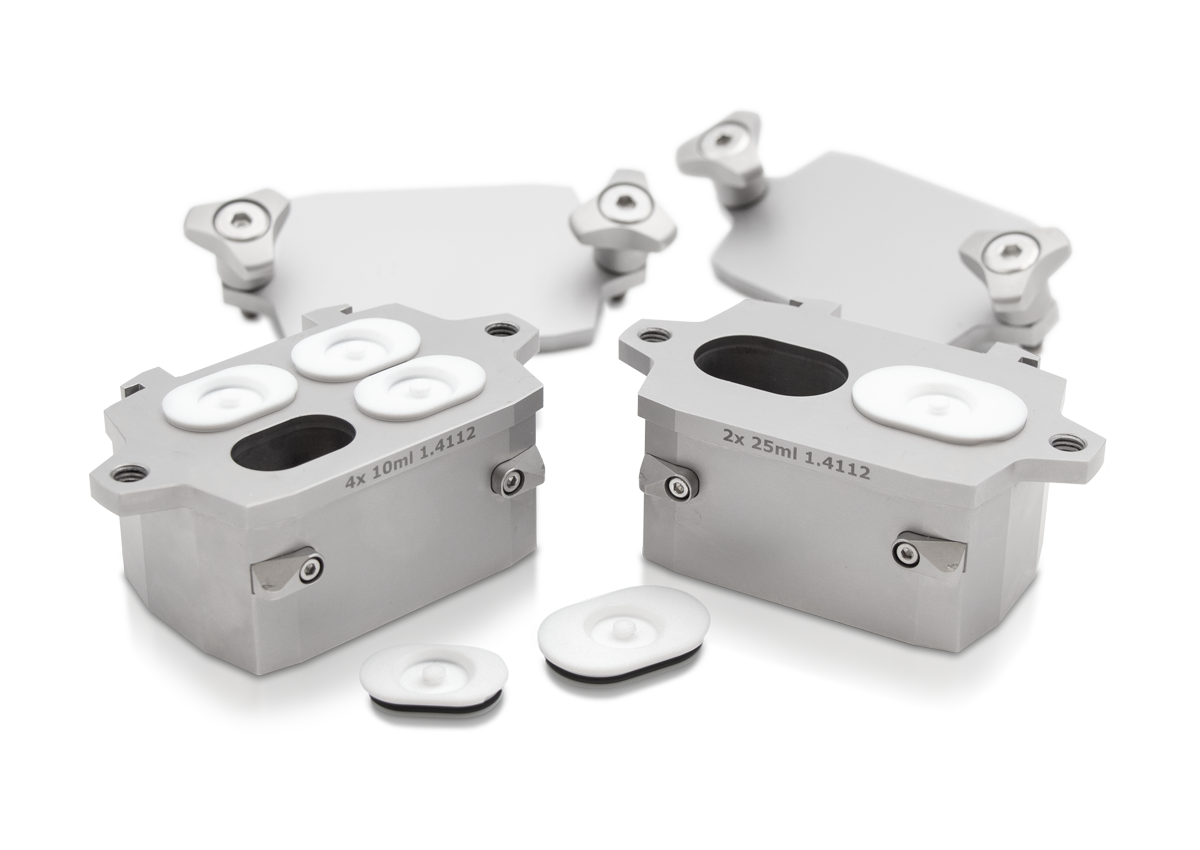
또한, MM 500 control 및 MM 500 nano 2 x 25 ml 또는 4 x 10 ml 다중 구멍 병을 수용 할 수 있으며, MM 400 10 ml 또는 25 ml 병으로 달성 된 것과 유사한 밀링 결과를 생산합니다. Planetary 볼 밀 12 ml 또는 25 ml 스테인리스 스틸 밀링 병을 사용하여 삽입하여 샘플 양을 두 배로 늘릴 수 있습니다. 1.5 ml 유리 병용 어댑터도 사용할 수 있으며 기계화학적 응용 분야에 적합합니다.
Successful Mechanochemical Synthesis of Bütschliite from Carbonates
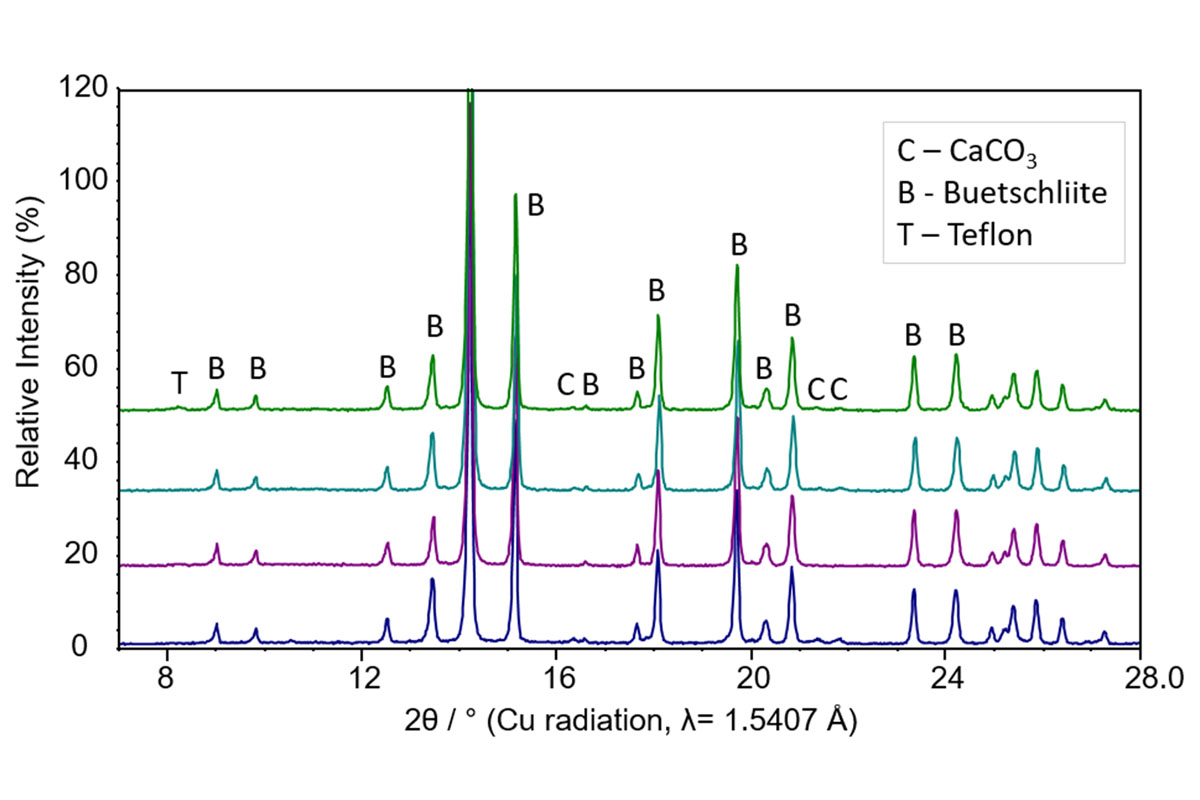
A 1:1 molar ratio of K2CO3 and CaCO3 (total mass of 0.5 g) was milled in the 5 ml jars for 2 h at 30 Hz. 3 x 7 mm steel balls per jar were used, corresponding to a B/P ratio of 8.4:1. The reaction to buetschliite K2Ca(CO3)2 was successful and reproducible in the 4 jars. Results presented by the group of Claudia Weidenthaler. [8]
The solution for efficient and sustainable co-crystal synthesis
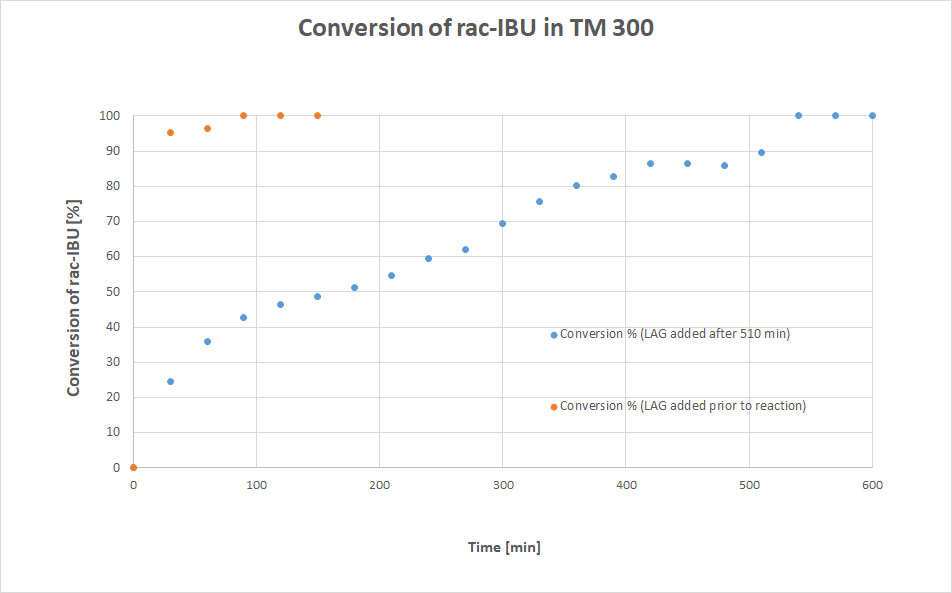
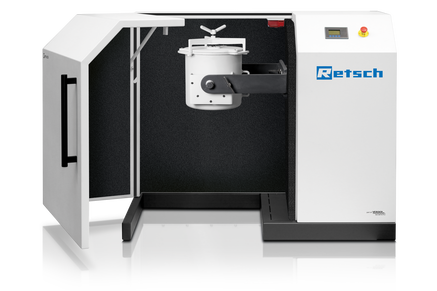
The TM 300 is capable of meeting the demands of modern pharmaceutical manufacturing. This can be demonstrated by the example of the mechanochemical synthesis of rac-Ibuprofen:Nicotinamide co-crystals. The TM 300 is an environmentally friendly alternative to conventional solution-based methods. In just 90 minutes, 3.2 kg of co-crystals with a yield of 99 % were produced, using only minimal amounts of ethanol in the LAG process.
The diagram shows a conversion of rac-IBU. Blue plot: neat grinding approach with addition of 10 kg of balls (d = 10 mm) after 270 min and 10 kg of balls (d = 30 mm) after 360 min; addition of LAG additive EtOH after 510 min. Orange plot: LAG-assisted approach with EtOH added prior to the reaction and 20 kg balls 10 mm.
Results presented by the research group of Michael Felderhoff [6]
TM 300 enables mechanochemical processes to be carried out on a kilogram scale, opening up new possibilities for sustainable industrial manufacturing processes. Particularly interesting is the minimal metal abrasion – the measured values were well below concerning levels and significantly lower than, for example, in eccentric vibratory mills. The table shows the minimal abrasion values in the TM 300 during the test run.
| Sample | Al [ppm] | Cr [ppm] | Co [ppm] | Fe [ppm] | Ni [ppm] |
|---|---|---|---|---|---|
| Raw material IBU | 11.3 | 39.0 | 25.7 | 71.9 | 34.9 |
| Raw material Nicotinamid | 8.9 | 33.3 | 26.7 | 40.0 | 33.3 |
| Co-crystals after 30 min | 10.8 | 35.9 | 30.8 | 51.3 | 38.5 |
| After 60 min | 11.0 | 37.0 | 31.7 | 63.4 | 39.6 |
| After 90 min | 17.2 | 43.8 | 35.9 | 64.6 | 45.3 |
Results presented by the research group of Michael Felderhoff [6]
Setup:
- 2,03 kg rac IBU; 1,20 kg NIC
- 10 l drum for wet grinding, 20 kg 10 mm grinding balls stainless steel
- LAG Ethanol 0.1 ml/g
- 60 rpm for 90 min
- 99 % yield
Co-cristal 검사
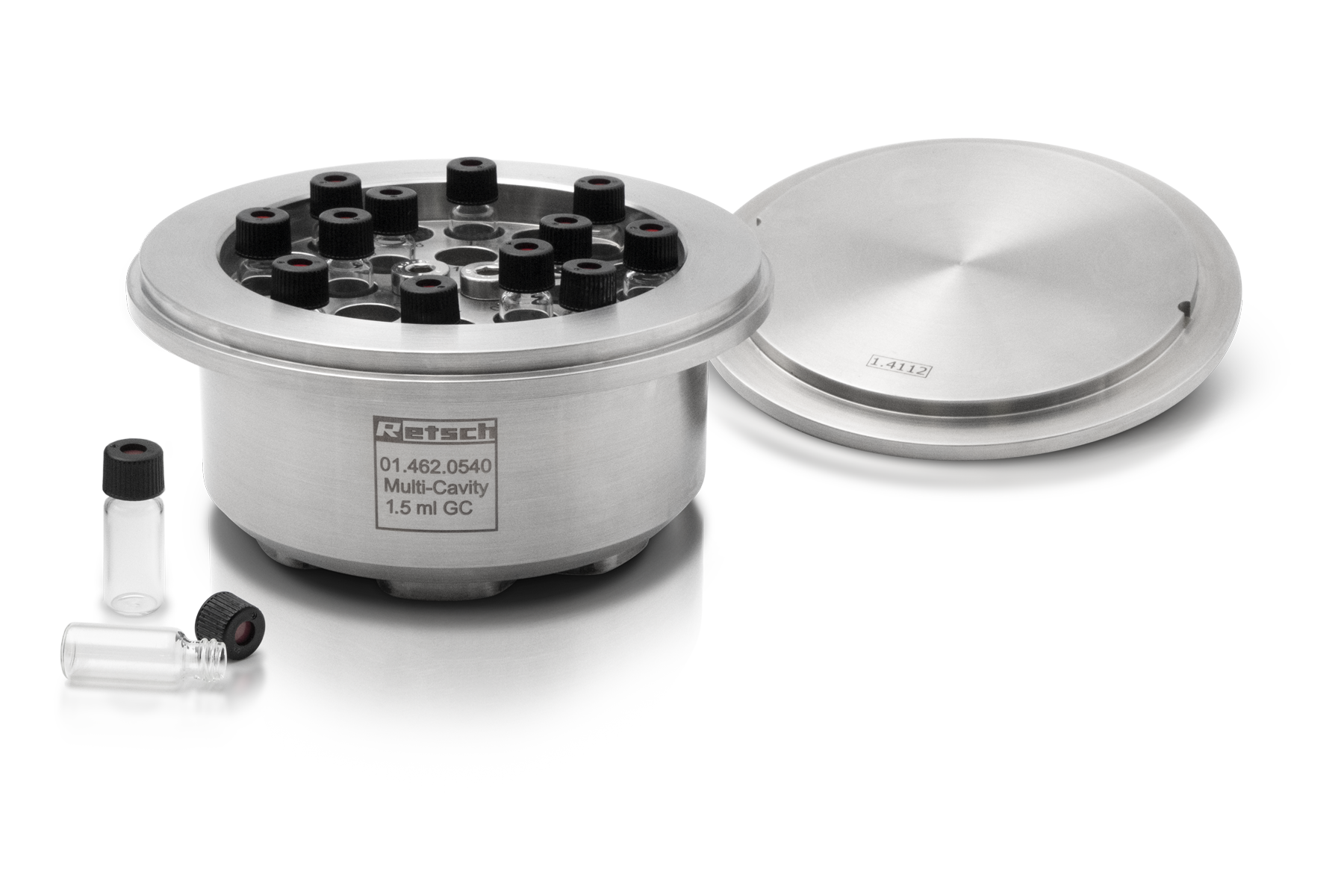
특수 어댑터를 사용하면 행성 볼 밀(행성 볼 밀 PM 400를 사용하면 최대 64 개의 샘플을 동시에 검사할 수 있습니다. 내부 링의 8 개의 위치와 16 개의 위치를 가진 외부 링에 배치된 24 개의 위치를 갖추고 있습니다. 외부 링은 최대 16 개의 샘플을 수용합니다. 내부 링의 8 개의 위치는 다른 에너지 공급을 가진 실험을 수행하기에 적합합니다.
이 어댑터는 PM 100, PM 300 및 PM 400 모델과 호환됩니다.

The video shows use of Planetary Ball Mills for co-crystal screening.
Co-crystallization
Co-Crystallization is a method to modify and optimize the properties of active materials (e.g. APIs or catalysts) by aggregation of two or more different chemical entities in a crystalline lattice.
Co-Crystal Screening with the MM 400
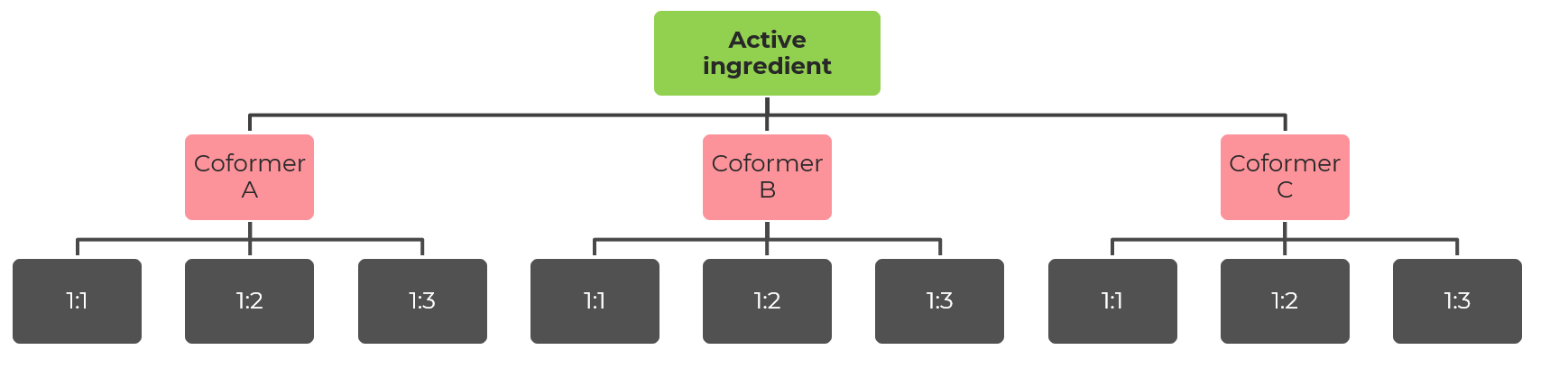
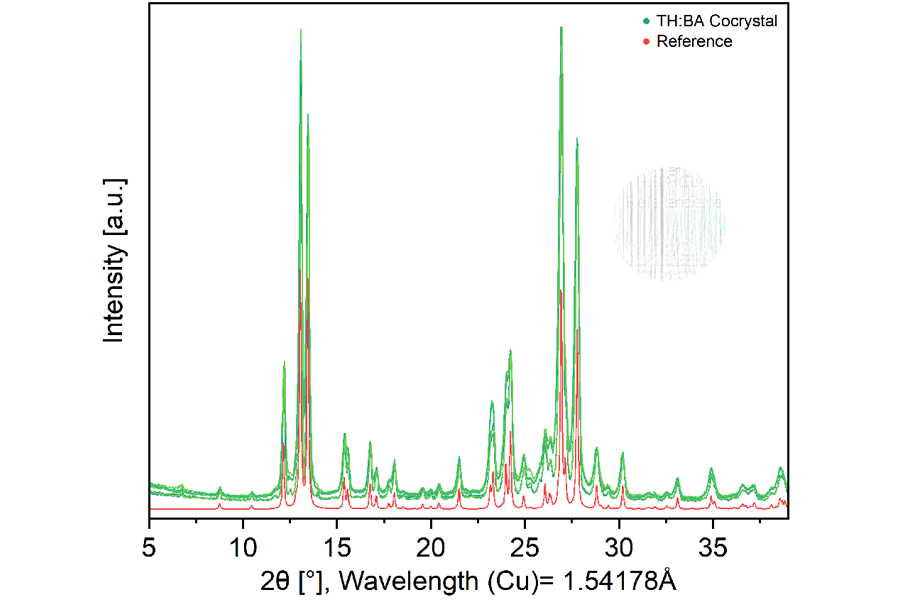
Co-crystal screening can be effectively performed in Mixer Mills. In a study [9] using the MM 400, 2 ml steel tubes and the corresponding PTFE adapter were employed to co-crystallize theophylline and benzamide in a 1:1 ratio under the following conditions:
- 60 min milling time
- 30 Hz frequency
- One 6 mm steel ball per tube
- Four experiments without solvent and four with 20 µL ethanol
Co-crystal screening can be effectively performed in Mixer Mills. In a study [9] using the MM 400, 2 ml steel tubes and the corresponding PTFE adapter were employed to co-crystallize theophylline and benzamide in a 1:1 ratio under the following conditions:
MM 400: in-situ RAMAN 스펙트로스코피 및 빛으로 인한 반응에 대비
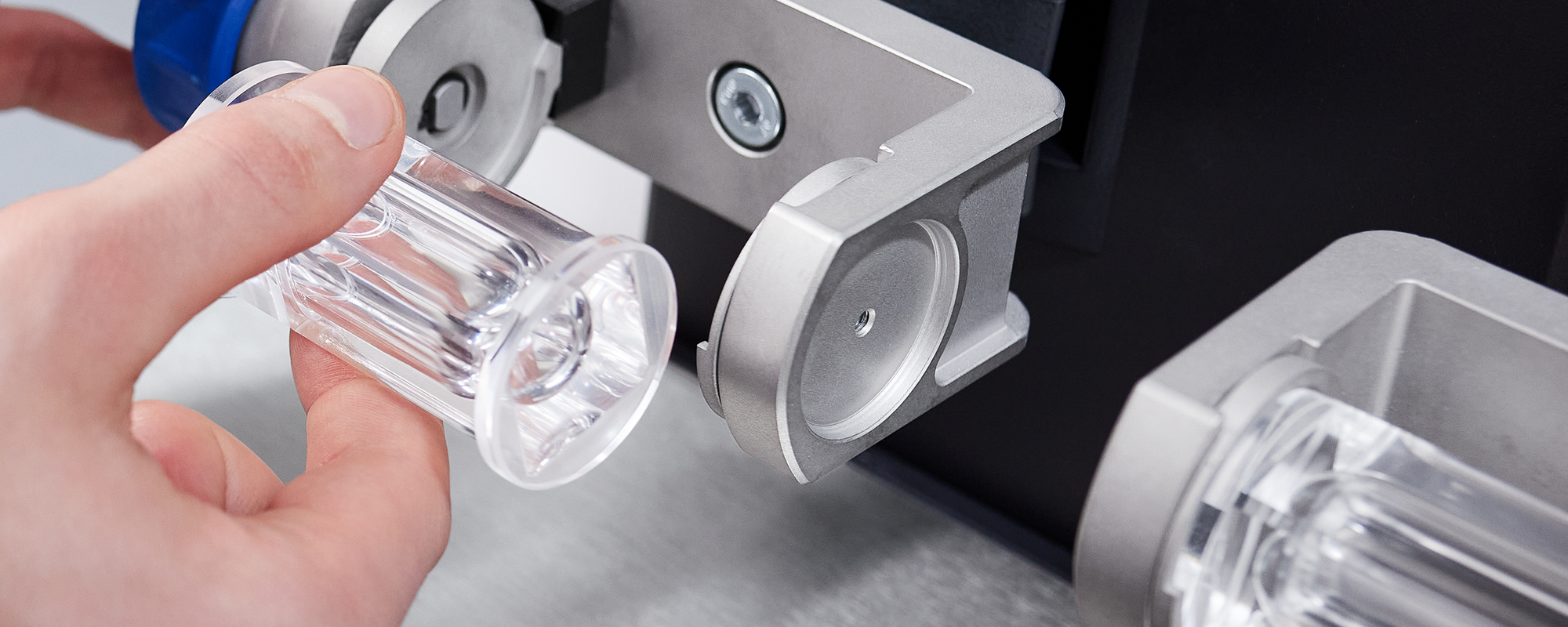
MM 400 새로운 특징은 기계화학적 응용 분야를 고려하여 개발되었습니다. 투명 삭감 잔은 RAMAN in-situ 스펙트로스코피의 기초이며, 내부에서 발생하는 화학 반응을 관찰 할 수 있습니다. 이를 수행하는 가장 좋은 방법은 잔 아래에 RAMAN 스펙트로미터를 배치하는 것입니다. 삭감 잔 아래의 덮개는 세 개의 나사로 쉽게 제거 할 수 있습니다. 기계의 바닥판에는 RAMAN 스펙트로미터가 삭감 잔의 바닥을 향해 표시하는 두 개의 개방이 있습니다. 이 특별한 설정 덕분에 MM 400 기계화학적 목적을 위해 완벽하게 장착되어 있습니다. 투명성 덕분에 PMMA 잔은 또한 사진 기계 화학 반응을 수행하는 데 적합합니다.
기계화학 반응의 확장
믹서 밀은 기계화학적 테스트 및 실험을 수행하는 데 필수적인 도구로 사용됩니다. 그러나 최대 125 ml의 믹서 밀 크기와 함께, 그들의 확장 능력은 제한적입니다. 논리적 진전은 행성 볼 밀을 사용하는 것입니다, 이는 배당 최대 4 x 500 ml 볼 밀을 수용 할 수 있습니다. 이러한 밀 사이의 다른 기능 원칙을 고려하여, 믹서 밀 TM 300 및 TM 500에서 행성 볼 밀에 성공적인 반응의 직접 전환이 보장되지 않습니다, 최대 150 리터를 포함하는 볼 밀을 장착해야합니다.
더 확장하기 위해 RETSCH는 믹서 밀과 행성 볼 밀의 작동 메커니즘이 더 낮은 에너지를 제공하는 결과를 보여주었습니다.
Drum Mills - 큰 볼륨의 미세 밀링
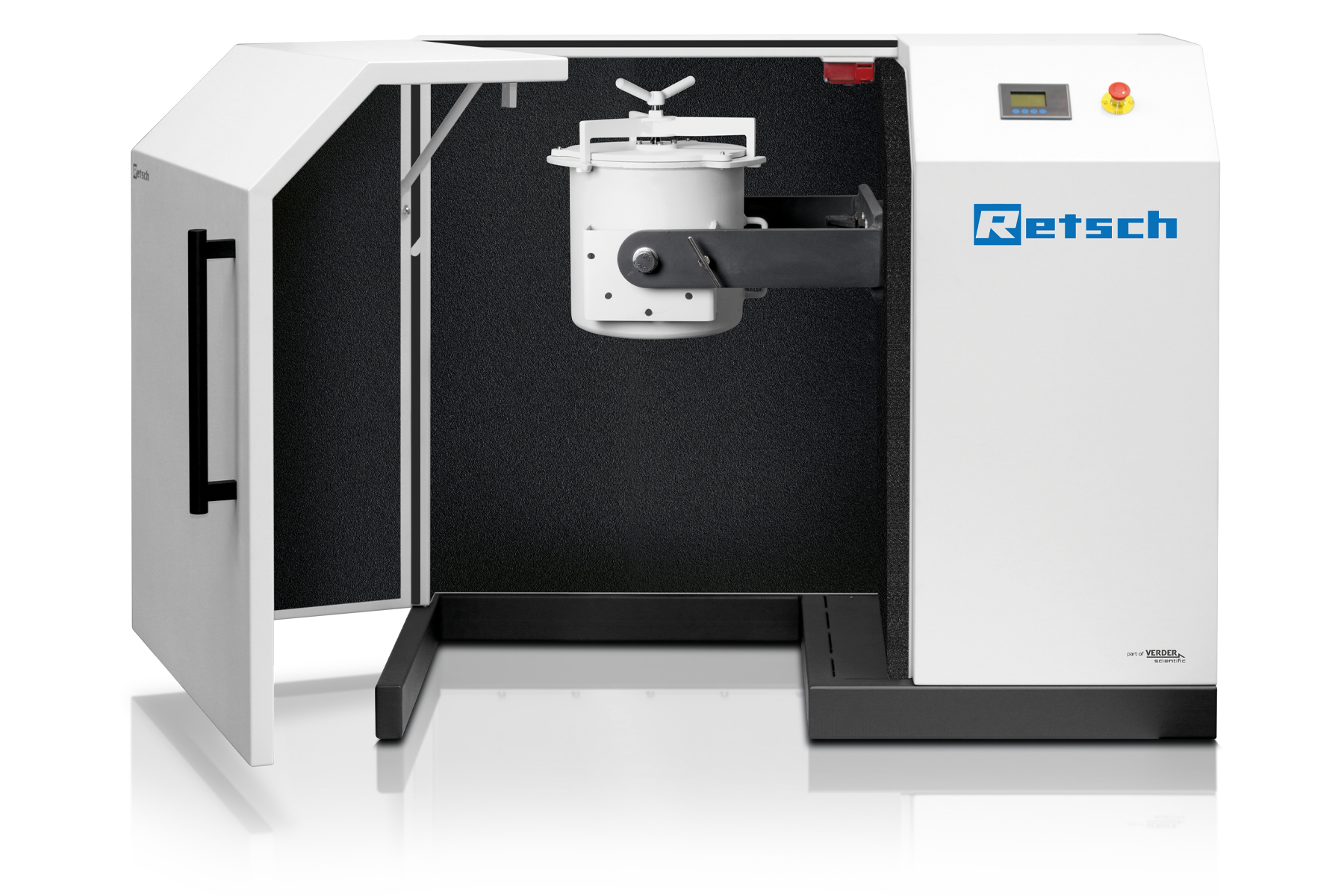
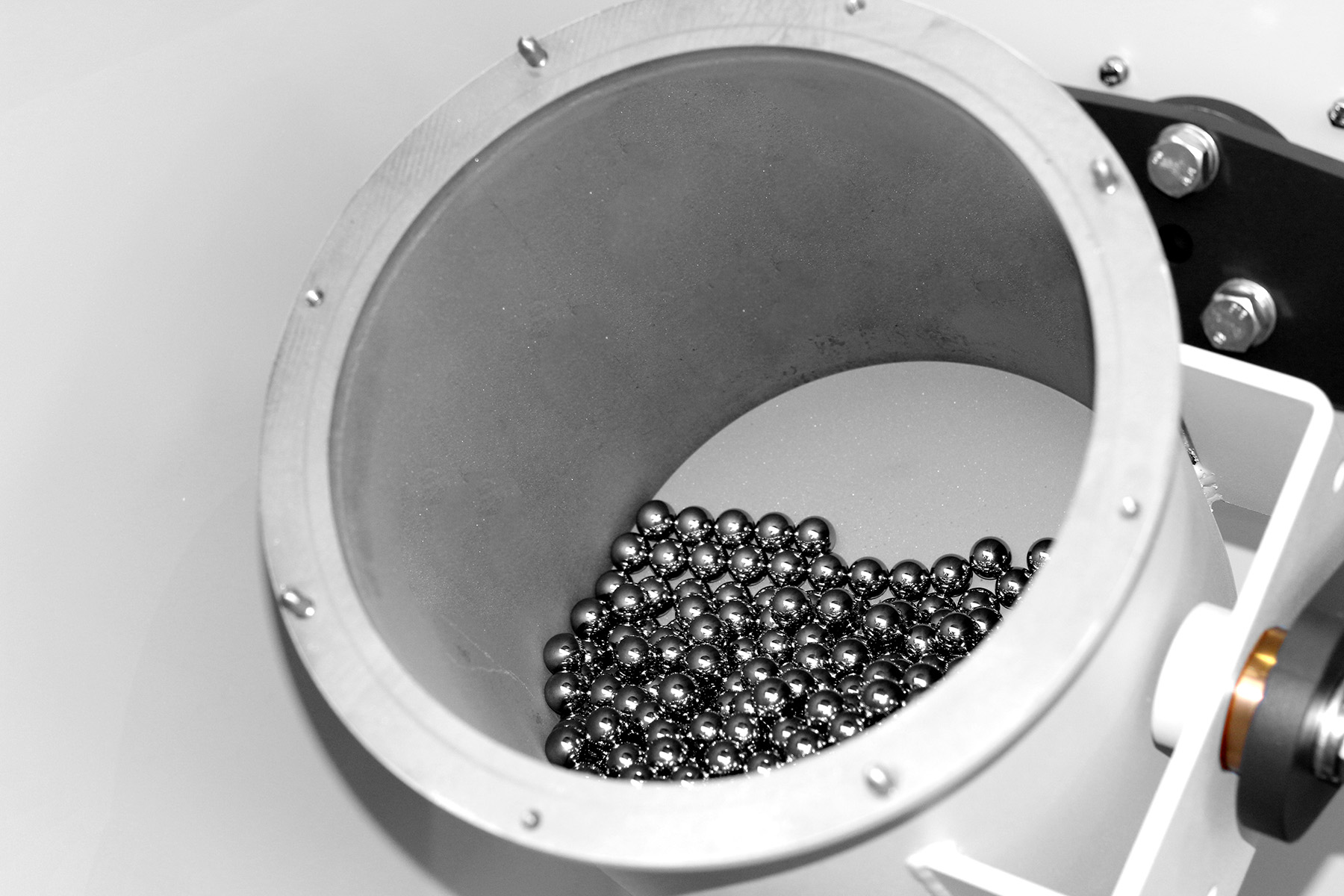
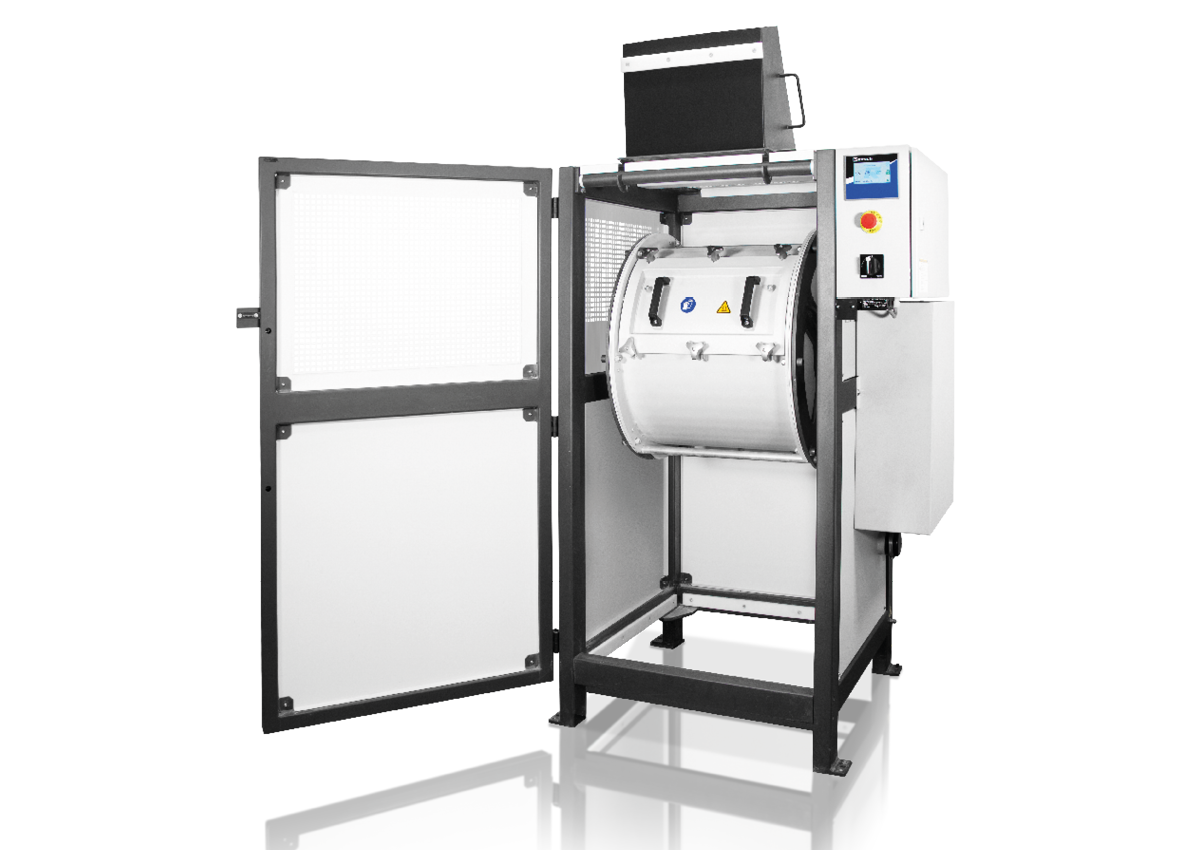
TM 300 드럼이 회전함에 따라, 마찰 공이 드럼 벽에 상승하게됩니다. 이 거리는 드럼의 속도와 함께 증가합니다. 센트리볼 힘이 중력력을 초과 할 때까지, 볼이 회전하는 동안 벽에 붙어 있습니다. 이 속도는 "critical speed"라고합니다.
NC = 42.3/{√(D-d)} [분당 혁명]
D = 트럼프의 내부 직경 [m] = 0.3 m for TM 300 [rpm]
d = 공 직경 [m]
중요한 속도는 ~80 rpm 이지만 볼 직경에 따라 다릅니다.
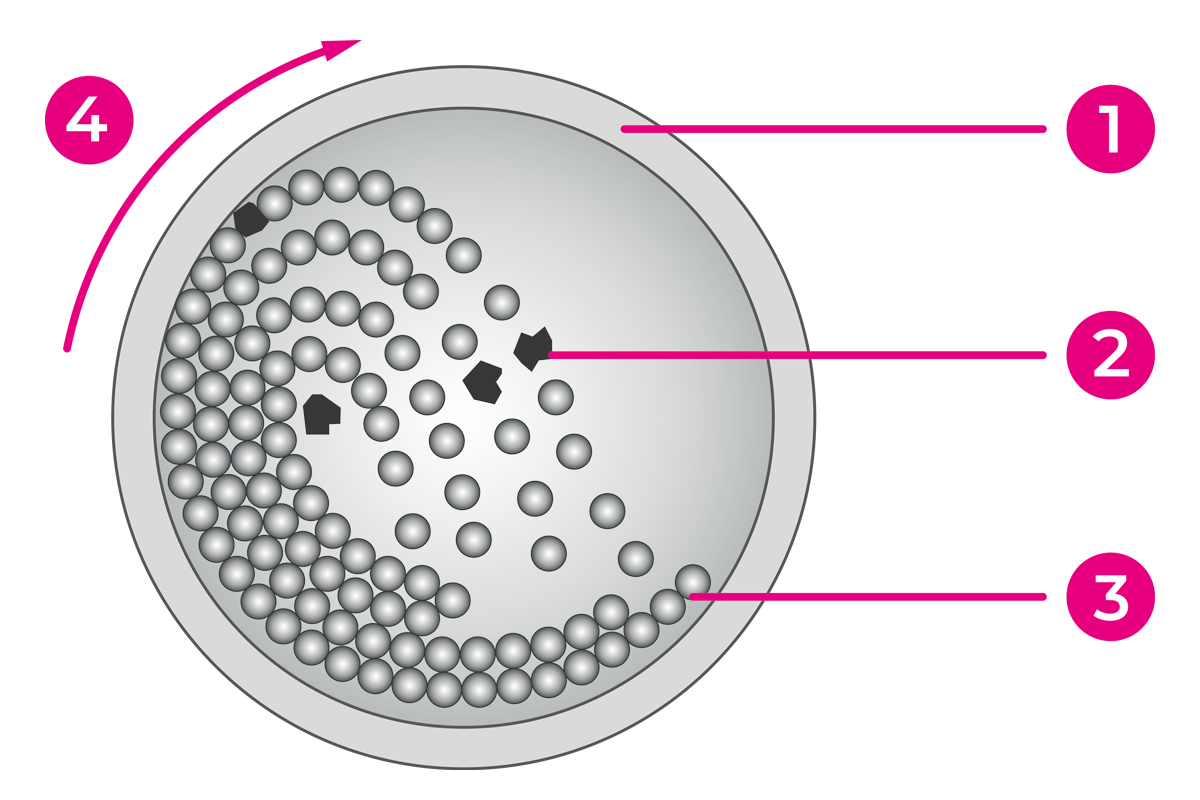
2. Sample
3. Schilling balls
4. Rotation direction
TM 300 두 가지 모드에서 작동합니다. 카타라크트 및 캐스케이드. 카타라크트 모드에서 장치는 임상 속도의 약 70%, TM 300 경우 55-60 rpm로 작동합니다. 이 속도는 볼이 트럼프의 벽을 따라 상당히 많이 이동할 수 있습니다. 비록 그들은 임상 속도를 도달하지 않지만, 볼은 궁극적으로 벽에서 분리되고, 트럼프의 중앙을 넘어 이동하며, 샘플을 트럼프의 바닥에 충돌합니다. 이 모드는 특히 큰 입자를 빠르게 분리하는 데 유익합니다.
Cascade 모드에서, 약 50 rpm에서 활성화됩니다.
Mechanochemical 애플리케이션을 위한 밀링 잔의 채우기 레벨
기계화학의 경우, 특히 행성 볼 밀 경우, 공구 채우는 방법은 일반적인 1/3 공구 (1/3 공구, 1/3 샘플, 1/3 빈 공간)의 규칙과는 다르다. 높은 가속의 필요성과 때때로 샘플 재료의 부족 때문입니다. 집중은 특정 질량 비율을 사용하도록 이동합니다. 이는 반응 물질의 양을 고려하고 사용되는 질량 비율에 대한 명확한 결정이 필요합니다.
추가적으로, 공구의 크기가 결정되어야합니다. 기계화학 원칙에 관한 섹션을 참조하십시오. 공구의 샘플 크기가 매우 작기 때문에 일반적인 세 번째에 접착하는 것보다 공구와 공구의 피해의 위험이 더 높습니다.
일반적으로 1 : 10의 질량 비율이 사용되지만 1 : 5 또는 1: 15도 가능합니다. 이것은 15 g의 교육을 사용하면 150 g의 공이 필요하다는 것을 의미합니다.
- 150 g = 각각 7.75 g의 20 x 10 mm 텅스텐 카바이드 볼.
- 20 x 10 mm 공의 경우 최소 50 ml의 냄비 볼륨이 필요하며, 80 ml도 더 좋습니다(행성 볼 밀 제품 페이지에 권장되는 냄비 채우기를 참조하십시오).
- 150 g = 5 x 15 mm 텅스텐 카바이드 볼은 26.2 g 각각 125 ml의 최소 용량을 필요로합니다.
- 150 g = 11 x 15 mm 스테인레스 스틸 볼 13.9 g 각각 125 ml의 최소 용량을 필요로합니다.
| Milling jar nominal volume |
샘플 금액 | 최대 투입 크기* | Ø 5 mm* | Ø 7 mm* | Ø 10 mm* | Ø 15 mm* | Ø 20 mm* | Ø 30 mm* |
|---|---|---|---|---|---|---|---|---|
| 12 ml | up to -까지 ≤ 5 ml | < 1 mm | 50 | 15 | 5 | - | - | - |
| 25 ml | up to -까지 ≤ 10 ml | < 1 mm | 95 – 100 | 25 – 30 | 10 | - | - | - |
| 50 ml | 5 – 20 ml | < 3 mm | 200 | 50 – 70 | 20 | 7 | 3 – 4 | - |
| 80 ml | 10 – 35 ml | < 4 mm | 250 – 330 | 70 – 120 | 30 – 40 | 12 | 5 | - |
| 125 ml | 15 – 50 ml | < 4 mm | 500 | 110 – 180 | 50 – 60 | 18 | 7 | - |
| 250 ml | 25 – 120 ml | < 6 mm | 1100 – 1200 | 220 – 350 | 100 – 120 | 35 – 45 | 15 | 5 |
| 500 ml | 75 – 220 ml | < 10 mm | 2000 | 440 – 700 | 200 – 230 | 70 | 25 | 8 |
*권장 볼 충전 (부품)
테이블은 분쇄 용량, 샘플 수량 및 최대 공급 크기와 관련하여 크기가 다른 분쇄 공의 권장 충전 (부품)을 보여 줍니다.
Mixer Mills 의 Mechanocatalysis
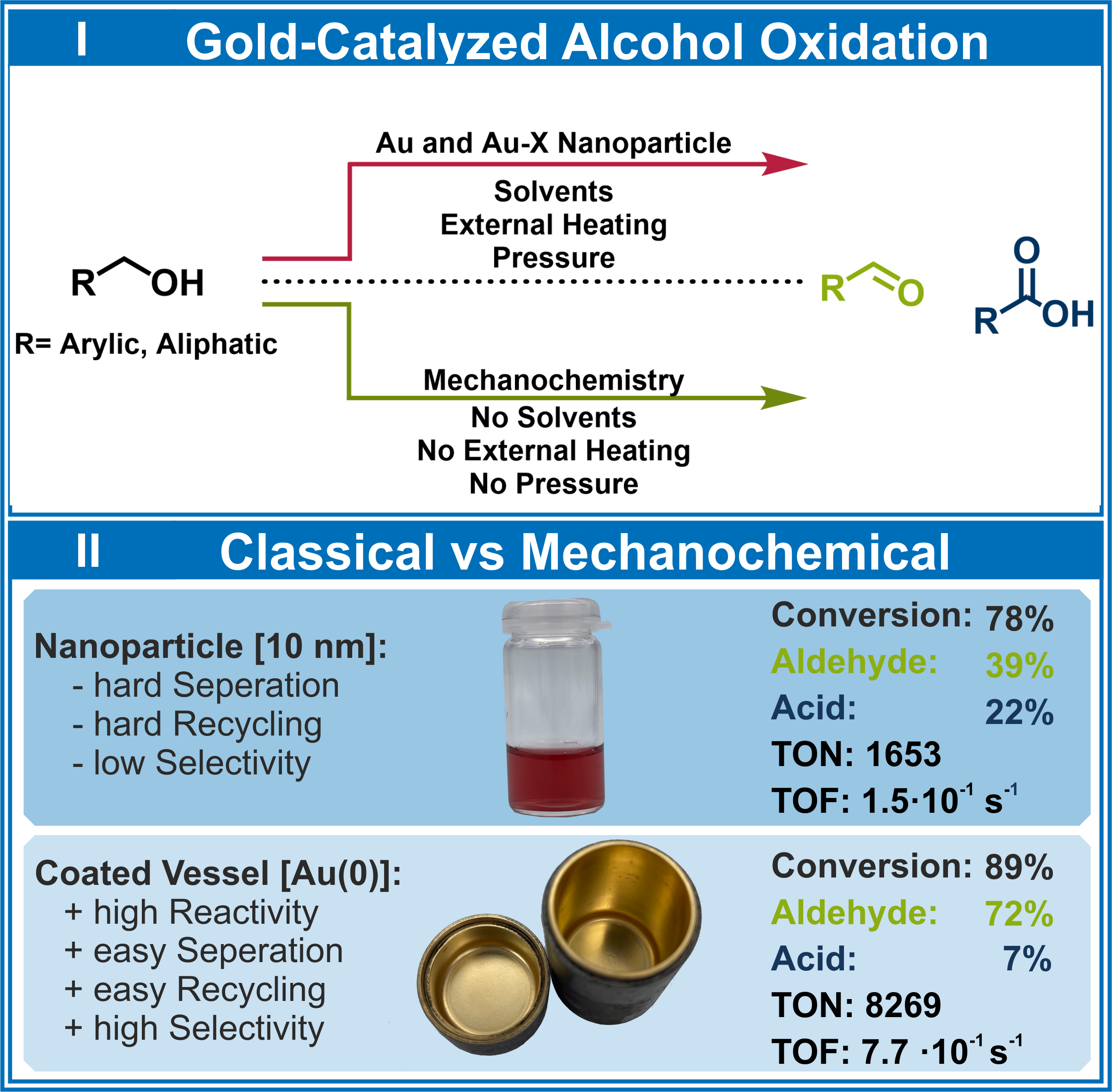
알데히드는 화학 산업에서 필수적인 화합물이며, 제약, 비타민 및 향수 제조에 필수적입니다. 이 문제는 알데히드로 알데히드를 선택적으로 산화시키는 데 있습니다. 카보실산 및 에스테르와 같은 원치 않는 부작용을 생성하지 않고. 많은 전통적인 방법은 과산화로 이어지고 용액 및 환경에 해로운 화학 물질의 사용을 필요로합니다. 이 결과는 위험한 폐기물뿐만 아니라 사용자에게도 상당한 위험을 초래합니다 [6]. 종종 알데히드와 알데히드 같은 민감한 서브러트를 분해시킬 수있는 높은 온도와 압력은 필요합니다.
Mechano-catalytic conversion of alcohols into aldehydes has been demonstrated at Ruhr University Bochum and the results have been published [6].
Mechanochemical Synthesis Reactions (MSR)의 현장 모니터링
"압력"과 "온도"의 두 변수를 모니터링하면 밀링 용기 내부에서 일어나는 일에 대한 가치있는 정보를 제공합니다. Retsch GrindControl 시스템은 콜로이드 또는 장기 밀링 프로세스를 제어하거나 기계적 합금 또는 기타 기계화학 프로세스와 같은 재료 합성을 성공적으로 수행하는 데 사용됩니다. GrindControl 시스템은 Planetary 볼 밀 PM 100, PM 300 및 PM 400, Mixer Mills MM 500 nano 및 MM 500 control 및 고 에너지 볼 밀 Emax 사용할 수 있습니다.
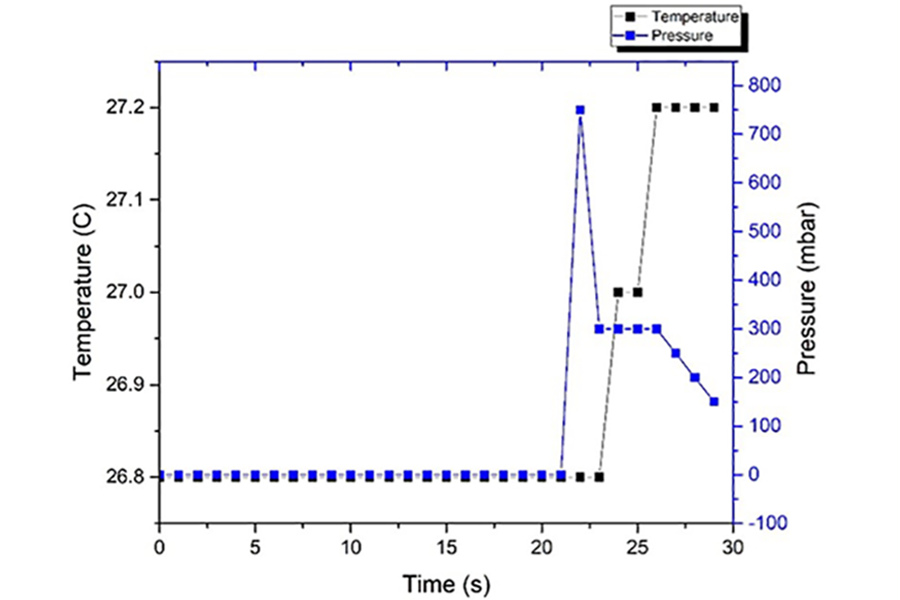
기계화학적 합성은 MM 500 nano 믹서 밀 125ml 스테인레스 스틸 밀링 병을 사용하여 가스 및 압력 모니터링을 위해 GrindControl 장착했습니다. 원소 전구는 32 x 10mm 스테인레스 스틸 볼과 함께 병에 도입되었습니다. 반응은 공기 분위기 아래 20Hz로 수행되었습니다. 밀링 프로세스는 갑작스러운 온도와 압력의 변화가 MSR의 성공적인 완료를 나타내는 0에서 730 mbars의 압력 증가와 온도 상승으로 이어졌을 때 중단되었습니다.
이 응용 프로그램에서 GrindControl 합성 과정에서 기계적으로 유발 된 자발 증식 반응 이벤트를 정확하게 관찰하여 GrindControl 시스템을 사용하여 모니터링되었습니다. [7]
Chemistry in the Mill: Teflon Recycling (PTFE) Using Mechanical Energy
Mechanochemical Recycling of PTFE (Teflon)
Mechanochemistry not only enables new synthetic pathways but also opens up innovative approaches for recycling processes involving materials that are difficult to degrade. A recent example from research shows that even the extremely stable polymer polytetrafluoroethylene (PTFE), better known as Teflon, can be degraded mechanochemically. A decisive factor is continuous mechanical stress: During grinding with the RETSCH MM 400, the reacted surface is constantly removed, exposing new surface area. This allows the reaction to proceed until a large portion of the polymer has been converted. In the study, up to 98% of the PTFE was converted into sodium fluoride and elemental carbon.
The resulting products can then be further utilized, for example as raw materials for battery materials or as fluorine-containing building blocks for pharmaceutical and agrochemical applications.
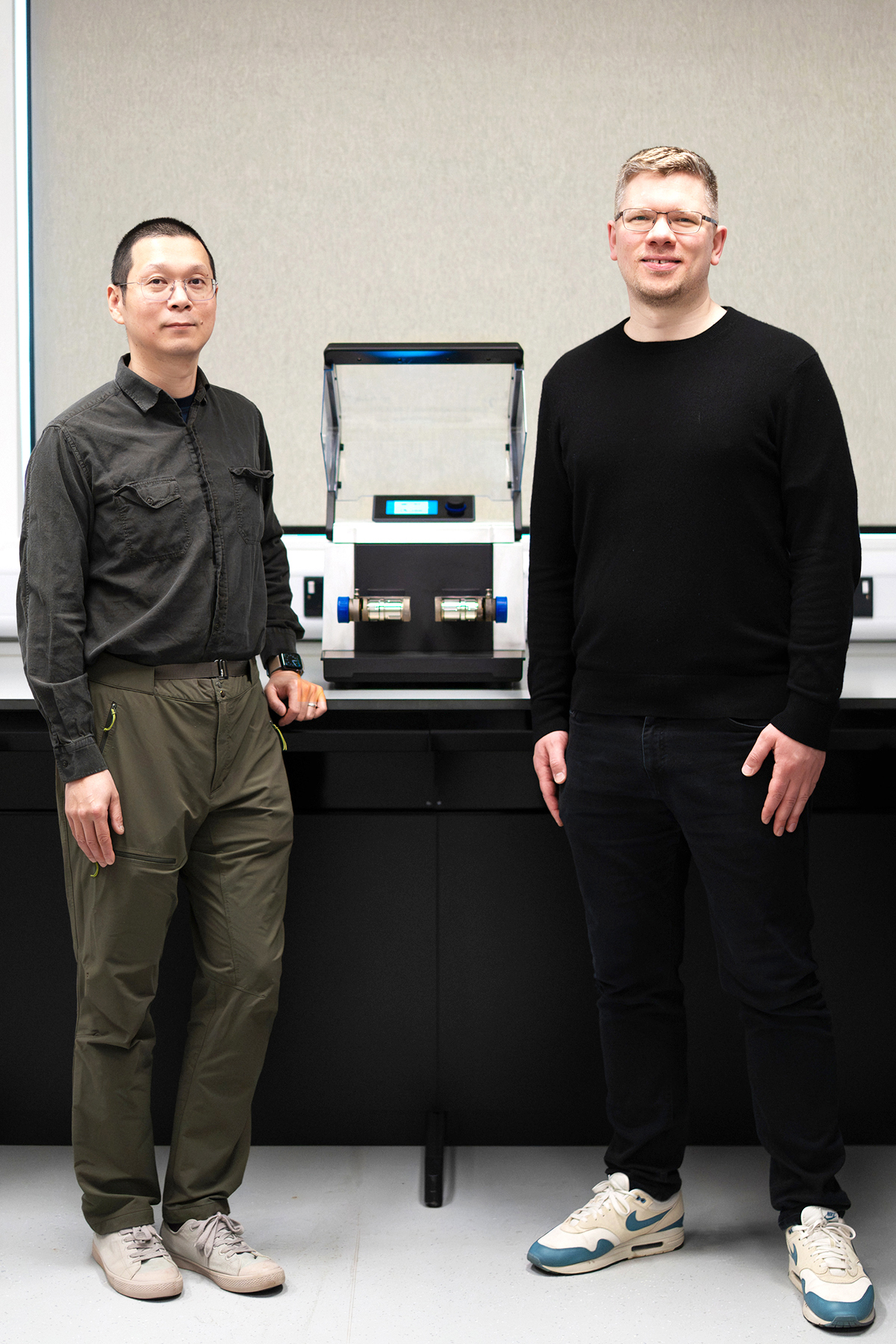
Image on the right: Dr. Erli Lu and Dr. Dominik Kubicki with the Mixer Mill MM 400, which was used to decompose PFAs. [15]
The renowned science program “Forschung aktuell” on Deutschlandfunk radio presented this research approach and its significance for future recycling technologies.
audio
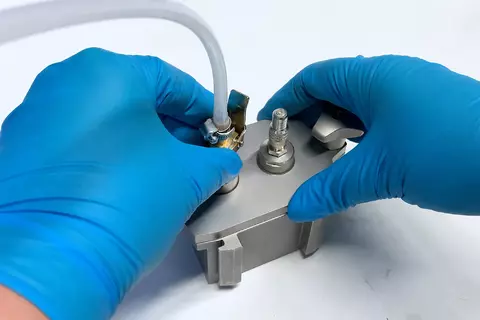
Aeration lids from RETSCH
Aeration lids have been engineered to improve both the efficiency and safety of grinding processes in laboratory environments. They are especially beneficial when working with materials that require a controlled atmosphere—such as during wet grinding or when handling reactive substances. In such cases, the internal atmosphere, including oxygen, can be replaced by flushing the jar with an inert gas like nitrogen.
These lids also enable the introduction of gases directly into the grinding jar, which is essential for certain chemical reactions or for maintaining an inert environment. The jars can be pressurized up to 5 bar, which may help facilitate the incorporation of gas molecules into the reaction during milling.
Additionally, aeration lids allow the grinding jar to be connected directly to an analyzer—either after operation in a planetary ball mill (or in the Emax) or even during operation in the MM 500 nano or MM 500 control. This setup makes it easy to analyze gases released during grinding processes or generated by chemical reactions. The lids are equipped with inlays made from various materials—such as stainless steel, zirconium oxide, and tungsten carbide—allowing the same lid to be used with different jar types.
믹서 밀 MM 400 기계화학 반응의 재생성
재생성은 과학적 연구의 기본 원칙이며, 과학적 발견의 신뢰성과 신뢰성을 보장하는 데 필수적입니다. MM 400 믹서 밀 기계화학 반응 내에서 재생성에 관하여 테스트되었으며, 여러 번 반복하는 동안 우수한 재생성을 제공한다는 것을 증명할 수있었습니다. [8]
MM 400 주장에 의해 충족되는 전도 증명서가 제공됩니다.
기계화학 반응의 수출에 영향을 미칩니다. 믹서 밀 설정된 값, 예를 들어 30 Hz를 유지하고, 그것과 거슬러지지 않습니다.
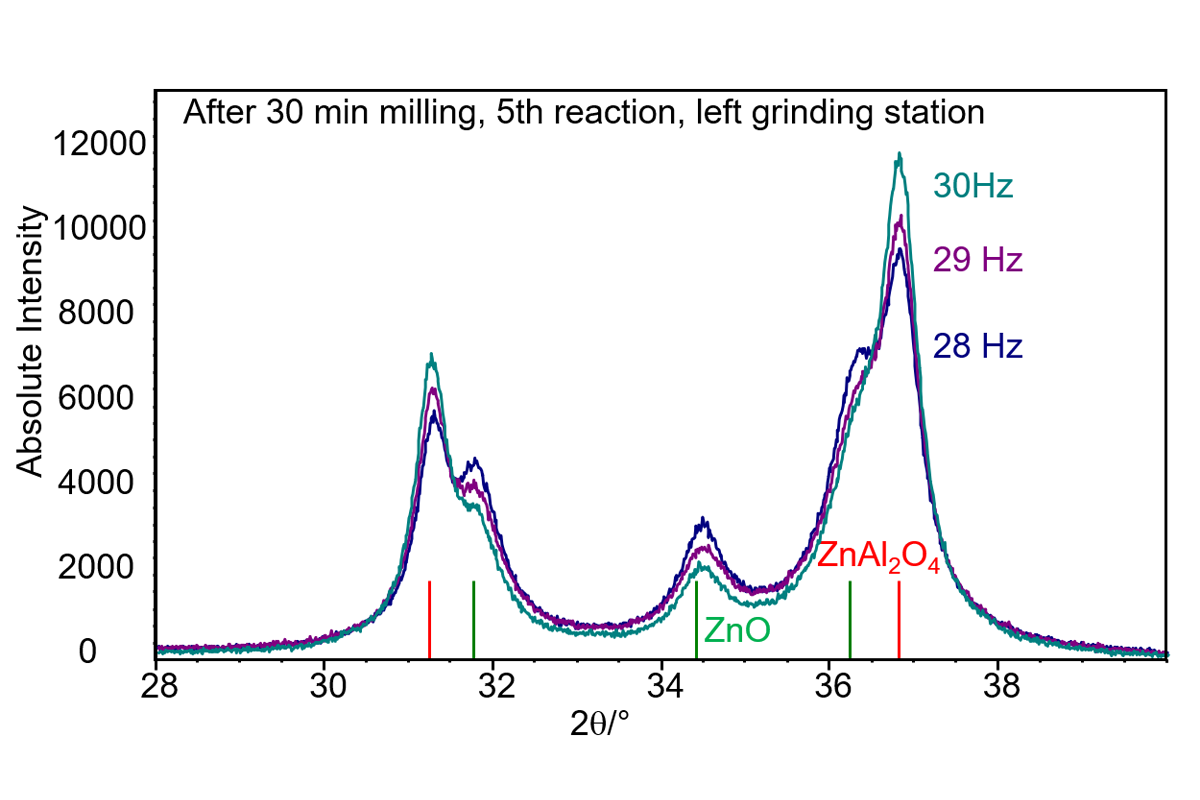
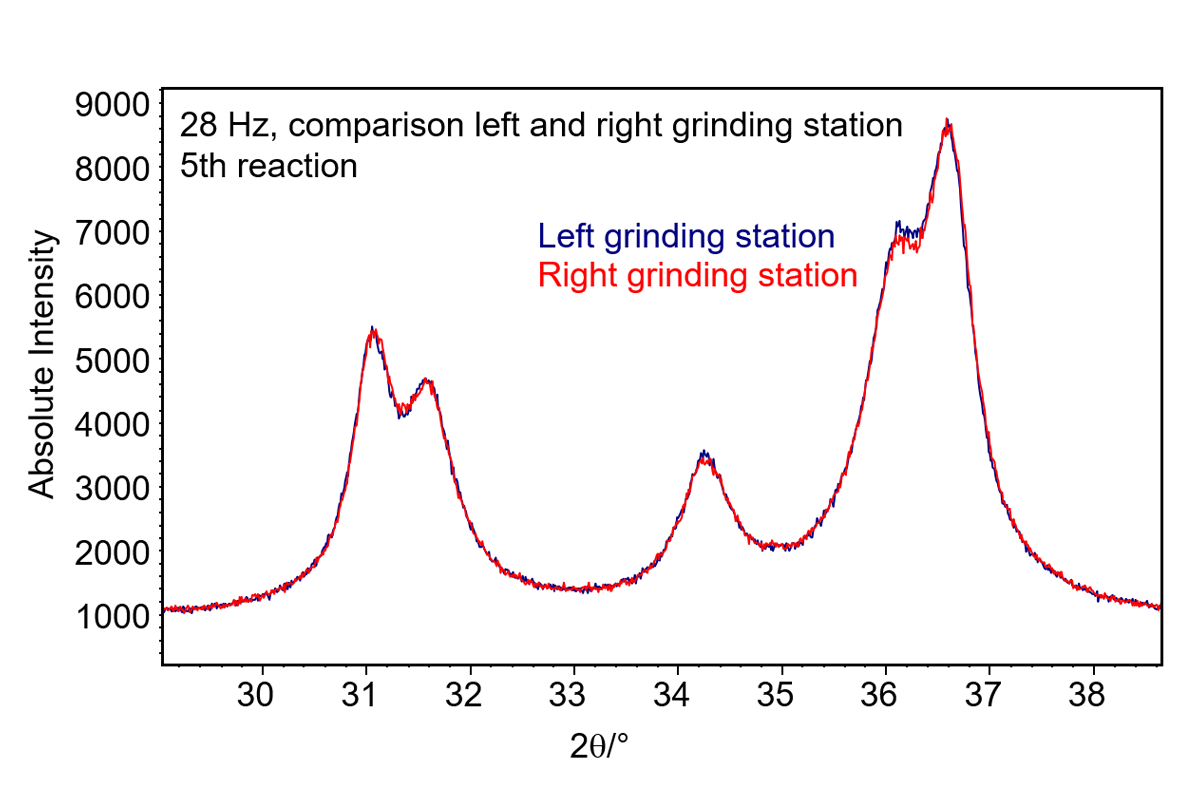
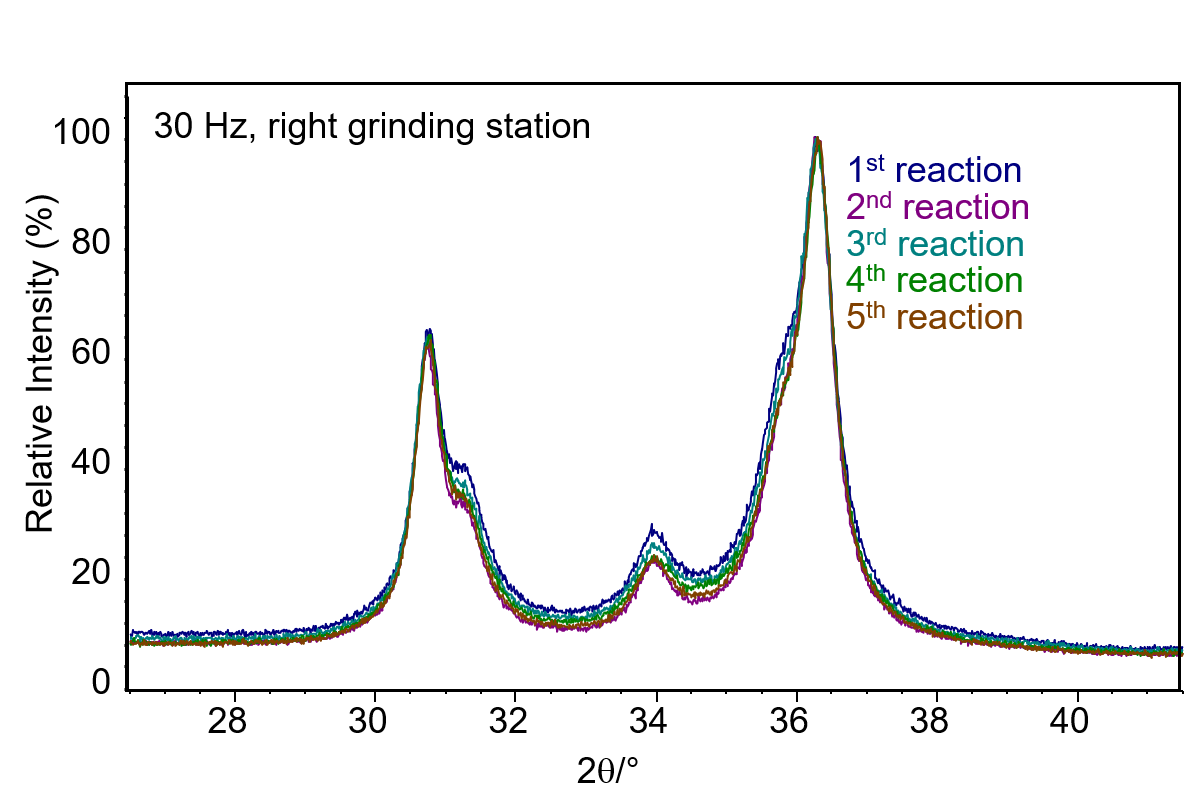
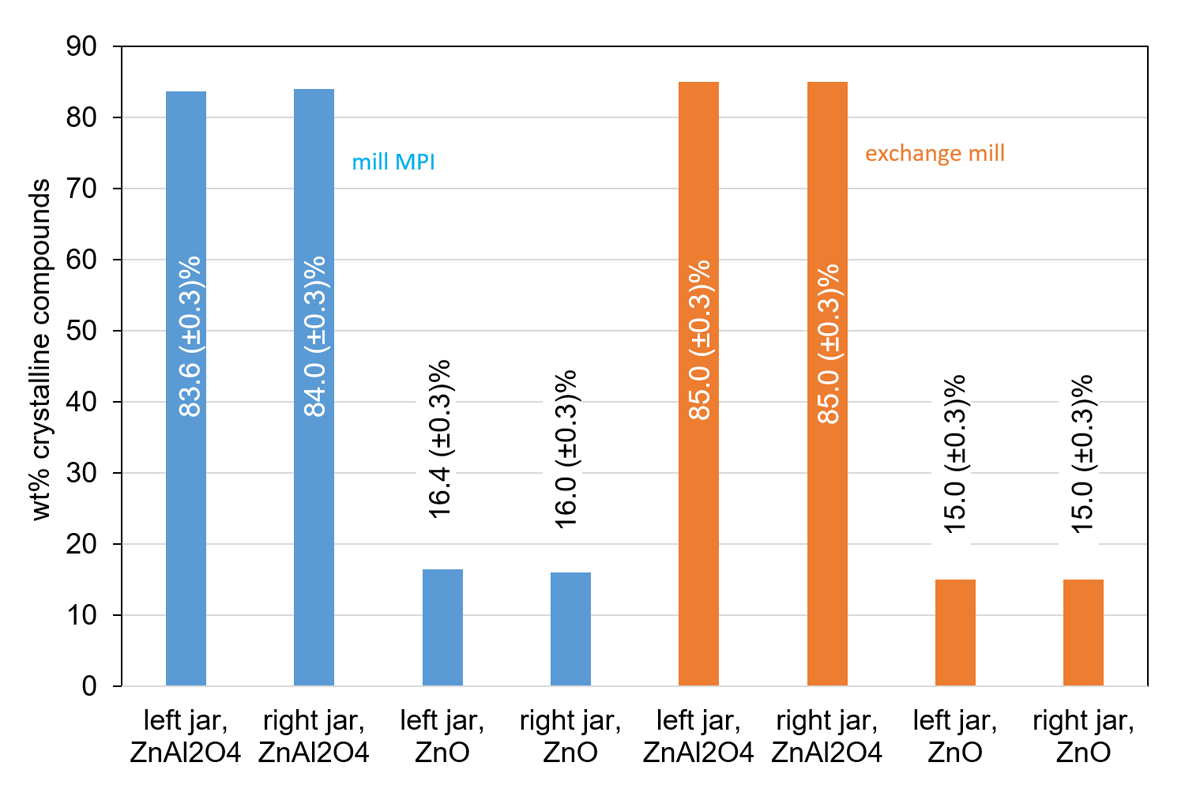
기계화학 반응 γ-Al2O3 + ZnO -> ZnAl2O4:
왼쪽: 28 Hz, 29 Hz 및 30 Hz에서 닦는 결과는 5번째 반응 후에 나타납니다.
중간: 28 Hz 각각 5번째 반응에서 왼쪽과 오른쪽 닦는 스테이션을 비교합니다.
오른쪽: 30 Hz에서 1~5개의 반응, 오른쪽 닦는 스테이션. Claudia Weidenthaler의 그룹에 의해 발표된 결과입니다. [8]
이 실험은 다른 MM 400 장치를 사용하여 반복되었으며, 왼쪽과 오른쪽 모기 스테이션 모두에서 30Hz에서 수행된 5개의 실험에서 우수한 재현성을 확인했습니다.
무료 상담 문의하기
RETSCH 제품과 서비스는 자회사와 완벽하게 교육된 유통업체의 글로벌 네트워크를 통해 제공됩니다. 당사의 모든 직원들이 고객님의 문의 사항을 기꺼이 도와드리겠습니다.

우리의 백서와 기사로 더 많은 통찰력을 얻으십시오.

From Screening to upscaling - Solutions for CO-Grinding
Different crystalline forms of a drug, known as polymorphs play a crucial role in the pharmaceutical industry, as they can significantly impact the physical and chemical properties of a drug, such as solubility, stability, and bioavailability, These polymorphs can exhibit varying characteristics, which can influence the drug's performance and effectiveness. Polymorph screening is an essential process in drug development, as it helps identify stable forms of a drug with desirable properties, ultimately improving drug formulation and performance.
Green Cement - How Ball Milling Activates Clay for A Sustainable Future
The construction industry is rapidly evolving to meet the demands of sustainability, and green cement is at the forefront of this transformation. Traditional cement production is one of the largest sources of CO₂ emissions, mainly due to the energyintensive process of heating limestone and burning fossil fuels. Green cement tackles this issue by incorporating Supplementary Cementitious Materials (SCMs), such as activated clays, fly ash, and slag, which replace part of the conventional clinker - the primary source of emissions in cement. Activated clays are especially promising: they are abundant, locally available, and, when properly processed, can significantly reduce the carbon footprint of cement production.

Mechanical Alloying with High-Energy Ball Mills
The traditional way to produce alloys such as stainless steel is to fuse the components at very high temperatures. If only small quantities are required, or if melting cannot fuse the alloys, mechanical alloying is an alternative. One approach to this application is to use ball mills like the High-Energy Ball Mill Emax.
Mechanochemistry: Preparation of Graphite for Adsorbing Hydrocarbons
Oil spills in the sea represent a serious threat to aquatic systems, affecting marine life, contaminating shores, and disrupting ecological balances. Therefore, it is essential to develop effective solutions to mitigate this problem. In this video, we will explore an innovative alternative for the preparation of expanded graphite, a material with a high capacity for adsorbing hydrocarbons in water.
Mechanochemistry: Working Toward a Sustainable Future
In the light of sustainability and Green Chemistry, mechanochemistry offers fast reactions in a solvent-free environment. Mass productivities often exceed the solvent-based reaction equivalents, and the work-up procedures are generally easier. Beside thermal, electrochemical and photochemical energy supply, a less known form of mechanochemistry is based on energy input by impact and shearing forces; typically ball mills are used to conduct those reactions. This article gives examples how mixer mills and planetary ball mills are successfully used to conduct mechanochemical processes.
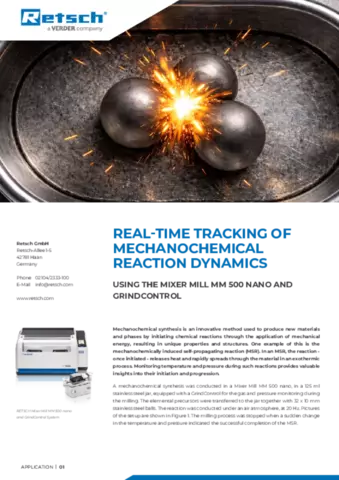
Real-time tracking of mechanochemical reaction dynamics
Mechanochemical synthesis is an innovative method used to produce new materials and phases by initiating chemical reactions through the application of mechanical energy, resulting in unique properties and structures. One example of this is the mechanochemically induced self-propagating reaction (MSR). In an MSR, the reaction - once initiated - releases heat and rapidly spreads through the material in an exothermic process. Monitoring temperature and pressure during such reactions provides valuable insights into their initiation and progression.
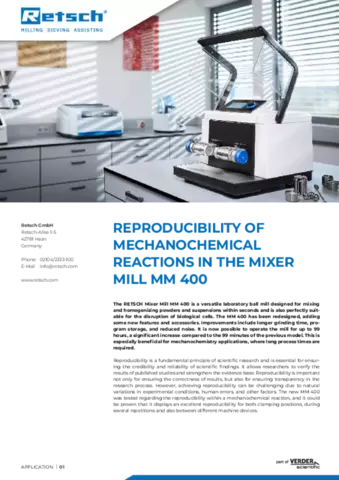
Reproducibility of Mechanochemical Reactions in the Mixer Mill MM 400
Reliable results can only be obtained with reliable instruments. The Mixer Mill MM 400 is known for its ease of use and fast grinding in terms of sample preparation prior to quality analysis. Conducting various mechanochemical reactions we have proven that the MM 400 provides reproducible results for both grinding stations with minimal standard deviations between different processes. This is due to the consistent frequency which is stable and reproducible in processes over time. It could also be demonstrated that results obtained with different MM 400 devices are also reproducible.
참고
[1] Wilm Angocolid Pickhardt, Claudio Beakovic, Maike Mayer, Maximilian Wohlgemuth, Fabien Joel Leon Kraus, Martin Etter, Sven Grätz, and Lars Borchardt: The direct Mechanocatalytic Suzuki-Miyaura Reaction of small organic molecule. Angew. Chem. Int. Ed. 2022, e202205003.
[2] Ma, X, Maximilian Wohlgemuth, Fabien Joel Leon Kraus, Michael Etter, Sven Grätz, and Lars Borchardt: The direct Mechanocatalytic Reaction of small organic molecule. Angew. Chem. Int. 2022 e202205003.
[2] Chemical Communications, 50(13), Yuan, W., 1585-1587.
[3] Reaction scheme performance and the experiments: Dr. Sven Grätz, Ruhbrbrbrr-University Bochum: Lars Grathal&Worcock, University of Chemistry and Biochemistry
[9] Reaction scheme and performance of the experiments: Dominik Al-Sabbagh, Chemistry Laboratory Technician, Division 6.3 – Structure Analysis, Federal Institute for Materials Research and Testing (BAM), Berlin.
[10] Kapish Gobindlal, Zoran Zujovic, Jacob Jaine, Cameron C. Weber, Jonathan Sperry; Solvent-free ambient temperature and pressure destruction-of PFSAs under MCD presents a detailed study on the mechanochemical destruction (MCD) of perfluorosulfonic acids (PFSAs), Environmental Science & Technology 2023, DOI: 10.1021/acs.est.2c06673.
[11] Recording of the video and performance of the experiments: Imelda Octa Tampubolon (PhD. student) and Matej Baláž (leading researcher, both Institute of Geotechnics, Slovak Academy of Sciences) and Tomislav Stolar (post-doctoral researcher, Division 6.3 – Structure Analysis, Federal Institute for Materials Research and Testing (BAM), Berlin). The experiment was performed at BAM.
[12] Maximilian Wohlgemuth, Sarah Schmidt, Lars Beißel and Lars Borchardt; Ligand-free reductive amination via Pd-coated mechanocatalysis. The Royal Society of Chemistry 2025, DOI: 10.1039/d5cc04707b.
[13] Adrian H. Hergesell, Claire L. Seitzinger, Justin Burg, Renate J. Baarslag and Ina Vollmer; Influence of ball milling parameters on the mechano-chemical conversion of polyolefins. The Royal Society of Chemistry 2025, DOI: 10.1039/d4mr00098f
[14] Tatsiana Nikonovich, Yao Yu, Mikko Korkiakoski, Chengji Yang, Iris Seitz, Daniel Langerreiter, Mauri A. Kostiainen, Eduardo Anaya-Plaza, and Sandra Kaabel; Solid-State Synthesis of Cationic Cellulose Fibers from Low-Processed Cotton for Efficient Virus Capture; ACS Sustainable Chemistry & Engineering 2025 13 (42), DOI: 10.1021/acssuschemeng.5c07884[15] With permission of Dr Erli Lu, Associate Professor in Mechanochemistry & Sustainable Synthesis School of Chemistry, University of Birmingham