





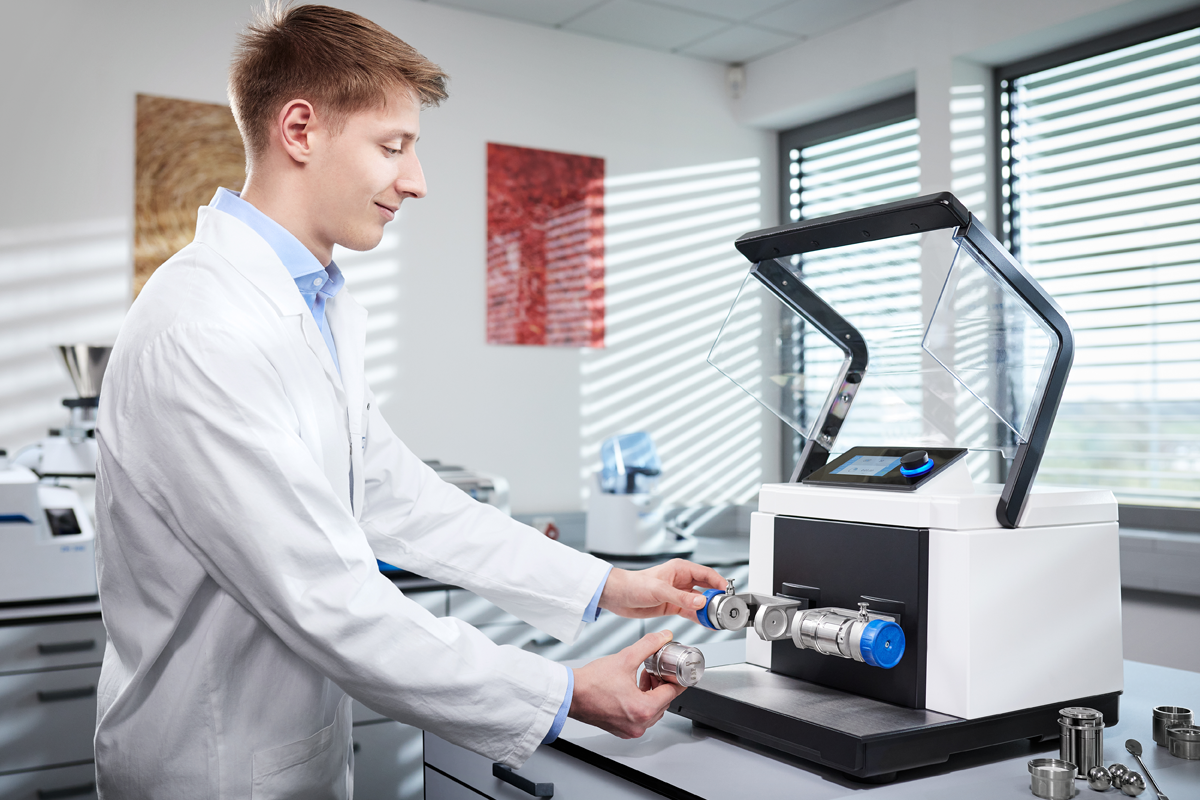
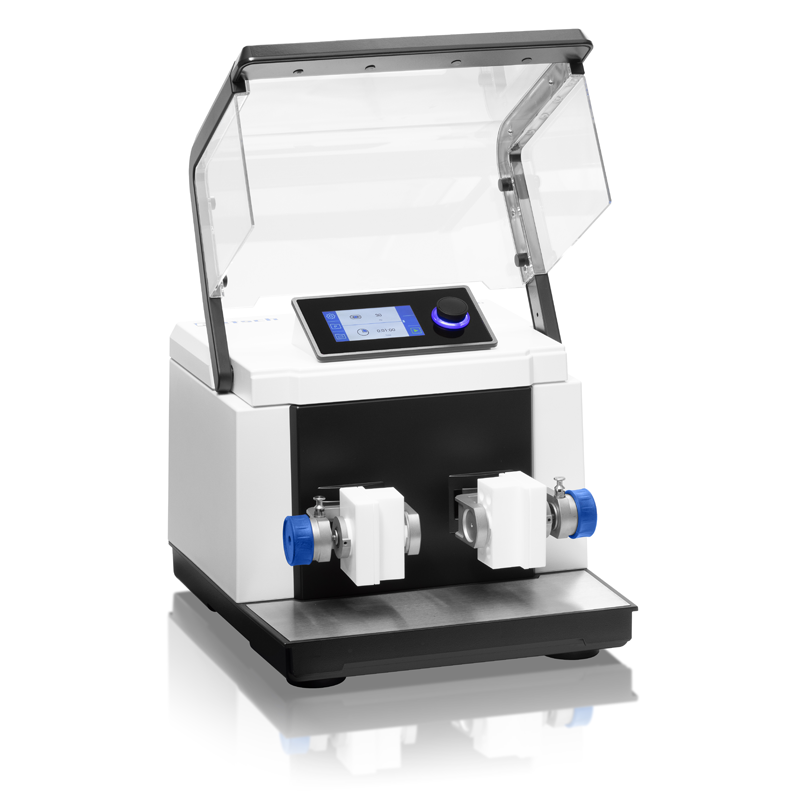

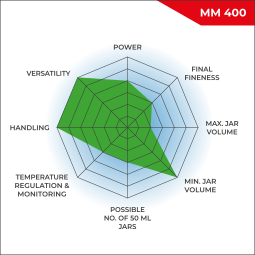
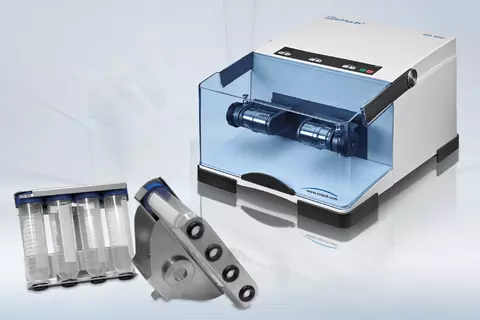
De Kogeltrilmolen MM 400 is een werkelijk veelzijdige molen, die ontworpen werd voor droge, natte en cryogene maaltoepassingen van kleine volumes tot 2 x 20 ml. Hij mengt en homogensieert poeders en suspensies met een schudfrequentie tot 30 Hz in enkele seconden – ongeëvenaard snel en eenvoudig te bedienen.
Het compacte tafelmodel is geschikt voor klassieke homogenisatie-processen, maar ook voor biologische cel-disruptie voor DNA/RNA en eiwit-extractie. Lange maalprocessen tot 99 uren maken de MM 400 ook ideaal geschikt voor onderzoekstoepassingen, bijvoorbeeld in mechanochemie
Met betrekking tot de performantie en flexibilieit van deze molen, bestaat er geen gelijkwaardig toestel in de markt.
Mogelijks heeft u ook interesse in de kogeltrilmolens MM 500 nano en MM 500 vario die op het zelfde werkingsprincipe gebaseerd zijn bij een schudfrequentie tot 35 Hz maar nog hogere performantie bieden. Voor toepassingen waarbij afkoeling of opwarming gewenst is, hebben we de MM 500 control als perfecte keuze. Iedere RETSCH kogeltrilmolen heeft een specifieke toepassingsfocus.
Product Video
De meest veelzijdige allrounder van Kogelmolens
- Max. snelheid 30 Hz
- Horizontale oscillatie veroorzaakt sterke impacteffecten voor effectieve monsterverwerking
- Tot 8 mm voergrootte en 5 μm eindfijnhd
- 2 Slijp stations voor potjes van min 2 ml en max 50 ml, adapter voor 10 x 2 ml flacons voor eenmalig gebruik en 4 x 50 ml conische centrifugeerbuisjes
- Stalen potten kunnen handmatig worden voorgekoeld in vloeibare stikstof
- Gekalibreerde snelheid en tijd, klein tafelmodel, opbergbare SOP's en cyclusprogramma's, 7 verschillende potmaterialen
Kogeltrilmolen MM 400 Dit zeggen onze klanten
Trusted reviews provided by

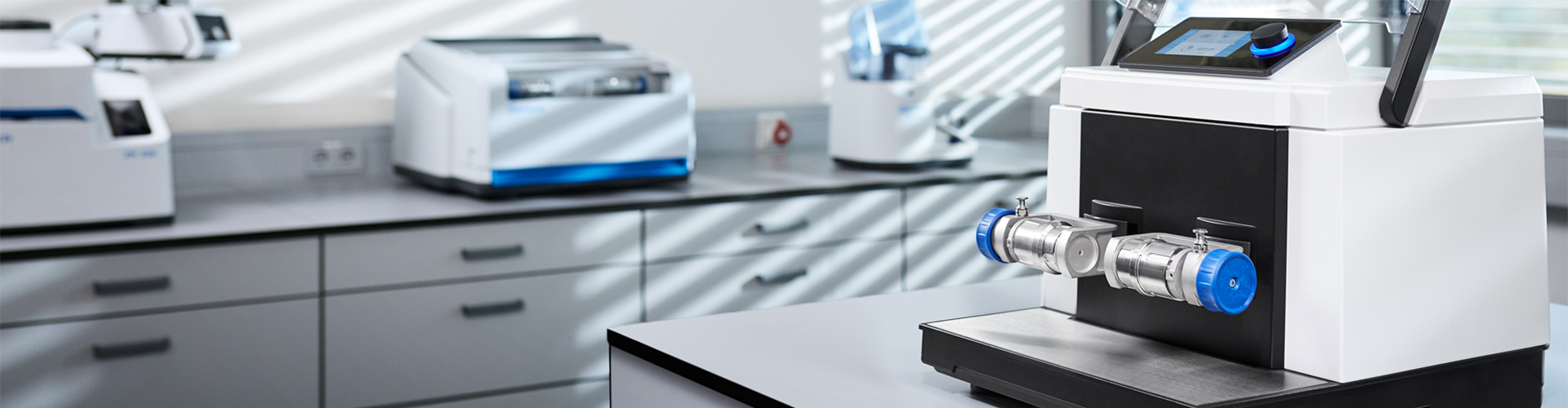
Performantie en Design
- Krachtig malen door impact en wrijving tot 30 Hz
- Uitgerust met 2 maalstations voor tot 20 monsters per keer
- Geheugen voor 12 Standaard Procedures (SOP) en 6 programma-cycli
- Comfortabel aanraakscherm
Grote flexibiliteit
- 3 verschillende maal-modi: droog, nat of cryogeen0
- Mengt poederige monsters en een bindmiddel in kusnstof-containers als voorbehandeling bijvoorbeeld voor het persen van XRF tabletten
- Geschikt voor onderzoek toepassingen zoals de mechanochemistry of voor biologische celdisruptie door bead beating
- Extractie van pesticiden (QuEChERS) en kruiden-ingrediënten
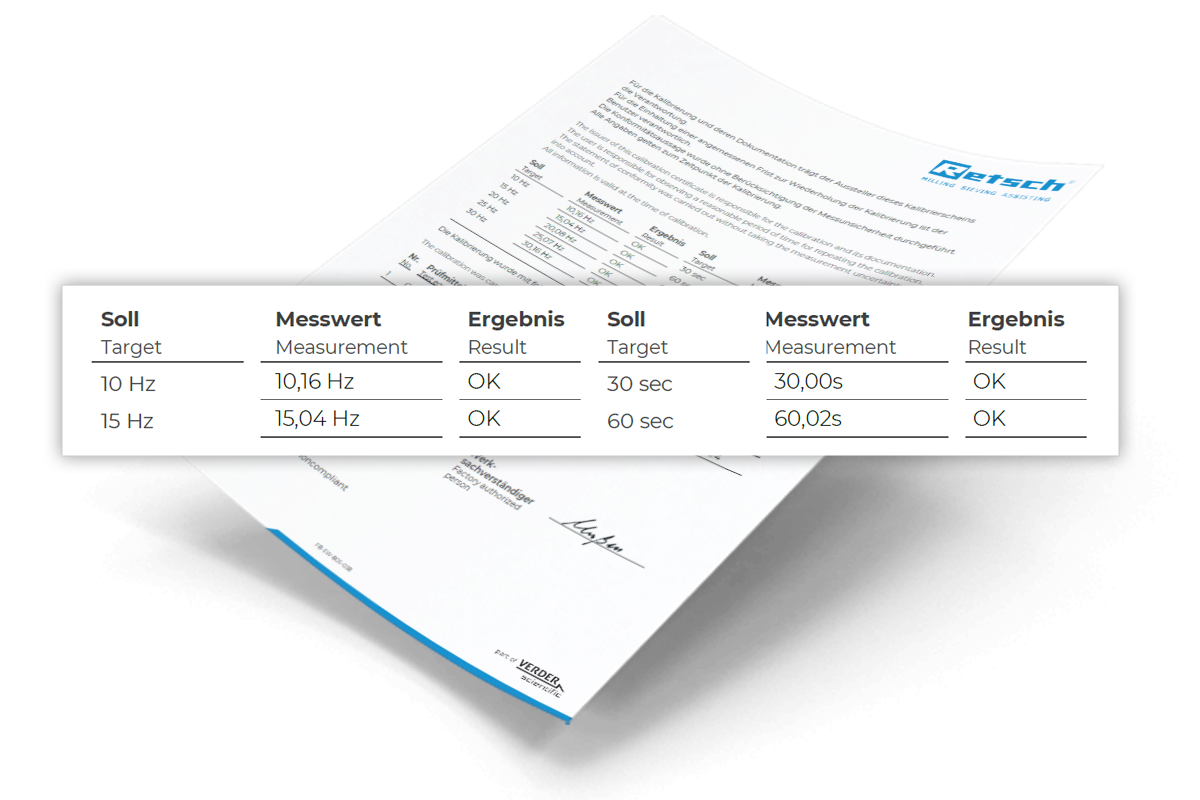
Kogeltrilmolen MM 400 Calibratie verzekert reproduceerbare resultaten
Reproduceerbaarheid speelt een belangrijke rol in de procesketen van monstername tot analyse. Lab apparatuur die gecalibreerd kan worden, garandeert reproduceerbare resultaten met minimale standaard-afwijking, telkens weer. Dit kan bijzonder bruikbaar zijn, bij vergelijking van resultaten op verschillende locaties.
De MM 400 is de eerste laboratorium molen die gecalibreerd kan worden. RETSCH calibreert bij uitlevering de tijd en schudfrequentie ien we bieden de mogelijkheid om calibratie-service op een af te spreken interval
Deze functionaliteit kan meerbepaald nuttig zijn voor
- Testlaboratoria met verschillende locaties
- Geaccrediteerde labs volgens ISO/IEC 17025 of ISO 9000ff
- Farmaceutische producten
Kogeltrilmolen MM 400 Reproduceerbaarheid van mechanochemische reacties in de Kogeltrilmolen MM 400
Reproducibility is a fundamental principle of scientific research and is essential for ensuring the credibility and reliability of scientific findings. The Mixer Mill MM 400 was tested regarding the reproducibility within a mechanochemical reaction, and it could be proven that it provides excellent reproducibility during several repetitions, for both clamping positions, and also between different devices. [1]
Minor variations of the frequency from 30 Hz to 29 Hz or 28 Hz have an influence on the yield of the reaction. It is of fundamental interest that the mixer mill maintains a set value, e.g. 30 Hz, and does not deviate from it. A premise which is fulfilled by the MM 400 which comes with a calibration certificate.
The mechanochemical reaction γ-Al2O3 + ZnO -> ZnAl2O4 was conducted for 30 min using 25 ml grinding jars, 2 x 15 mm grinding balls, 1 g educts, at 28 Hz, 29 Hz and 30 Hz five times in a row. The comparison between left and right clamping station showed highly reproducible results, also the comparison between the 5 trials.
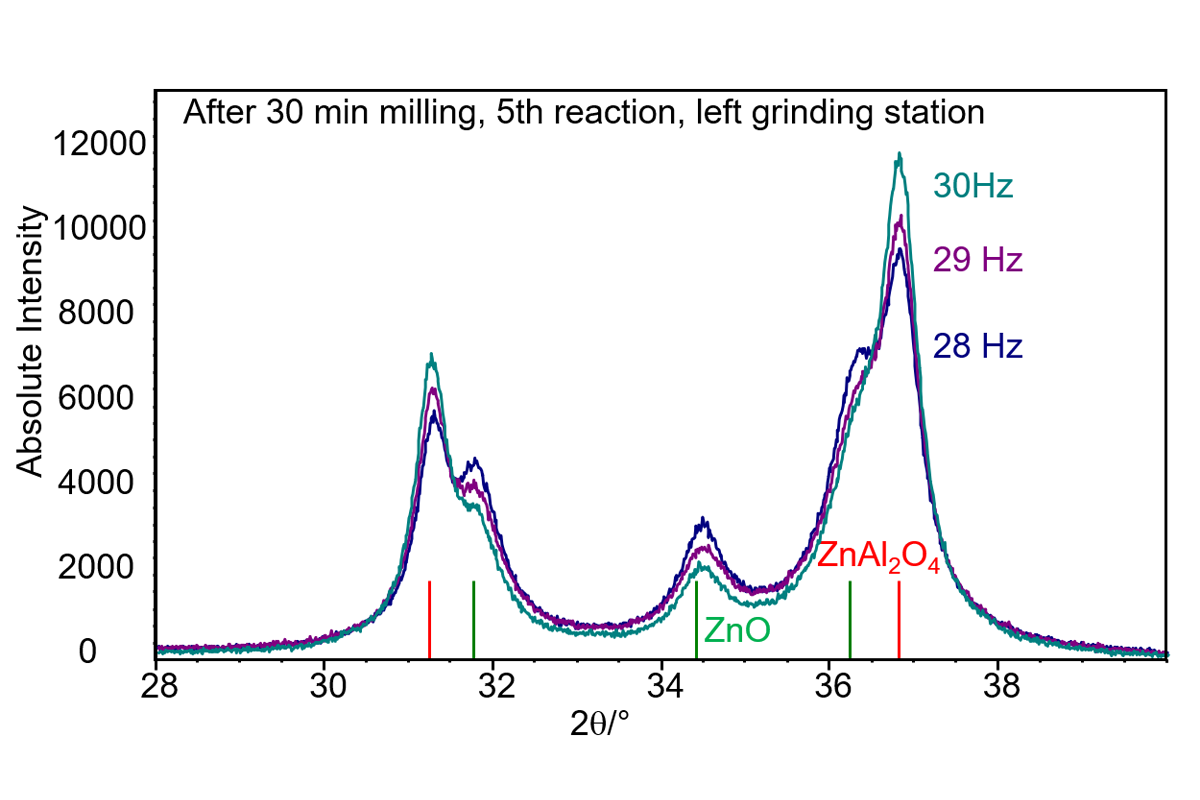
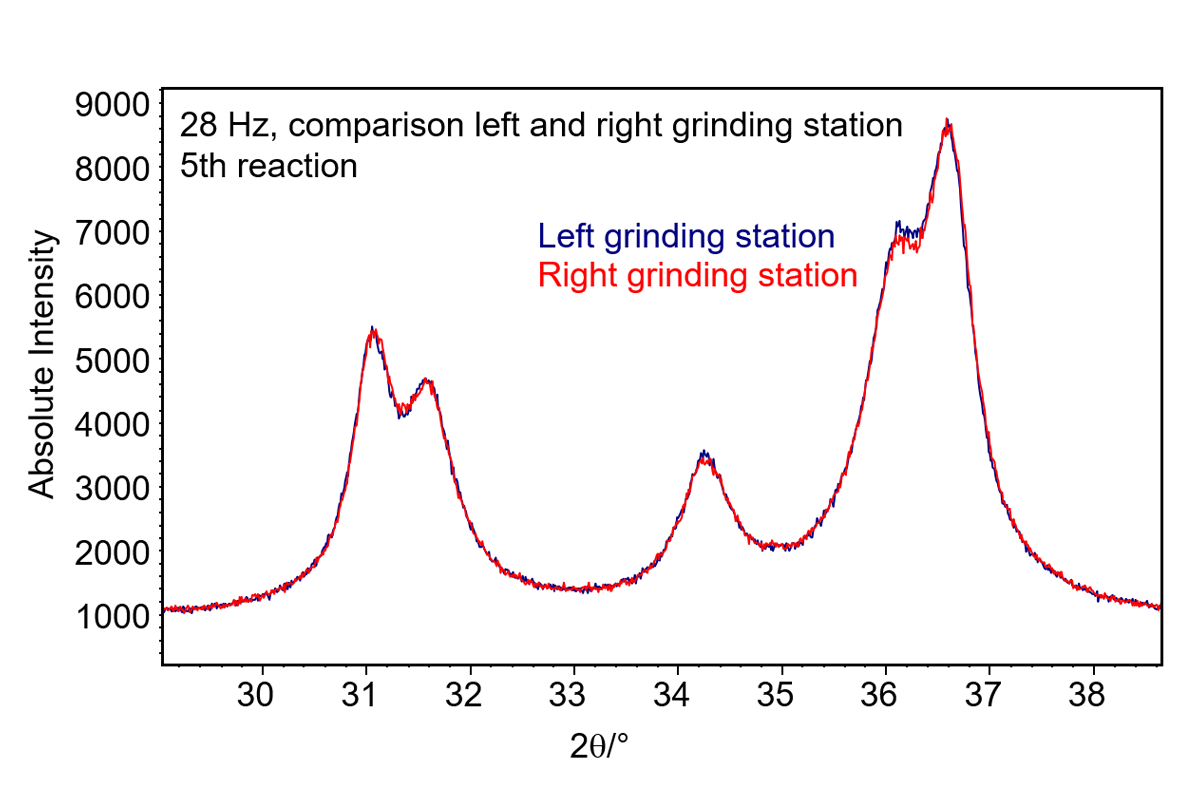
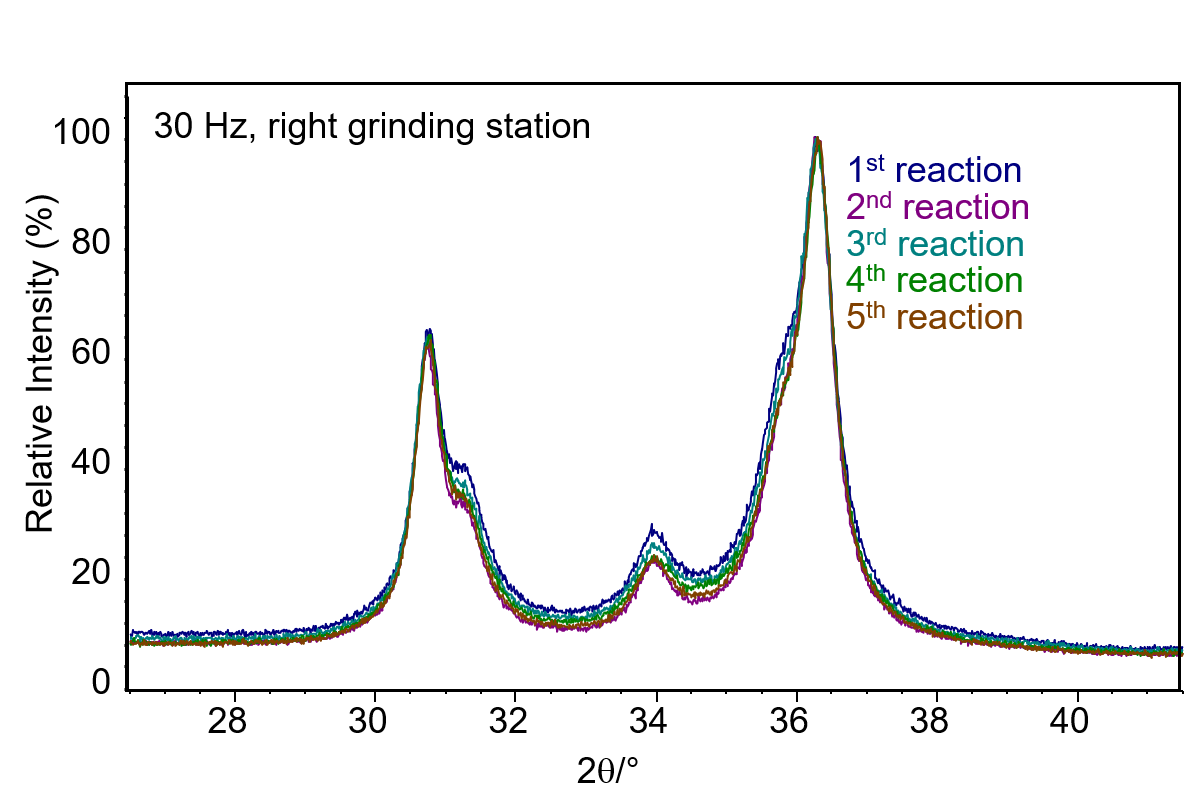
XRD patronen na de mechanochemische reactie γ-Al2O3 + ZnO -> ZnAl2O4:
Links: Slijpen bij 28 Hz, 29 Hz en 30 Hz, resultaten na 5e reactie.
Midden: Vergelijking links en rechts Slijpen station bij 28 Hz 5e reactie elk.
Rechts: Reactie 1 tot 5 bij 30 Hz, rechts Slijpen station. Resultaten gepresenteerd door de groep van Claudia Weidenthaler. [8]
De experimenten werden herhaald met behulp van een ander MM 400 apparaat om de resultaten tussen de twee frezen te vergelijken.Opnieuw werd de uitstekende reproduceerbaarheid geverifieerd voor de 5 tests die werden uitgevoerd bij 30 Hz, voor zowel links als rechts Slijpend station.
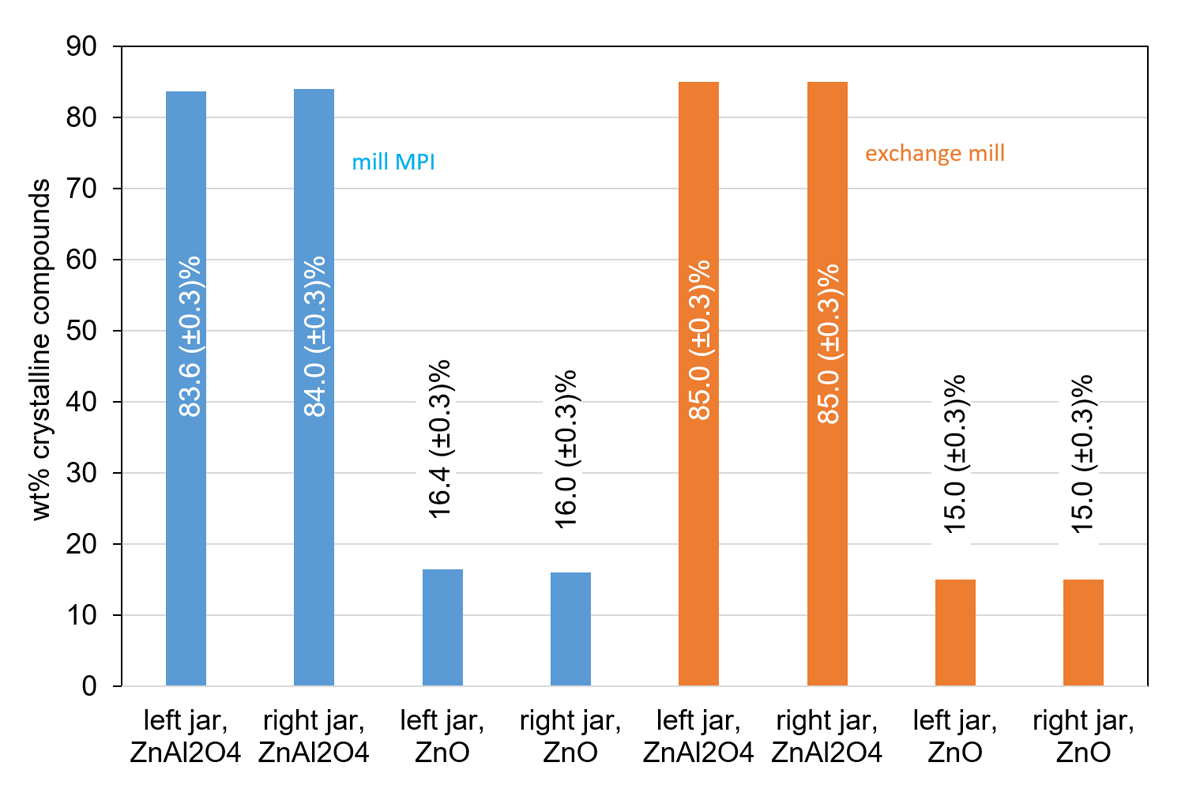
Almost identical results (weight % of educts and product) and reproducibility are obtained with a different MM 400 device. Results presented by the group of Claudia Weidenthaler. [1]
Kogeltrilmolen MM 400 Oplossingen voor biologische toepassingen en celdisruptie
Kogeltrilmolens worden vaak ingezet voor de homogenisatie van biologische monsters. Het zogenaamde bead beating with small glass beads is an established method for cell disruption of yeasts, microalgae or bacteria. The sample is only moderately warmed in the process which can be reduced to a minimum by pre-cooling.
The MM 400 allows for efficient cell disruption of up to 240 ml cell suspension for DNA/RNA and protein extraction. For accurate diagnosis of infections, it is possible to isolate intact bacteria from tissue in 8 x 30 ml bottles or 10 x 5 ml vials by using adapters.
The MM 400 can be operated with a range of adapters for single-use vials with the following capacities:
20 x 0.2 ml / 20 x 1.5 or 2 ml / 10 x 5 ml / 8 x 30 ml / 8 x 50 ml
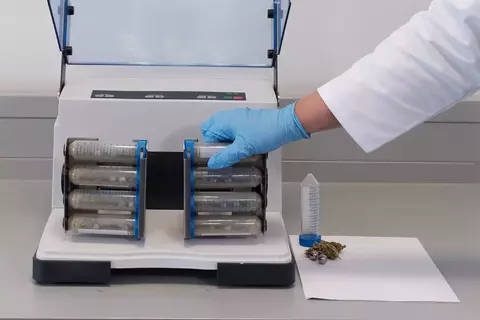
Voor het verpulveren van 25 tot 30 g plantenmateriaal, zoals cannabis bloemen, zijn de konische centrifugebuizen het best geschikt. Tot 8 weefselmonsters, zoals lever in buffer-oplossing, kunnen ook gehomogeniseerd worden in deze 50 ml tubes met behulp van stalen of zirconoiumoxide maalkogels. Om de mechanische belasting van de recipiënten zo laag mogelijk te houden, raden we aan om te werken met verminderde schudfrequentie en een hoge vulgraad van de containers met vloeistof of monster.
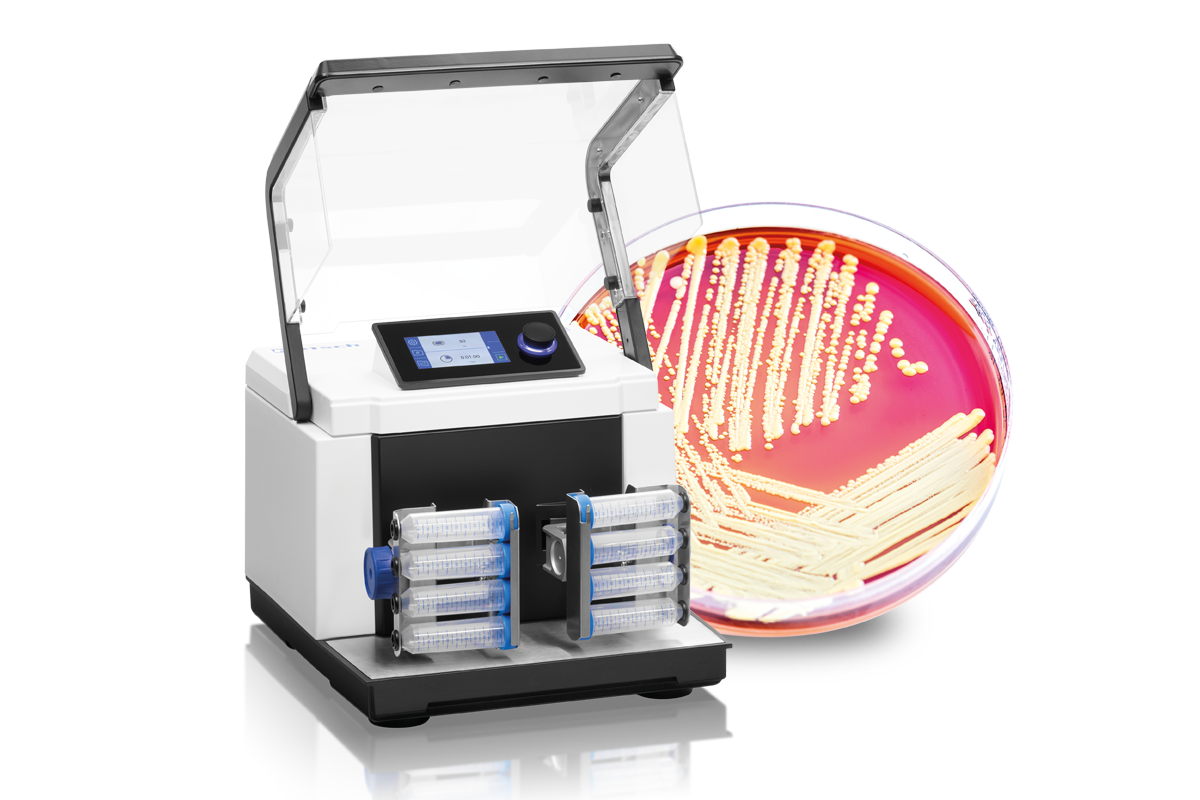
Mixer Mill MM 400 - Gist Cel Disruptie*
Kogeltrilmolen MM 400 - Homogenisatie van cannabis*
*De video toont het vorige model met hetzelfde functioneringsprincipe.
Kogeltrilmolen MM 400 Oplossingen voor cryogeen malen
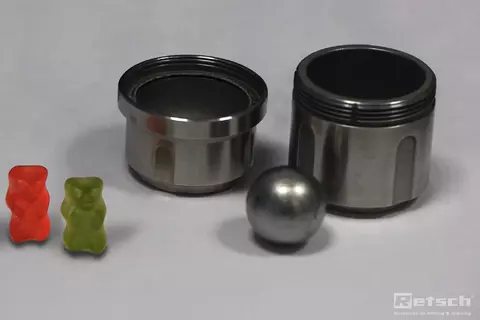
De CryoKit is een kosten-effectieve oplossing voor cryogene monsterverwerking met de kogeltrilmolen MM 400. De set bestaat uit twee geïsoleerde bakjes, twee klemmen en een veilgheidsbril.
Het te verwerken monster wordt samen met de maalkogel(s) in een roestvrij stalen maalpot gebracht, die vervolgens goed wordt afgesloten. Indirecte verbrossing wordt bekomen door de afgesloten maalbeker gedurende 2 minuten in een bad met vloeibare stikstof te plaatsen, waardoor het monster voldoende gekoeld wordt voor cryogene verwerking.
Wanneer rechtstreeks contact met vloeibare stikstof moet vermeden worden, dan zijn de CryoMill of Kogeltrilmolen MM 500 control geschikte opties. Beide molens kunnen gebruit worden met maalkamers uit andere materialen dan staal voor het cryogene malen.
Mixer Mill MM 400 - Cryogeen Malen
Kogeltrilmolen MM 400 Toepassingen in mechanochemie
Mechanochemie maakt snelle reacties van stoffen in een oplosmiddelvrije omgeving mogelijk. Sommige chemische reacties vereisen de wrijvingskrachten van een planetaire kogelmolen, terwijl andere reactietypes energie-invoer door impact nodig hebben - dat is waar de Kogeltrilmolen MM 400 in het spel komt.
De beschikbare monstervolumes voor onderzoekstoepassingen zijn vaak erg laag. Dit maakt kleine maalbekers tot 50 ml, zoals ze verkrijgbaar zijn voor de MM 400, voordelig. Vanwege de vaak lange reactietijden is de mogelijkheid om procestijden van meerdere uren te programmeren een ander belangrijk aspect.
Mixermolens bieden een uniek voordeel ten opzichte van planetaire kogelmolens in mechanochemische toepassingen: het gebruik van transparante potten in combinatie met de typische horizontale beweging van de potten maakt in-situ RAMAN-spectroscopie mogelijk. Dit maakt real-time monitoring van het reactieproces mogelijk om de optimale tijd voor maximale opbrengst te identificeren en langdurige verwerking te voorkomen.
De MM 400 biedt vele voordelen voor mechanochemische toepassingen:
- Procestijd instelbaar tot 99u
- Diverse maalkamer formaten en materialen
- Transparent PMMA grinding jars enable in-situ RAMAN spectroscopy
- Programmeerbare frequentie en pauze-tijden
- Adaptor voor 4 x 5 ml roestvrij stalen maalkamers om gelijktijdig tot 8 monsters te behandelen
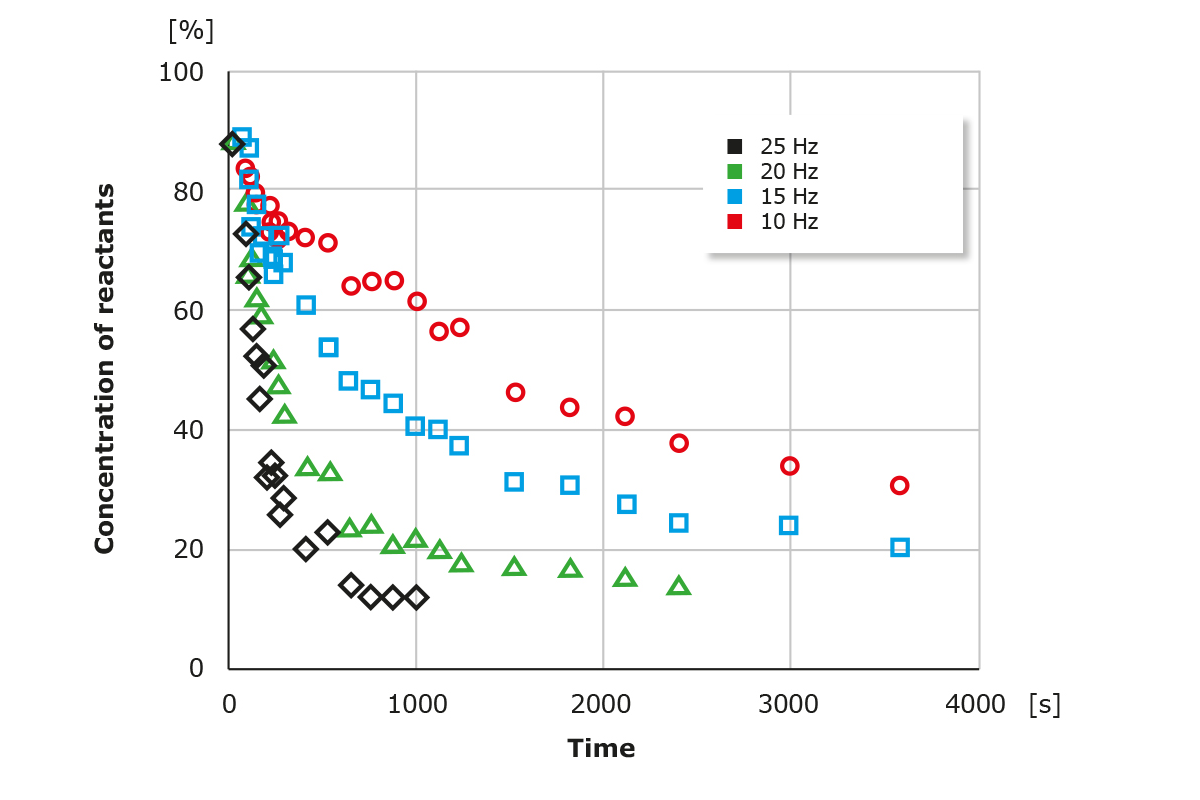
Tijdsverloop van de Knoevenagelreactie tussen vanilline en barbituurzuur onder mechanochemische omstandigheden met behulp van 2x10 mm zirkoniumoxide maalkogels in 19 ml PMMA maalpot bij 30 Hz. Reactie loopt over 30 minuten met zichtbare voortgang aangegeven door kleurverandering.
Met dank aan Dr. Sven Grätz, Ruhr-Universiteit Bochum, Faculteit Scheikunde en Biochemie, AG Prof. Borchardt.
Co-Crystal Screening with the MM 400
Co-crystal screening can be effectively performed in Mixer Mills. In a study [9] using the MM 400, 2 ml steel tubes and the corresponding PTFE adapter were employed to co-crystallize theophylline and benzamide in a 1:1 ratio under the following conditions:
- 60 min milling time
- 30 Hz frequency
- One 6 mm steel ball per tube
- Four experiments without solvent and four with 20 µL ethanol
X-ray powder diffraction patterns of the eight resulting samples (shown in green) align closely with the simulated reference pattern of the target co-crystal. All observed signals correspond to the desired product, with no significant additional signals, indicating successful and reproducible co-crystal formation. The MM 400 with 2 ml steel tubes delivers consistent results, and this compatibility extends to the MM 500 series, which can also accommodate 2 ml steel tubes.
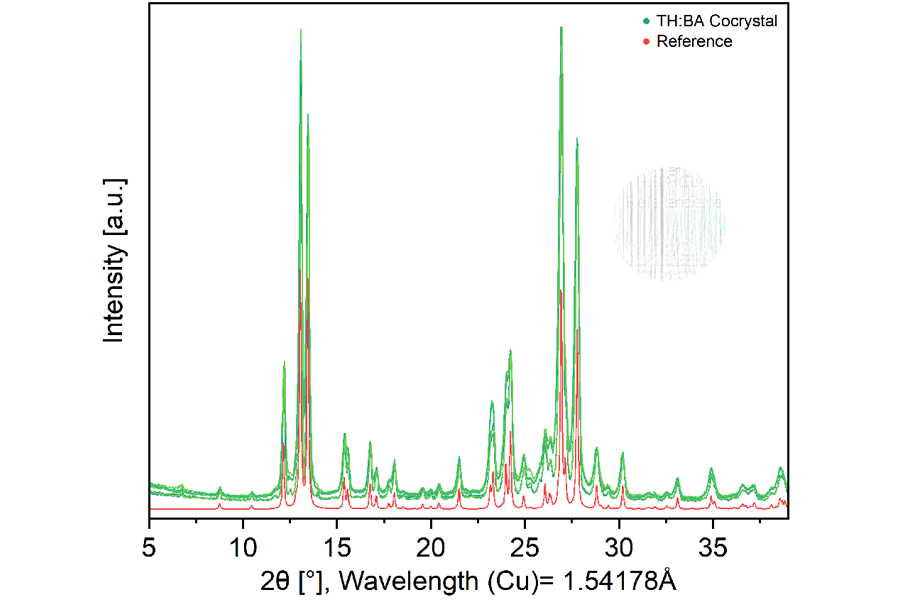
XRD patterns after the co-crystal formation of theophylline and benzamide after 60 min milling time in the MM 400 against a simulated reference. Results presented by experiments of Dominik Al-Sabbagh. [2]
Chemistry in the Mill: Teflon Recycling (PTFE) Using Mechanical Energy
Mechanochemical Recycling of PTFE (Teflon)
Mechanochemistry not only enables new synthetic pathways but also opens up innovative approaches for recycling processes involving materials that are difficult to degrade. A recent example from research shows that even the extremely stable polymer polytetrafluoroethylene (PTFE), better known as Teflon, can be degraded mechanochemically. A decisive factor is continuous mechanical stress: During grinding with the RETSCH MM 400, the reacted surface is constantly removed, exposing new surface area. This allows the reaction to proceed until a large portion of the polymer has been converted. In the study, up to 98% of the PTFE was converted into sodium fluoride and elemental carbon.
The resulting products can then be further utilized, for example as raw materials for battery materials or as fluorine-containing building blocks for pharmaceutical and agrochemical applications.
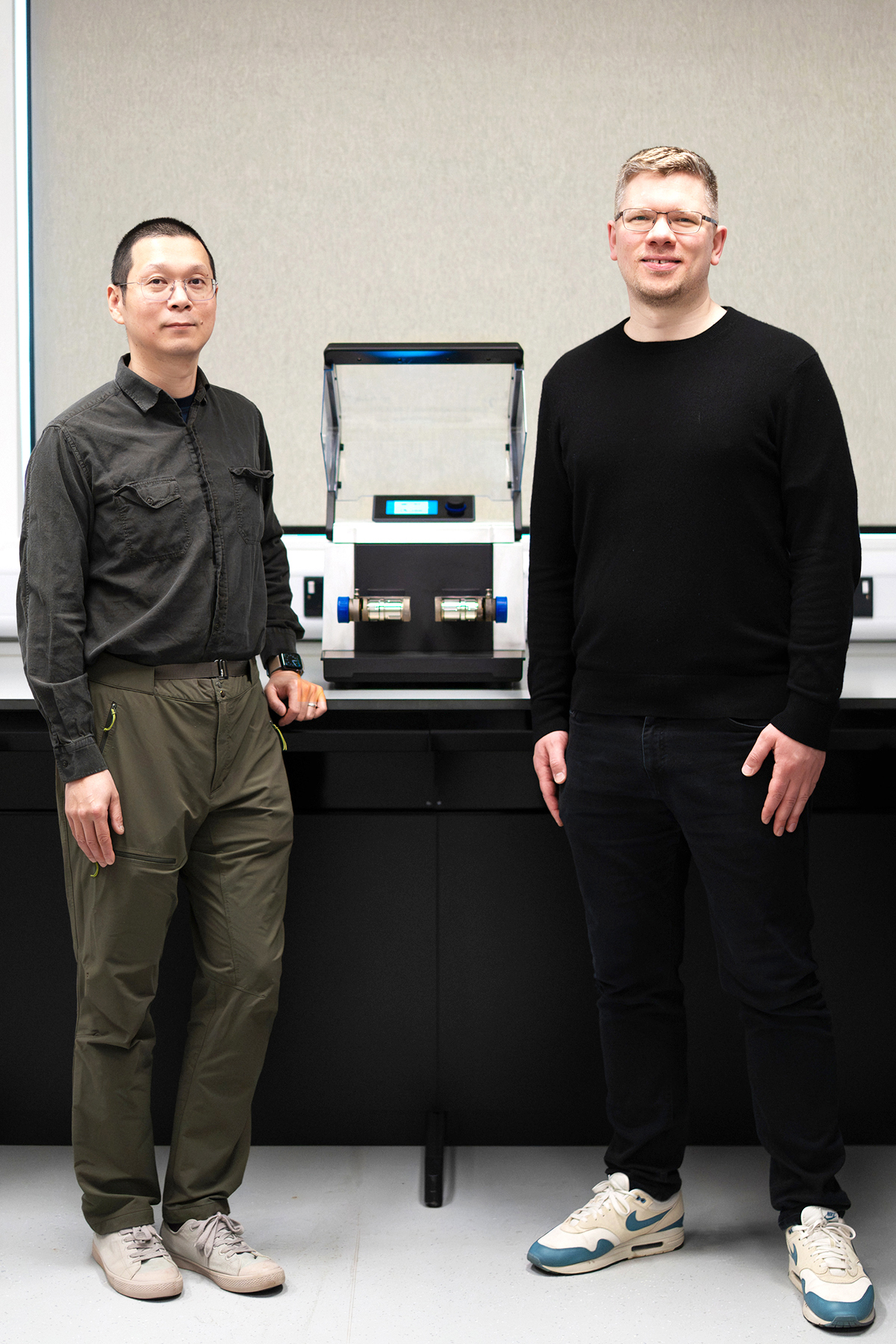
Image on the right: Dr. Erli Lu and Dr. Dominik Kubicki with the Mixer Mill MM 400, which was used to decompose PFAs. [15]
The renowned science program “Forschung aktuell” on Deutschlandfunk radio presented this research approach and its significance for future recycling technologies.
audio
Functionalizing biomass for pharma applications via mechanochemistry
Mechanochemistry is transforming how functional biomaterials are made, and cationic cellulose is a prime example. Using a solvent-free process, cotton fibers are combined with a catalytic base and a minimal additive, then milled together with the cationic reagent to activate the reaction using the Mixer Mill MM 400. This solid-state approach eliminates water and bulk solvents, dramatically reducing chemical use and waste compared to conventional methods. After milling, a short aging step completes the reaction, delivering highly charged cellulose fibers with exceptional performance. [14]
Optimal reaction conditions: Cotton fibers were milled in a 50 ml stainless steel jar with 3 x 10 mm balls for 5 min at 25 Hz, then EPTMAC was added, and the mixture was milled for additional 30 min. The subsequent aging of the reaction mixture at 50 °C for 24 h, followed by Soxhlet extraction (48 h) and freeze drying, resulted in the isolation of pure cCF material.
Why is this exciting for pharma?
These cationic fibers show strong electrostatic binding to viruses, enabling efficient removal of pathogens from water and process streams—critical for sterile manufacturing and clean water applications. Beyond filtration, the material offers potential in drug delivery, antimicrobial surfaces, and bioprocessing aids. The process achieves outstanding sustainability metrics aligning with green chemistry principles and industry goals. It also allows precise control over charge density for tailored performance.
This innovation demonstrates how mechanochemistry can deliver high-value, eco-friendly solutions for pharmaceutical production—combining safety, efficiency, and sustainability in one breakthrough approach.
Kogeltrilmolen MM 400 In-situ Raman spectroscopy
In-situ Raman spectroscopy is a powerful analytical technique that allows for the monitoring and analysis of materials in their natural or process environment. This method utilizes Raman scattering, a phenomenon where light interacts with molecular vibrations, leading to shifts in the wavelength of the scattered light. These shifts provide a unique spectral fingerprint for the material being analyzed, offering insights into its chemical composition or molecular structure.
The "in-situ" aspect refers to the ability to observe and measure these characteristics directly during an ongoing process. This can include observing changes in the presence of various chemical reactions, also the so called mechanochemistry. Mechanochemistry involves the use of impact, shearing, or friction actions to induce chemical changes in solids. This approach is increasingly popular for its ability to bypass the need for solvents, potentially offering a more environmentally friendly and energy-efficient pathway for chemical synthesis. The Raman spectroscopy can provide invaluable insights into the reaction mechanism, phase transformations, reaction kinetics or for optimization of reaction conditions.
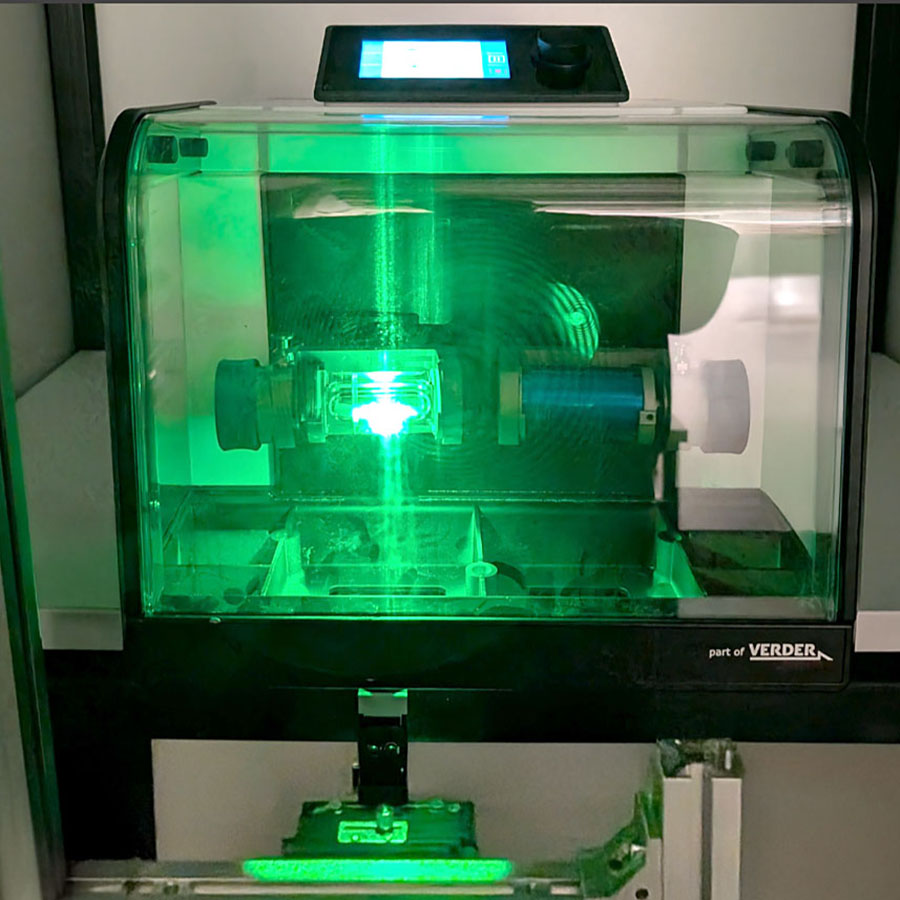
The MM 400 is “Raman-ready”, allowing easy removal of the bottom plate inlay. The bottom plate has openings for the Raman probe to consistently measure at the bottom of the jars by placing the Raman probe underneath the mill and thus underneath the jars, where particle interaction is most intense, ensuring accurate data. The Retsch PMMA grinding jars, with their transparency and chemical resistance, enhance spectral data without contamination. The plane outer shapes of the jars further enhance the spectroscopic data. These design adjustments streamline the experimental workflow. Researchers can now perform in-situ Raman spectroscopy with greater ease and precision, opening new possibilities for in-depth material analysis.
VOOR VEILIGE EN EFFICIËNTE MAALPROCESSEN TOEBEHOREN VOOR DE MM 400
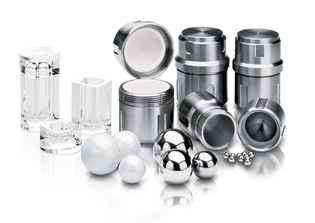
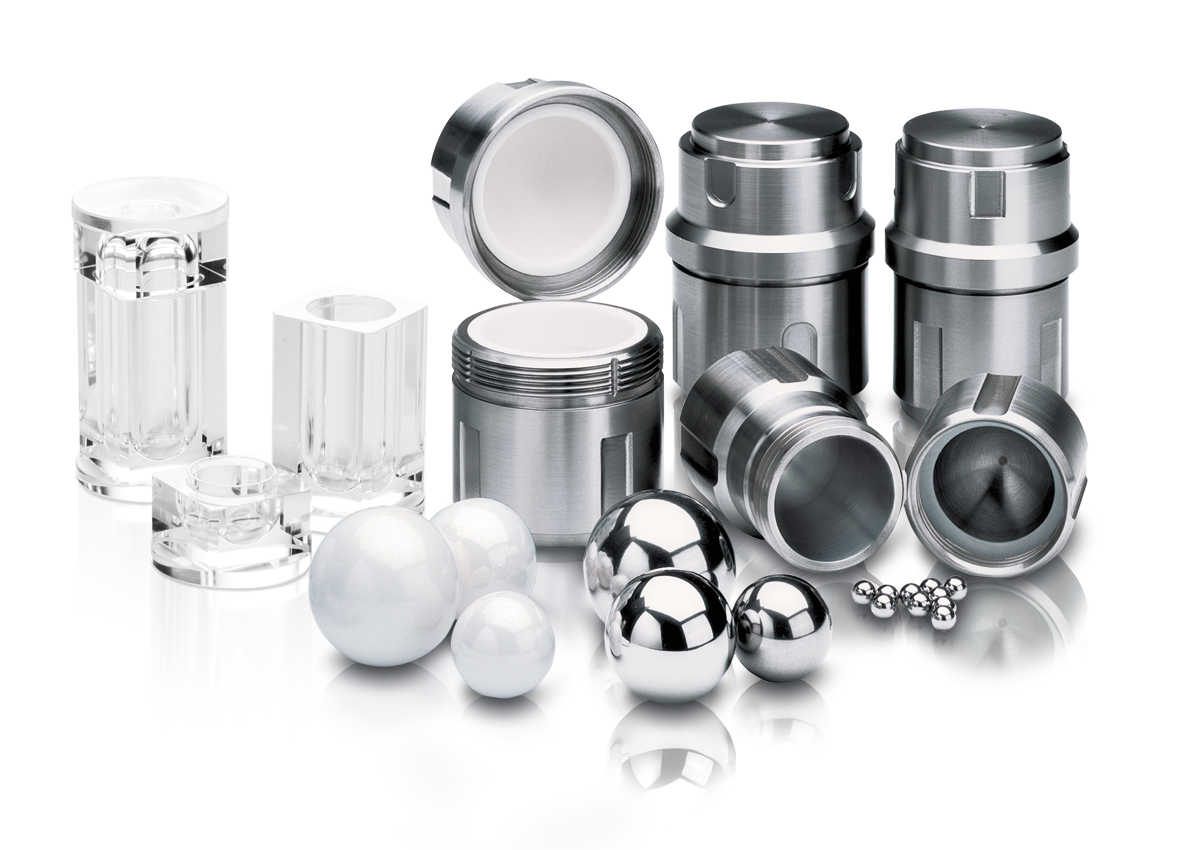
Maalkamers in 7 verschillende materialen
Het nominale volume van de verschroefbare maalkamers varieert van 1.5 ml tot 50 ml; beschikbare materialen zijn gehard staal, roestvrij staal, agaat, wolframcarbine, zirconiumoxide en PTFE, waarmee een contaminatie-vrije monstervoorbereiding gewaarborgd wordt.
Transparante PMMA maalbekers worden gebruikt voor in-situ RAMAN spectroscopie maar maken ook toepassingen mogelijk met foto-chemische reacties. Bovendien zijn deze bestand tegen talloze chemicaliën. De maalbekers kunnen gebruikt worden met de voorloper van de MM 400, evenals omgekeerd waarbij de oude maalkamers passen op dit nieuwste model kogeltrilmolen.
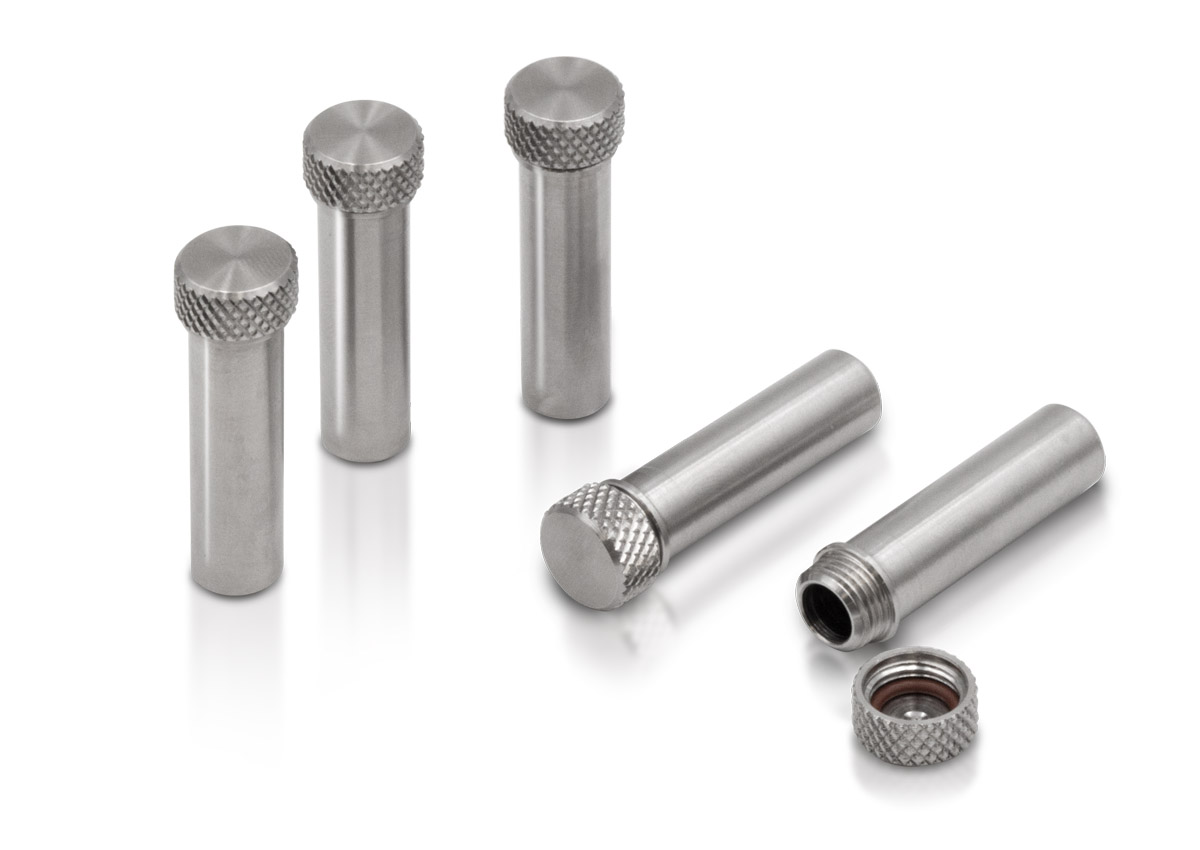
2 ml tubes for cryogenic grinding
Small 2 ml steel tubes are used for cryogenic applications. Up to 20 of these tubes can be clamped into the MM 400 using an adapter. The advantage: they can withstand low temperatures and mechanical stress and do not break like disposable vessels. Ideal for the smallest sample quantities in the cryogenic range.
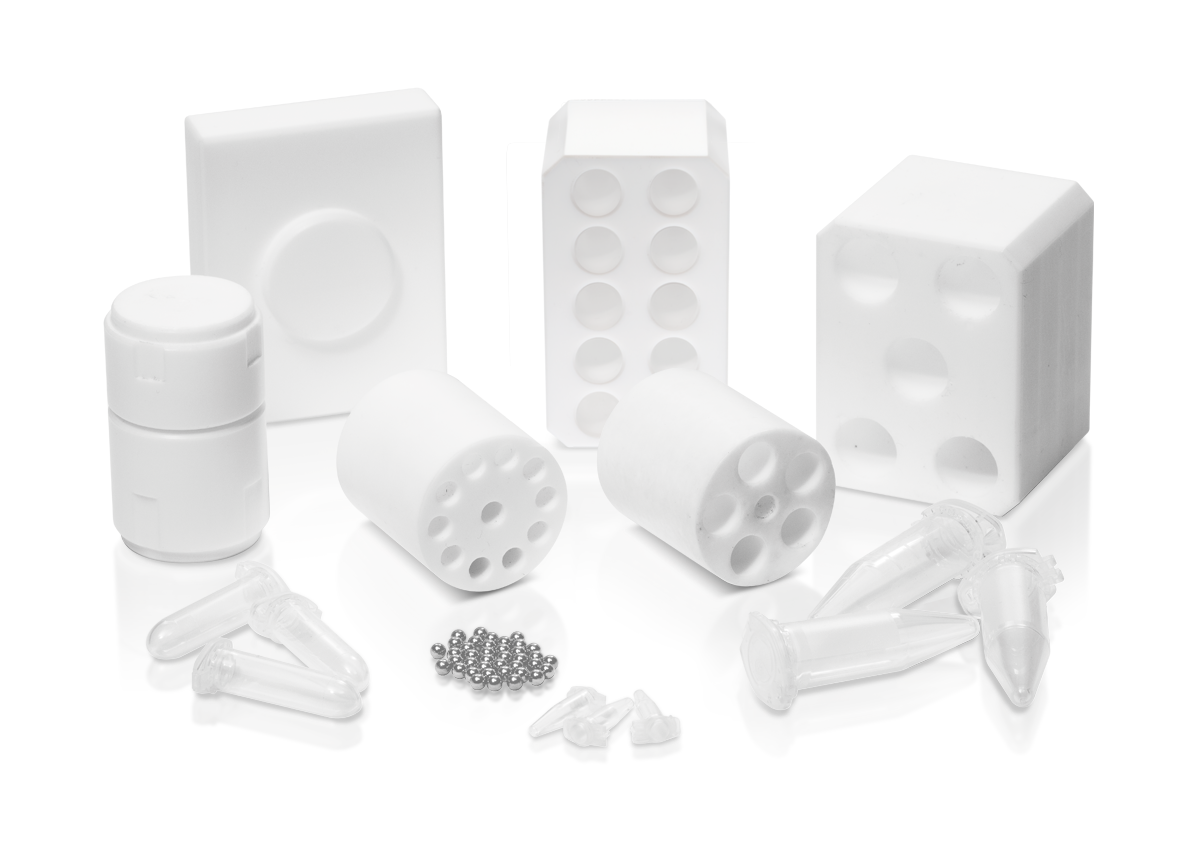
ADAPTERS VOOR WEGWERPCONTAINERS
Adapters voor 0.5 / 1.5 / 2 / 5 ml wegwerpcontainers kunnen in de MM 400 gebruikt worden. Voor grotere monstervolumes, bvb. voor proteïne-extractie, kunnen konische centrifugeerbuizen van 50 ml ofwel wijdmondsflessen van 30 ml gebruikt worden.
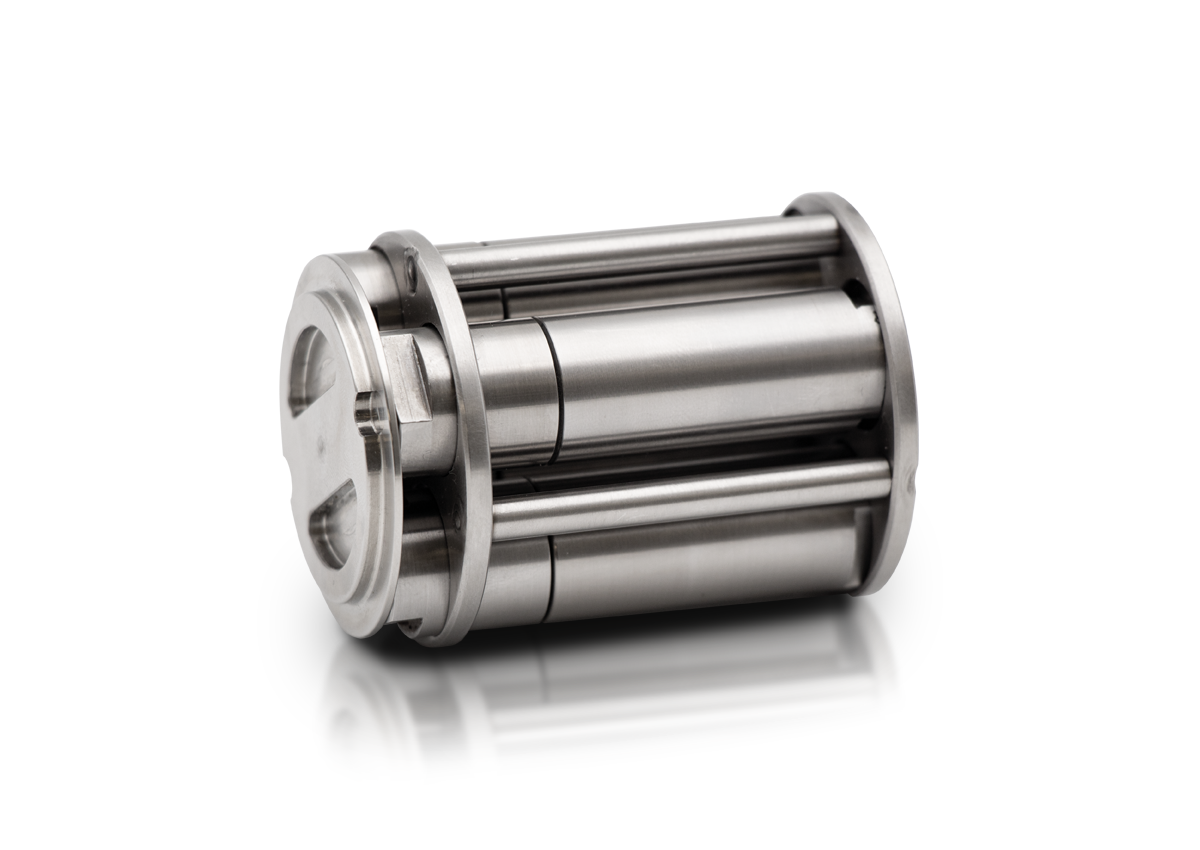
Adapters voor een groter aantal monsters
De MM 400 kan uitgerust worden met adapters voor gelijktijdige vermaling in vier maalkamers van 5 ml uit roestvrij staal, dus ober beide schudarmen gespreid een gelijktijdige vermaling van 8 monsters. Deze verhoogde capaciteit kan met name van voordeel zijn bij mechanochemische toepassingen.
Cuvetten, flessen en buizen beschikbaar voor MM 400
1.5 of 2 ml
Safe-lock
wegwerpbuisjes
2 x 10 buisjes max.
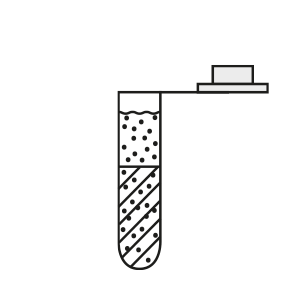
- Celdisruptie voor DNA/RNA eiwitten/metabolieten
- Cryogeen malen van zacht monster (weefsel, planten, cel pellets, insecten)
- Droog of natte homogenisatie van zachte monsters (weefsel, insecten)
5 ml
Safe-lock
wegwerpbuisjes
2 x 5 buisjes max.
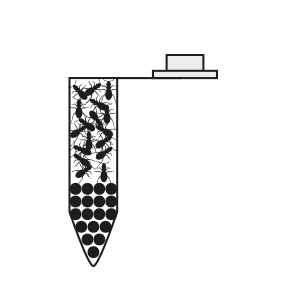
- Celdisruptie voor DNA/RNA eiwitten/metabolieten
- Cryogeen malen van zacht monster (weefsel, planten, cel pellets, insecten)
- Droog of natte homogenisatie van zachte monsters (weefsel, insecten)
30 ml
wegwerp
wijdmondsflessen
2 x 4 flessen max.
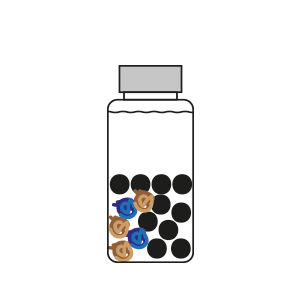
- Celdisruptie voor DNA/RNA eiwitten/metabolieten
- Droog of natte homogenisatie van zachte monsters (weefsel, insecten)
- Droog malen van harde monsters (kwartszand)
50 ml
wegwerp konische
centrifugebuizen
2 x 4 buizen max.
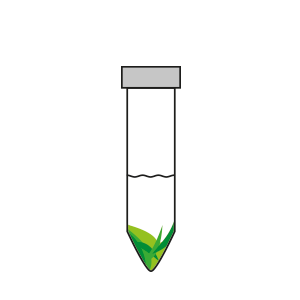
- Celdisruptie voor DNA/RNA eiwitten/metabolieten
- Droog of natte homogenisatie van zachte monsters (weefsel, insecten)
- Extractie van pesticiden uit voedsel/planten (QuEChERS)
- Mengen van poeder en wax om tabletten voor XRF te persen
Kogeltrilmolen MM 400 Aanbevolen maalbeker vullingen
Het maalkamervolume moet aangepast zijn aan de monstergrootte om optimale resultaten te bekomen. Idealiter zijn de maalkogels 3 keer groter dan de grootste te vermalen deeltjes. Het aantal en de aanbevolen afmetingen zijn terug te vinden in onderstaande tabel volgens deze vuistregel. Om bijvoorbeeld 20 ml monster met stukken tot 8 mm te vermalen, gebruikt men best een 50 ml maalkamer en 25 mm maalkogels. Volgens de tabel volstaat 1 maalkogel per maalbeker. bij 20 ml van een monster met deeltjes van 5 mm, neemt men best vier knikker van 15 mm per maalkamer.
| Maalbeker nominaal volume |
Monsterhoeveelheid | Max. invoergrootte | Ø 5 mm* | Ø 7 mm* | Ø 10 mm* | Ø 12 mm* | Ø 15 mm* | Ø 20 mm* | Ø 25 mm* |
|---|---|---|---|---|---|---|---|---|---|
| 1,5 ml | 0,2 – 0,5 ml | 1 mm | 1 – 2 | - | - | - | - | - | - |
| 5 ml | 0,5 – 2 ml | 2 mm | - | 1 – 2 | - | - | - | - | - |
| 10 ml | 2 – 4 ml | 4 mm | - | 5 – 7 | 1 – 2 | 1 – 2 | - | - | - |
| 25 ml | 4 – 10 ml | 6 mm | - | - | 5 – 6 | 2 – 4 | 1 – 2 | - | - |
| 35 ml | 6 – 15 ml | 6 mm | - | - | 6 – 9 | 4 – 6 | 2 – 3 | 1 | - |
| 50 ml | 8 - 20 ml | 8 mm | - | - | 12 – 14 | 6 – 8 | 3 – 4 | 1 | 1 |
*De tabel toont de aanbevolen maalkogel vulling (in aantallen) van kogels van verschillende grootte in verhouding tot het maalpotvolume, de monsterhoeveelheid en de maximale invoergrootte.
Kogeltrilmolen MM 400 Typische Monsters
RETSCH kogeltrilmolens zijn echte allrounders. Ze homogeniseren bijvoorbeeld: legeringen, diervoeder, botten, keramiek, chemische producten, steenkool, cokes, drugs, elektronisch schroot, glas, granen, haar, mineralen, oliehoudende zaden, ertsen, papier, plantaardig materiaal, plastic, rioolslib, aarde, stro, tabletten, textiel, weefsels, tabak, afvalmonsters, hout, wol, enz.
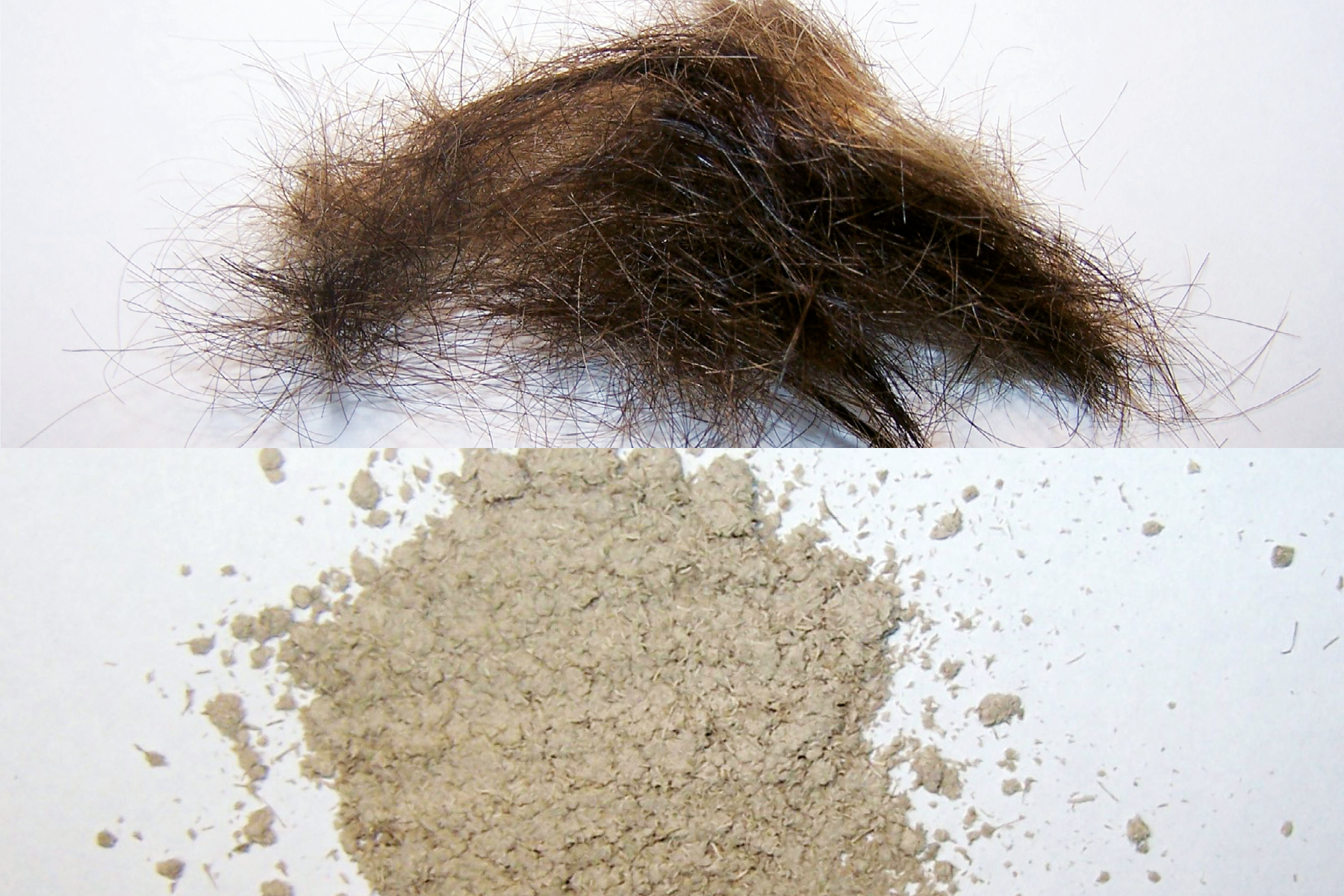
Vezelig: Haren
30 ml monster
50 ml roestvrij stalen maalbeker
1 x 25 mm roestvrij stalen maalkogel
2 min bij 30 Hz
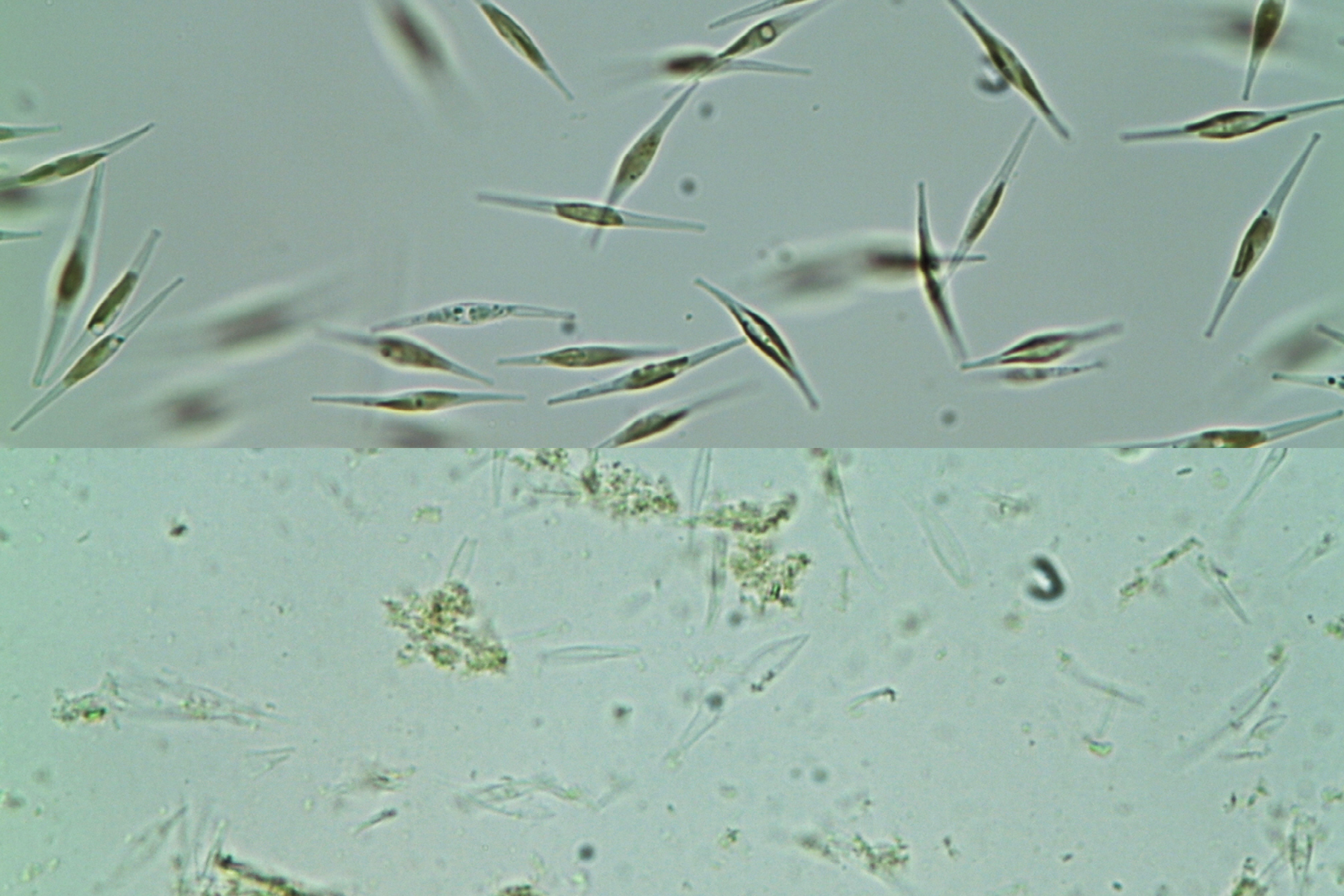
Cell disruptie: Microalgen
30 ml celsuspensie
8 x 50 ml conische centrifuge buizen (adapter)
met 25 ml glasparels elk; 0,5-0,75 mm
30 s bij 30 Hz
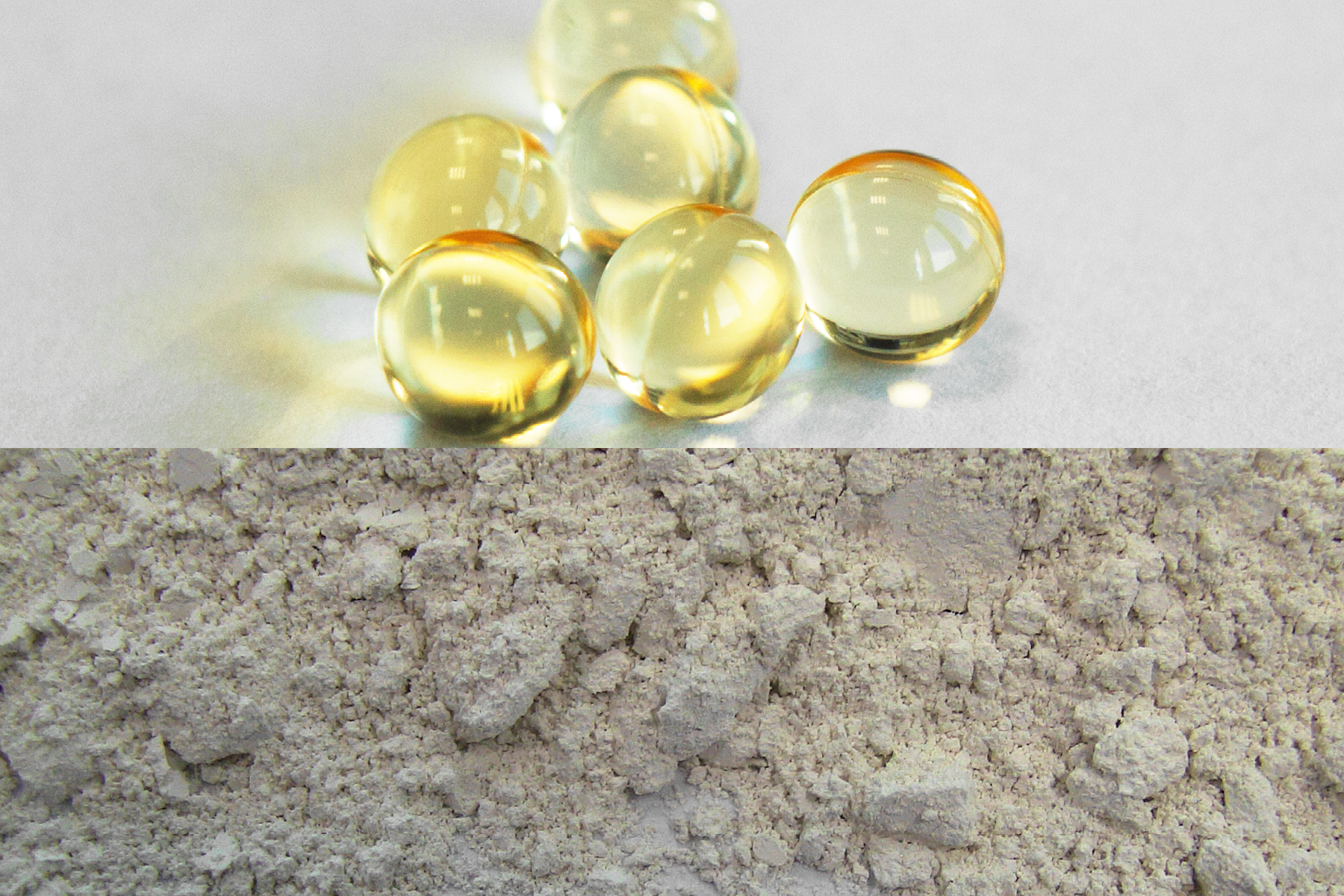
Elastisch-Vloeibaar:
Capsules met vloeistof
15 ml monster
50 ml roestvrij stalen maalbeker
1 x 25 mm roestvrij stalen maalkogel
verbrossing in LN2 (vloeibaar stikstof) gedurende 3 min
4 x 2 min bij 30 Hz met tussentijdse koeling
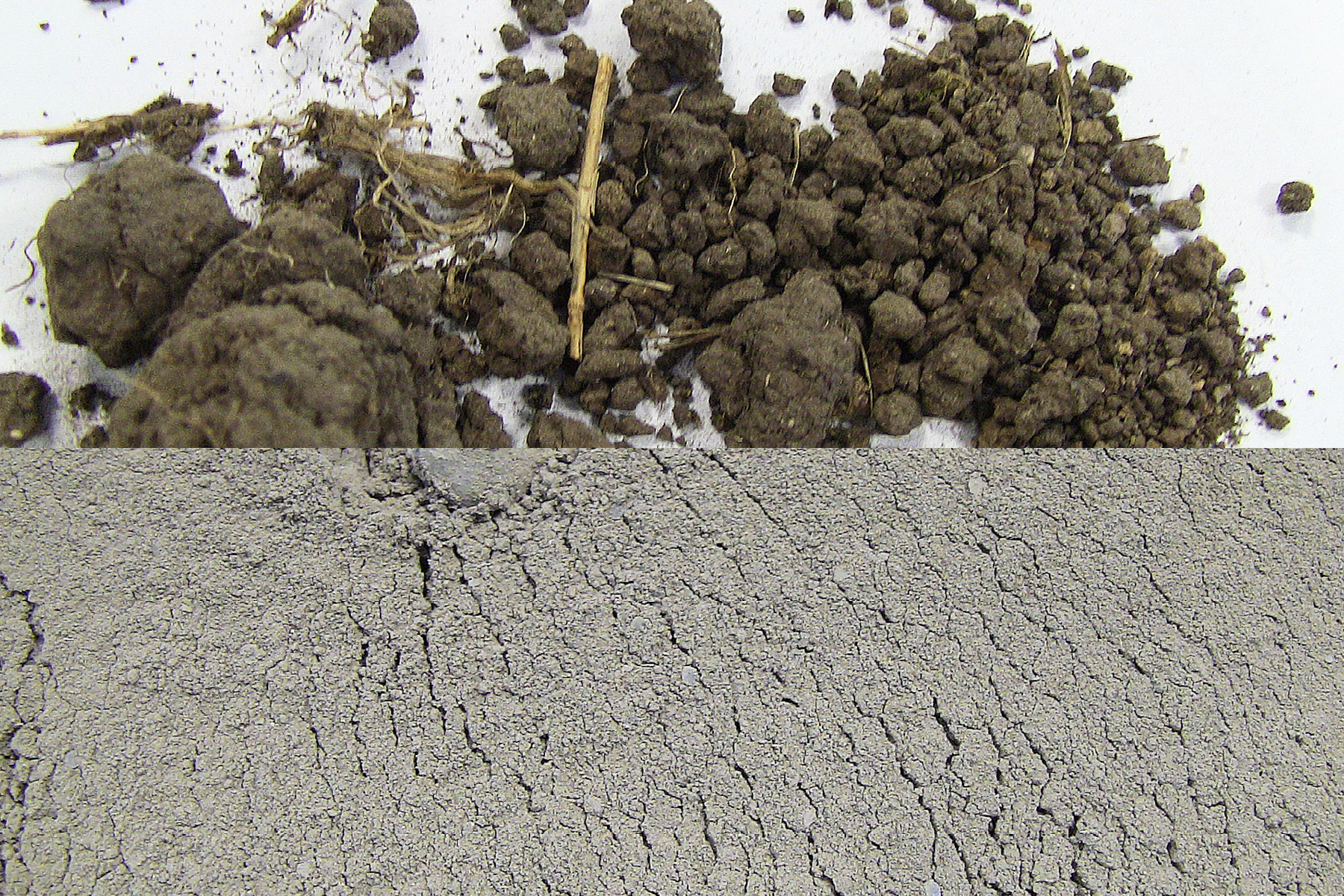
Medium-hard/ vezelig: bodems
20 ml monster
50 ml roestvrij stalen maalbeker
1 x 25 mm roestvrij stalen maalkogel
1 min bij 30 Hz
Parsley
20 ml monster
50 ml roestvrij stalen maalbeker
1 x 25 mm roestvrij stalen maalkogel
1 min bij 30 Hz
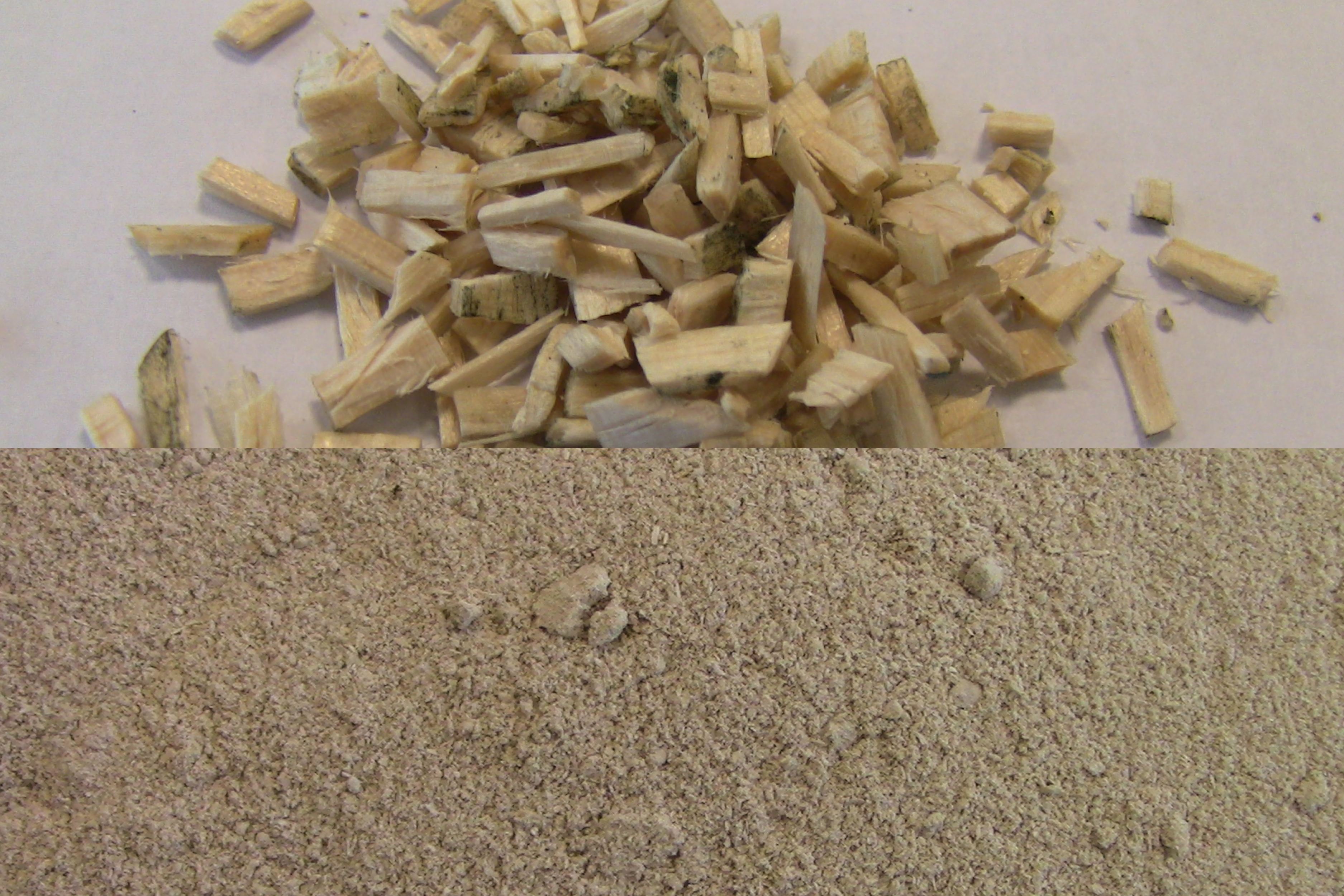
Taai-Vezelig: Hout
5 ml monster
10 ml zirconiumoxide maalbeker
2 x 12 mm zirconiumoxide maalkogels
3 min bij 30 Hz
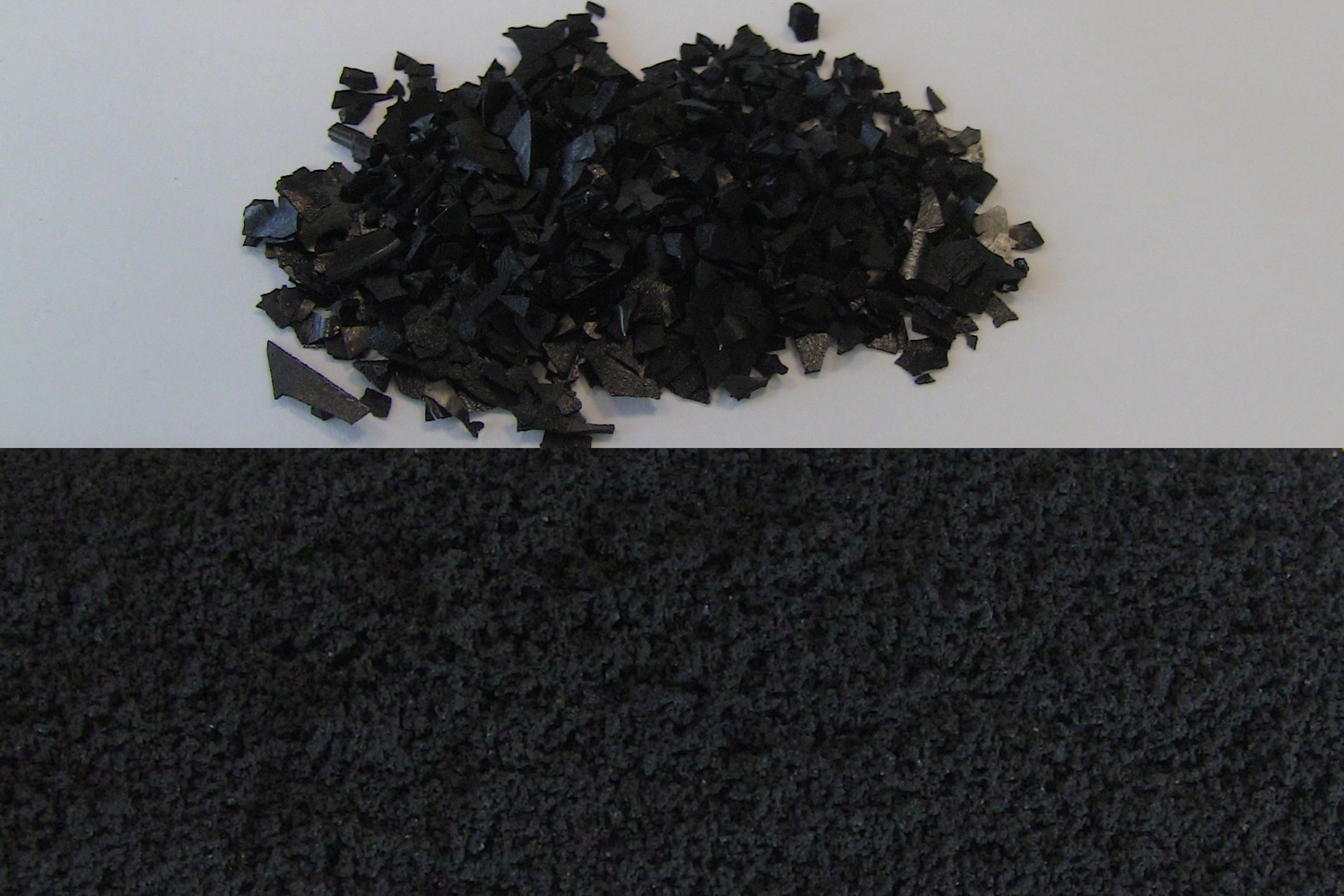
Elastic-taai:
Polyurethaan Pellets
20 ml monster
50 ml roestvrij stalen maalbeker
1 x 25 mm roestvrij stalen maalkogel
verbrossing in vloeibaar stikstof (LN2) gedurende 3 min
4 x 2 min bij 30 Hz met tussentijdse koeling
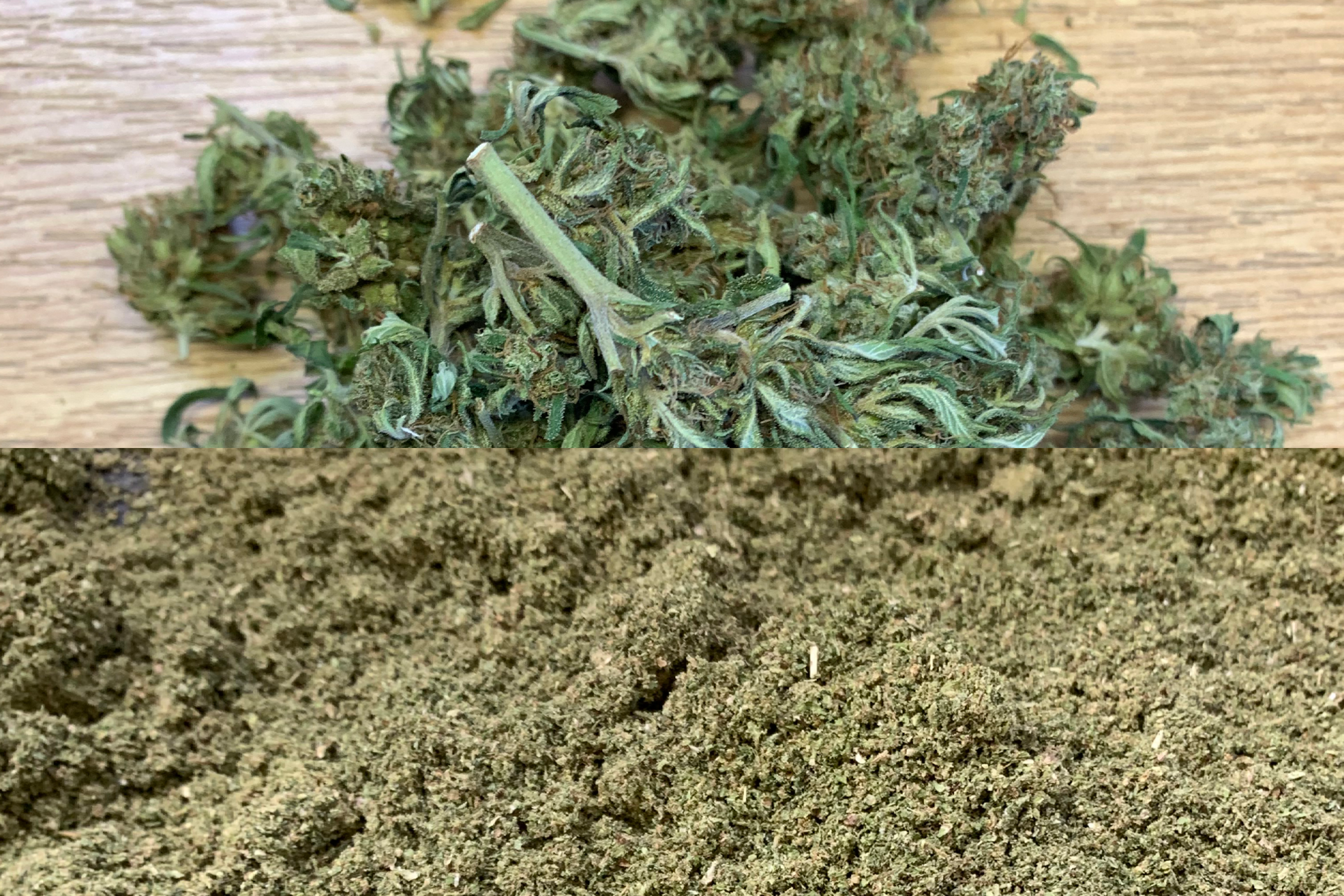
Vezelig: Cannabis
3 g monster
50 ml roestvrij stalen maalbeker
1 x 25 mm roestvrij stalen maalkogel
verbrossing met LN2 (vloeibaar stikstof) gedurende 2 min
90 s bij 30 Hz
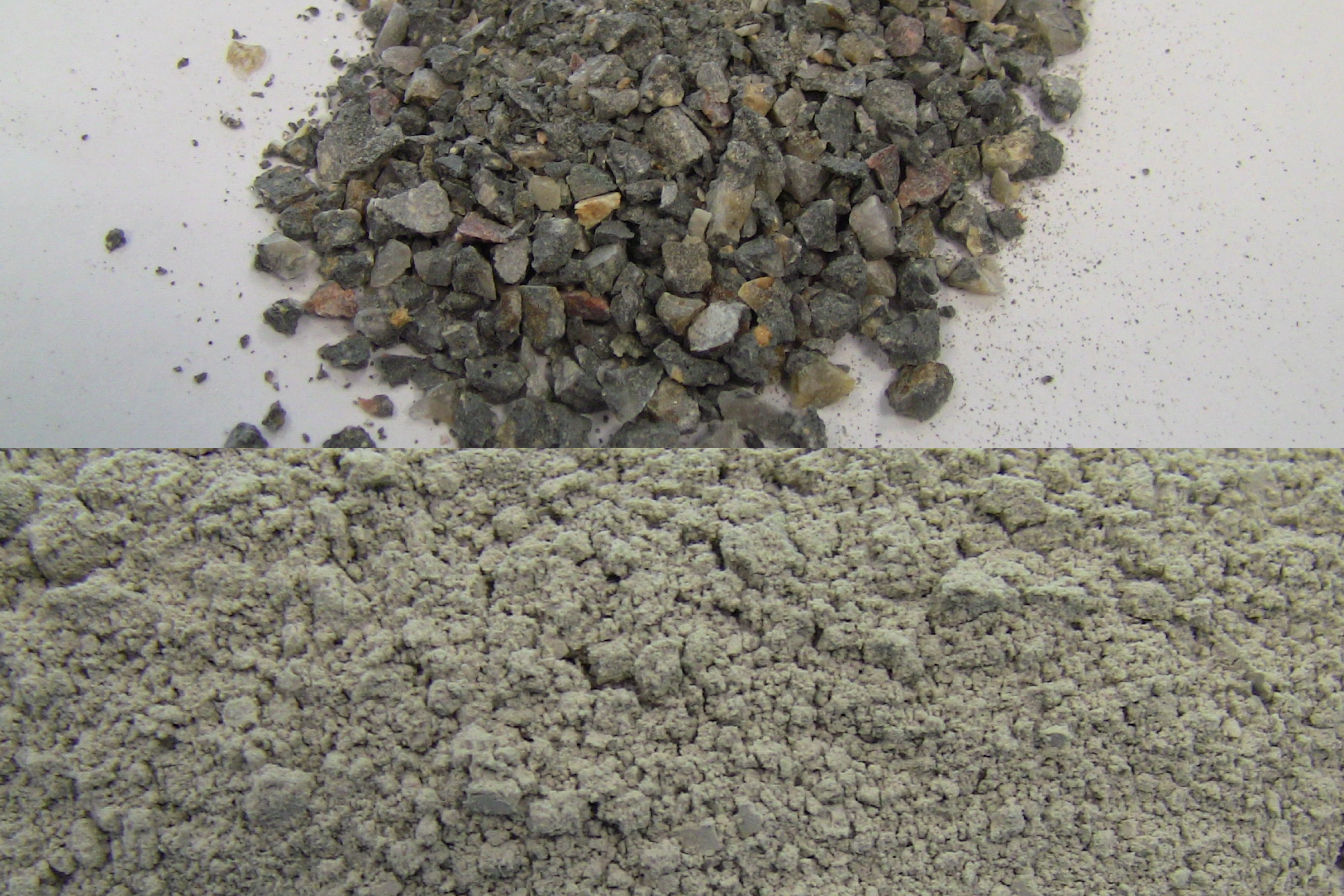
Hard-Breekbaar: Beton
10 ml monster
25 ml zirconiumoxide maalbeker
2 x 15 mm zirconiumoxide kogels
2 min bij 30 Hz
Bezoek onze toepassingsdatabase om de beste oplossing voor uw monstervoorbereiding of analyse te vinden.
Kogeltrilmolen MM 400 Principe
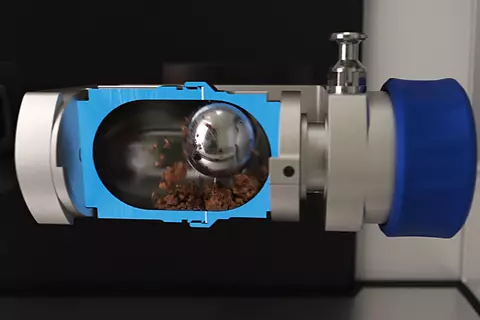
De maalbekers van de MM 400 voeren een radiale schudbeweging uit in horizontale positie. Door de intertie van de maalknikkers, ontstaat er een impact met zeer hoge energie op het monstermateriaal ter hoogte van de afgeronde uiteinden van de maalbeker, waardoor verpulvering optreedt. Daarnaast ontstaat er door de gelijktijdige beweging van de maalkogels en de maalbeker een intensief meng-effect.
De meng-graad kan nog versterkt worden door gebruik te maken van meerdere kleinere knikkers. Wanneer meerdere kleine kogels gebruikt worden (bvb. glasparels) dan kan men ook biologisch materiaal verwerken (celdisruptie). De hoge wrijvingseffecten tussen de knikkertjes vergroten de efficiëntie m het celmateriaal vrij te maken.
Kogeltrilmolen MM 400 Technische Gegevens
| Toepassingen | size reduction, mixing, homogenization, cell disruption, cryogenic grinding, mechanochemistry |
|---|---|
| Toepassingsdomein | landbouw, biologie, chemistrie / kunststoffen, bouwmaterialen, engineering / electronica, milieu / recycling, voeding, geologie / metallurgie, glas / keramiek, geneesmiddelen / farmaceutica |
| Toevoermateriaal | hard, middel-hard, zacht, breekbaar, elastisch, vezelig |
| Maalprincipe | impact, wrijving |
| Korrelgrootte materiaal* | = 8 mm |
| Eindfijnheid* | ~ 5 µm |
| Batchgrootte / Toevoerhoeveelheid* | max. 2 x 20 ml |
| Aantal maalstations | 2 |
| Vibrational frequency | 3 - 30 Hz (180 - 1800 min-1) |
| Typische gemiddelde maalduur | 30 s - 2 min |
| Max. grindig time | 99 uur |
| Droog malen | Ja |
| Nat malen | Ja |
| Cryogeen malen | Ja |
| Celdisruptie met reactiecups | ja, tot 20 x 2.0 ml |
| Autocentrerend klemsysteem | Ja |
| Maalbekertypes | met schroefdeksel |
| Materiaal van maalwerktuigen | hardened steel, stainless steel, tungsten carbide, agate, zirconium oxide, PTFE, PMMA |
| Maalbeker maten | 1,5 ml / 5 ml / 10 ml / 25 ml / 35 ml / 50 ml |
| Instelling maalduur | digitaal, 10 s - 8 h |
| Programma's (SOPs) | 12 |
| Gegevens electriciteit | 100-240 V, 50/60 Hz |
| Aansluiting electriciteit | mono fase |
| Vermogen | 165W |
| Beschermingsklasse | IP 30 |
| B x H x D gesloten | 385 x 350 x 470 mm |
| Netto gewicht | ~ 27,5 kg |
| Standaarden | CE |
Kogeltrilmolen MM 400 Downloads
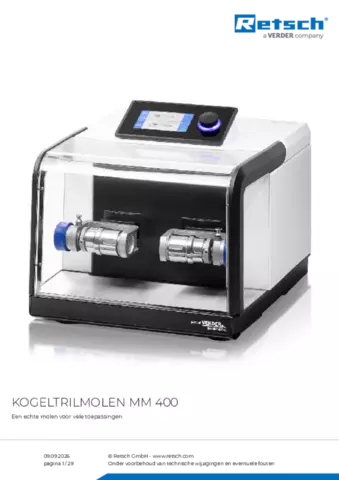
Productinformatieblad MM 400

Cannabis - Sample Preparation and Quality Control
RETSCH is putting to use its full product portfolio of grinders, sieve shakers and sample dividers to help process and prepare cannabis samples. The sample preparation process needs to be adjustable to the considerable complexity of the various matrices.
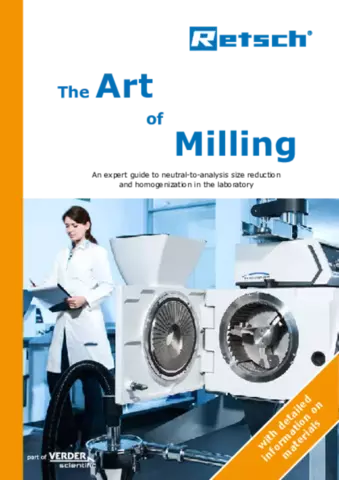
Expert Guide Milling
Why Size Reduction? A reliable and accurate analysis can only be guaranteed by reproducible sample preparation. The "Art of Milling" describes the process of turning a laboratory sample into a representative part sample with homogeneous analytical fineness.
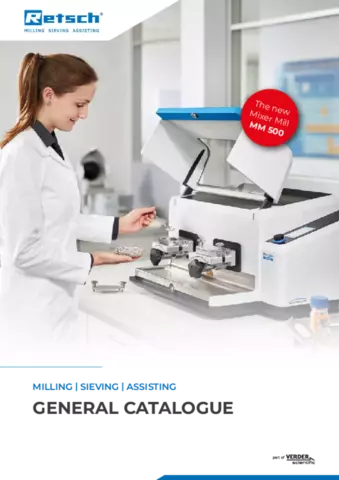
General Catalogue
Green Cement - Innovation in the Construction Industry
Green Cement represents a significant innovation in the construction industry, aimed at reducing environmental impact and promoting sustainable development. Traditional cement production is a major contributor to global CO emissions, accounting for approximately 7-8% of the total. With this material these emissions can be minimized by incorporating supplementary cementitious materials (SCMs) such as fly ash, slag and seashell by using alternative fuels and raw materials. Our solutions enable the production of a more sustainable product with high performance characteristics and exceptional physical properties.
Product Overview
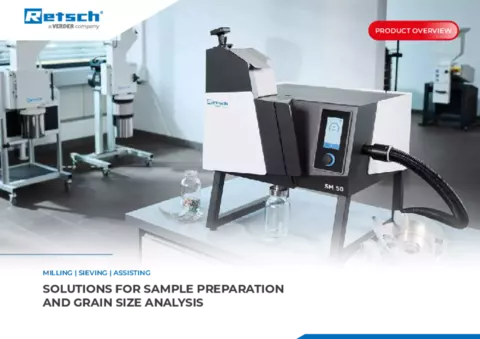
The right mill for every application.