





광물 자원
Construction materials
Typical recycled construction materials include concrete, cement, bricks and asphalt. After being crushed, concrete can be repurposed as aggregate for fresh concrete or as base material for roads. Similarly, asphalt from roads and roofing shingles can be processed into new asphalt.
The above materials are all hard and brittle, so that typically Jaw Crushers are used for initial size reduction. Retsch’s offering of crushers provides suitable models for feed sizes up to 350 mm. Benchtop units like the BB 50 are designed for lower sample throughput, whereas the largest model BB 600 processes up to 3.5 t/h. For crushing rather sticky material like asphalt, embrittling the sample with liquid nitrogen and using a crusher with front door for easy access to the grinding chamber is beneficial. Ideally, the pre-crushing step results in particle sizes around 3-5 mm, which can be reduced further by fine grinding. Here, ball mills are commonly used, covering a wide range from small sample volumes to about 200 g per batch and typically providing grind sizes down to 100 µm. For the sticky asphalt sample, cryogenic grinding is recommended to avoid caking effects.
A good alternative to ball mills are Vibratory Disc Mills such as the RS 200 or RS 300. These mills produce very fine particles in the shortest amount of time.


Insulation materials are usually not as hard and brittle as the above-mentioned sample materials. Here Cutting mills in combination with ball mills can be used to pre-cut and pulverize such samples. See section “Glass”.
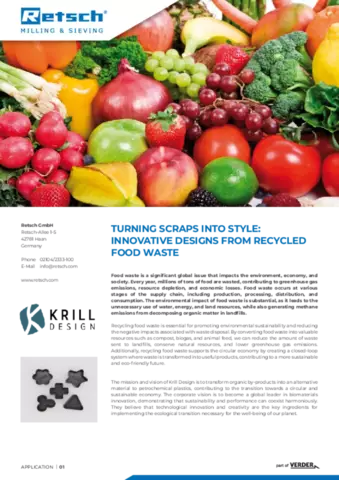
Innovative designs from recycled food waste
Food waste is a significant global issue that impacts the environment, economy, and society. Every year, millions of tons of food are wasted, contributing to greenhouse gas emissions, resource depletion, and economic losses. Food waste occurs at various stages of the supply chain, including production, processing, distribution, and consumption. The environmental impact of food waste is substantial, as it leads to the unnecessary use of water, energy, and land resources, while also generating methane emissions from decomposing organic matter in landfills.

무료 상담 문의하기
RETSCH offers a comprehensive portfolio of instruments for recycling processes - from quality control and sample preparation to innovative mechanochemical methods. Whether pre-grinding, sieving, pelletizing or the use of ball mills for sustainable recycling solutions: We have the right instruments for your requirements.
Our global network and experts are available to provide you with personalised advice. Contact us and work with our specialists to find the best solution for your application!
Glass
Glass is a hard and brittle material and is therefore ideally crushed in a jaw crusher or the Hammer Mill HM 200. The HM 200 may have the advantage that glass bottles must not be pre-crushed if they fit into the machine. In a jaw crusher, intact glass bottles may just roll between the two jaws. The HM 200 can crush, for example, 6 kg of sample in just 1.5 min to 2 mm particles. Subsequent pulverization is best carried out in a ball mill. For small sample quantities, Mixer Mills like the MM 400 are used. The Planetary Ball Mill PM 400 can be used to pulverize 4 samples of up to 220 ml each simultaneously. Usually, very fine particles below 30 µm are obtained in approximately 10 minutes.
To avoid contamination of the sample with metallic elements, grinding jars and accessories should be chosen carefully. Both MM 400 and PM 400 can be equipped with grinding jars made of agate, which is natural silicon dioxide, so that the material is not contaminated with other elements. For larger sample amounts up to 2 kg, the Drum Mill TM 300 is suitable. It also achieves very fine particles, but usually 1 to 3 h are required for such a large sample amount. A special case is recycling of insulation material like glass wool. Here, a Cutting Mill SM 300 should be used for primary grinding of the sample prior to a ball mill for pulverization.


Ceramics
Differentiating between various ceramic materials for reuse are pivotal in conserving natural resources and preventing environmental degradation. The recovery e.g. of valuable metals from spent catalysts, such as platinum and palladium, not only supports economic sustainability but also reduces the demand for mining activities. Ceramic bodies or misformed parts represent a unique opportunity for recycling and resource efficiency within the ceramics industry. These materials can be ground down and reused in the production of new ceramic items, significantly reducing waste and the need for virgin raw materials. Initial Crushing of ceramic material is easily done in Retsch Jaw Crushers. Depending on the feed size and the sample throughput, the most suitable model can be selected. Fine grinding is then performed in a Ball Mill for smaller sample volumes, like the MM 400. For larger sample quantities, the Disc Mill DM 200 or the vibratory disc mill RS 300 can be used. With this combination of pre-grinding and pulverisation, up to 3 kg samples can be crushed to about 100 µm particles in about 30 min. For harder samples, the Jaw Crusher, the Ball Mills and the RS 300 for example work with tungsten carbide accessories.


Mining waste
Mining waste is usually hard and brittle, therefore the best instrument to crush ore residues are Jaw Crushers. The BB 500 for example is capable to crush 8 kg gold ore to 5 mm particles in about 2.5 min. For fine grinding of mining samples, Vibratory Disc Mills are preferred. The RS 200 efficiently grinds up to 250 ml samples in only a few minutes, whereas the RS 300 is suitable to grind up to 2 l samples in one batch. Typical fineness of the ores is below 100 µm and suitable to prepare samples for XRF analysis.


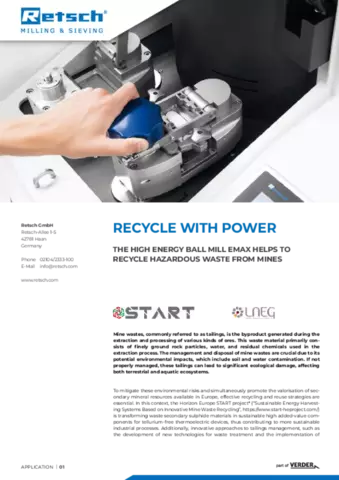
Recycling hazardous waste from mines
Mine wastes, commonly referred to as tailings, is the byproduct generated during the extraction and processing of various kinds of ores. This waste material primarily consists of finely ground rock particles, water, and residual chemicals used in the extraction process. The management and disposal of mine wastes are crucial due to its potential environmental impacts, which include soil and water contamination. If not properly managed, these tailings can lead to significant ecological damage, affecting both terrestrial and aquatic ecosystems.
Mining: Optimizing mineral analysis
Sample preparation in the mining sector is crucial for accurate mineral analysis. Despite technological advancements, the industry faces persistent challenges. Contamination during sample collection and preparation can skew results, leading to incorrect conclusions about ore quality. Achieving representative and homogeneous samples is difficult due to the heterogeneous nature of mineral deposits. Ensuring uniform mixing in fine grinding is vital for accurate analytical results, reducing sampling bias.
Soil remediation
Soil remediation refers to the process of cleaning, removing, or neutralizing contaminants from soil to restore it to a safe and usable condition. Common techniques are bioremediation (microorganisms or plants to break down or absorb contaminants), physical remediation (e.g. soil washing), chemical remediation (chemical reactions to neutralize contaminants) or thermal remediation (applies heat to remove contaminants). The soil samples need to be crushed and analysed regarding their harmful contaminant before and after the remediation process to check the success of the measures taken to clean the soil. Ball mills like the Planetary Ball Mill PM 400 or the Mixer Mill MM 400 can be used. 400 g wet soil sample for example is homogenized in the PM 400 within 10 min using 4 x 500 ml grinding jars. Small stones are no problem in this procedure. Small sample sizes up to 2 x 20 ml are better homogenized in the MM 400. If the sample contains no stones, the MM 400 together with the falcon tube adapter allowing to process 8 samples in one batch is a suitable way to crush 8 samples up to 50 g in just a few minutes to 150 µm particles. For larger sample quantities, the Rotor Beater Mill SR 300 is a suitable solution. Here, the 180° grinding insert should be used, if the sample contains stones. About 2 kg can be crushed to less than 1 mm particles in about 3-5 min. Another suitable mill for soil samples with high stone content is the Jaw Crusher BB 50, which is also able to crush soil samples to particles below 1 mm.


