






What is a rock crusher?
A rock crusher is a size reduction machine that breaks rock, ore, slag and construction material into smaller particles. The laboratory jaw crusher is one design of rock crusher and crushes coarse material by pressure. Rock crushers pre-crush large pieces, produce defined particle sizes and prepare representative samples for analysis or further processing.
The terms rock crusher and jaw crusher are not synonyms. Rock crusher is the umbrella term for machines that crush rock, and jaw crusher names the design with a fixed jaw and a moving jaw. Industrial plants also use cone, gyratory, impact and roll crushers. Retsch offers laboratory jaw crushers for pre-crushing and disc mills for the finer size reduction that follows. The sections below cover the Retsch BB 250 and Retsch BB 500 jaw crushers and the Retsch RS 200 vibratory disc mill.
In a laboratory, the rock crusher sets the starting point for reproducible analysis results. Analysis methods such as spectral analysis require a homogeneous sample of small particle size, and large particles often cannot reach analytical fineness in a single grinding step. A rock crusher with a set gap width therefore reduces rock, ore or construction material to a defined particle size before the sample enters a mill.
A rock crusher performs three functions:
- Pre-crushing of large pieces of rock, ore or construction material.
- Production of defined particle sizes through the set gap width of the jaw crusher.
- Preparation of samples for analysis or further processing.
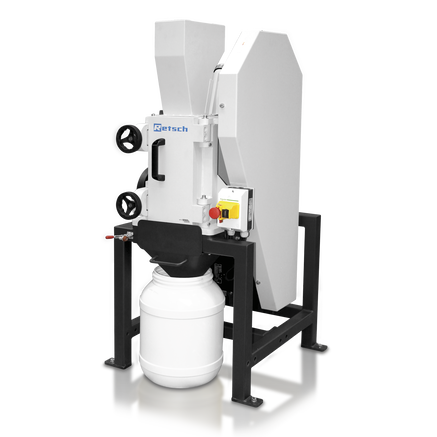
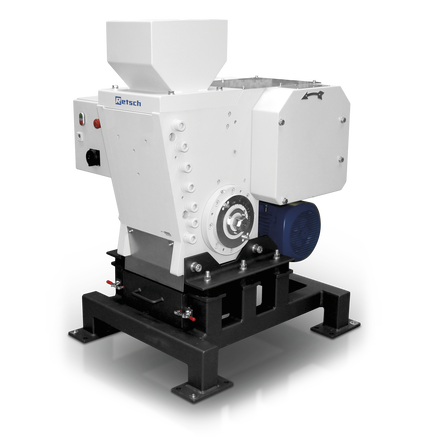
Which Retsch machine fits which feed size and final fineness?
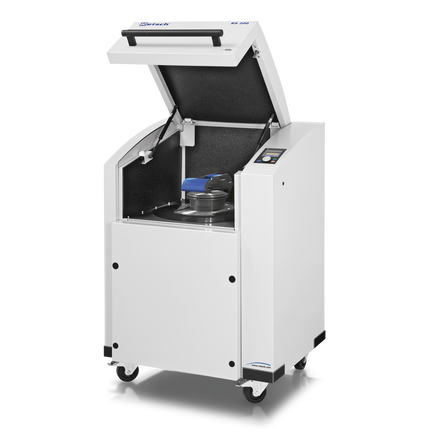
The Retsch BB 250 and the Retsch BB 500 are jaw crushers for pre-crushing, and the Retsch RS 200 is a disc mill for fine grinding. The feed limits are below 120 x 90 mm (Retsch BB 250), below 110 mm (Retsch BB 500) and below 15 mm (Retsch Vibratory Disc Mill RS 200). The required final fineness decides which machine fits.
| Product | Type | Max. feed size | Final fineness | Throughput or feed quantity |
|---|---|---|---|---|
| Retsch BB 250 | Jaw crusher | < 120 x 90 mm | < 2 mm | 300 kg/h |
| Retsch BB 500 | Jaw crusher | < 110 mm | 90% < 0.5 mm | 500 kg/h |
| Retsch RS 200 | Disc mill | < 15 mm | < 20 µm | 15 ml to 250 ml, depending on grinding set |
Feed size, final fineness and throughput of the Retsch BB 250, Retsch BB 500 and Retsch RS 200. Final fineness and throughput depend on the gap width and the breaking properties of the sample material.
Retsch lists a crushing ratio of 45 for the BB 250 and 220 for the BB 500. The final fineness of the BB 250 (below 2 mm) and of the BB 500 (90% below 0.5 mm) lies below the maximum feed size of the RS 200 (below 15 mm), so the crushed sample of either jaw crusher can be ground further in the RS 200. A sample with a feed size above the maximum of the BB 250 or the BB 500 requires a separate pre-crushing step.
Which feed size and throughput does the Retsch BB 250 handle?
The BB 250 jaw crusher accepts feed pieces smaller than 120 x 90 mm and crushes the pieces to a final fineness below 2 mm at a throughput of 300 kg/h. The gap width is adjustable steplessly from 0 mm to 30 mm, and the final fineness of 2 mm corresponds to a crushing ratio of 45.
The BB 250 operates in batch mode for sample amounts up to 10 l and continuously for larger volumes. The crushed sample falls into a removable collector with a capacity of 10 l. A front door gives direct access to the crushing chamber for cleaning between samples, and a connection for dust extraction is available. Retsch positions the Retsch BB 250 for sample preparation in laboratories and small-scale production.
| Parameter | Retsch BB 250 jaw crusher |
|---|---|
| Max. feed size | < 120 x 90 mm |
| Final fineness | < 2 mm |
| Gap width | 0 mm to 30 mm, stepless |
| Throughput | 300 kg/h |
| Crushing ratio | 45 |
| Drive power | 3.0 kW |
| Collector capacity | 10 l |
| Net weight | приблизително 350 кг |
Which feed size and final fineness does the Retsch BB 500 reach?
The BB 500 jaw crusher accepts feed pieces smaller than 110 mm and reduces 90% of the material to below 0.5 mm in one working step at a throughput of 500 kg/h. The gap width is adjustable steplessly from 0 mm to 11 mm, and the final fineness of 0.5 mm corresponds to a crushing ratio of 220.
In the Retsch BB 500, the moving jaw oscillates at high frequency and two flywheels deliver the impact forces. The motion keeps the gap width constant during the stroke cycle, so that the sample is crushed to the set fineness in one working step. The jaw width is 250 x 130 mm, the drive is a three-phase motor with 7.5 kW, the collector holds 15 l and the net weight is approx. 1,000 kg. The final fineness depends on the sample material. In a test from the Retsch brochure on ceramic production, 20 kg of Al₂O₃ with a feed size of 50 mm reached a final fineness below 0.7 mm in 5 min at a gap width of 2 mm.
| Parameter | Retsch BB 500 jaw crusher |
|---|---|
| Max. feed size | < 110 mm |
| Final fineness | 90% < 0.5 mm |
| Gap width | 0 mm to 11 mm, stepless |
| Throughput | 500 kg/h |
| Crushing ratio | 220 |
| Jaw width | 250 x 130 mm |
| Drive power | 7.5 kW, three-phase |
| Collector capacity | 15 l |
| Dimensions closed (W x H x D) | 930 x 1,400 x 1,080 mm |
| Net weight | приблизително 1000 кг |
How does a rock crusher work?
A jaw crusher crushes rocks by pressure. The feed material enters the wedge-shaped gap between a fixed jaw and a jaw moved by an eccentric drive shaft, and the elliptical motion breaks the pieces. The crushed sample falls under gravity into a collector as soon as the particles are smaller than the set gap width.
The gap width at the lower end of the crushing chamber sets the maximum particle size of the crushed sample. The gap width is adjustable steplessly from 0 mm to 30 mm in the BB 250 and from 0 mm to 11 mm in the BB 500. Throughput and final fineness depend on the crusher type, the selected gap width and the breaking properties of the sample material, and the crushing performance of a jaw crusher depends on the jaw slope, the gap width and the speed.
| Size reduction principle | Machine | Stage in sample preparation |
|---|---|---|
| Pressure | Jaw crusher, for example the Retsch BB 250 or the Retsch BB 500 | Pre-crushing of coarse material |
| Impact and friction | Mills for fine size reduction, for example the Retsch RS 200 | Fine size reduction after pre-crushing |
Which mill follows a rock crusher for finer size reduction?
A disc mill follows the rock crusher when crushed pieces must be ground to powder fineness. The RS 200 disc mill grinds feed below 15 mm to a final fineness below 20 µm. The final fineness of the Retsch BB 250 and the BB 500 lies below that feed limit.
A disc mill is a mill, not a crusher, and grinds pieces that a jaw crusher has already reduced. The jaw crusher sets the feed size for the disc mill, and the disc mill sets the final fineness for analysis.
| Stage | Machine | Max. feed size | Final fineness |
|---|---|---|---|
| Stage 1: pre-crushing | Retsch BB 250 jaw crusher | < 120 x 90 mm | < 2 mm |
| Stage 1: pre-crushing | Retsch BB 500 jaw crusher | < 110 mm | 90% < 0.5 mm |
| Stage 2: fine grinding | Retsch RS 200 vibratory disc mill | < 15 mm | < 20 µm |
Which fineness does the Retsch RS 200 reach?
The Retsch RS 200 vibratory disc mill grinds medium-hard, hard, brittle and fibrous samples with a feed size below 15 mm to a final fineness below 20 µm. The feed quantity is 15 ml to 250 ml depending on the size of the grinding set, and the speed is 700 min⁻¹ to 1,500 min⁻¹ at 50 Hz.
The RS 200 prepares samples for spectral analysis, with typical grinding times of 60 s to 180 s. In a Retsch test, 200 ml of cement clinker with particles up to 12 mm reached a final fineness of 85 µm after 60 s at 1,500 min⁻¹ in a 250 ml grinding set. The RS 200 is the fine-grinding stage after the BB 250 or the BB 500.
| Parameter | Retsch RS 200 vibratory disc mill |
|---|---|
| Feed material | Medium-hard, hard, brittle, fibrous |
| Max. feed size | < 15 mm |
| Final fineness | < 20 µm |
| Feed quantity | 15 ml to 250 ml, depending on grinding set |
| Speed at 50 Hz | 700 min⁻¹ to 1,500 min⁻¹ |
How is the right rock crusher selected?
The right rock crusher is selected by four criteria: the hardness of the material, the feed size, the required final fineness and the throughput. Hard, brittle samples call for a jaw crusher. A second size reduction stage in a disc mill is required when the final fineness must be finer than the jaw crusher produces.
| Criterion | What to determine | Value to compare |
|---|---|---|
| Material hardness | Hardness of the sample compared with the breaking jaws | Breaking jaw material, see the section on wear |
| Feed size | Largest piece of the sample | Max. feed size in mm: < 120 x 90 mm (BB 250), < 110 mm (BB 500) |
| Final fineness | Particle size required for the next step | Gap width in mm and final fineness: < 2 mm (BB 250), 90% < 0.5 mm (BB 500), < 20 µm (RS 200) |
| Throughput | Sample amount per hour or per batch | 300 kg/h (Retsch BB 250), 500 kg/h (Retsch BB 500), 15 ml to 250 ml (Retsch RS 200) |
| Number of stages | One stage or crushing followed by grinding | Retsch BB 250 or Retsch BB 500 followed by the Retsch RS 200 |
Why is a rock crusher used?
A rock crusher is used because analysis methods and downstream processes need smaller, more uniform particles than rock, ore or construction material provide. A rock crusher with a set gap width produces a defined particle size, which makes sample preparation reproducible and prepares the sample for fine grinding.
| Reason | What the rock crusher provides |
|---|---|
| Sample preparation | A defined particle size for the following grinding step and for analysis |
| Raw material processing | Smaller pieces of ore or rock for separation processes and further processing |
| Recycling | Reprocessing of construction waste and mining residues for material recovery and reuse |
Where is a rock crusher used?
Rock crushers are used in mining, the construction industry, recycling and laboratories. Mining crushes ores before separation processes, the construction industry produces aggregates for concrete and asphalt, recycling reprocesses construction waste into smaller fractions, and laboratories prepare samples for material analysis.
| Field | Task of the rock crusher |
|---|---|
| Mining | Crushing of ores; preparation for separation processes |
| Construction industry | Production of aggregates; concrete and asphalt production |
| Recycling | Reprocessing of construction waste; reduction of waste materials |
| Laboratories | Sample preparation; material analysis |
Retsch describes multi-stage crushing and grinding of rock, ore and drill core for XRF, XRD and fire assay on the Geology and Mining page, and the size reduction of construction waste and mining residues on the Recycling and Waste Management page.
Which sample materials does the Retsch BB 500 crush?
The Retsch BB 500 jaw crusher is used for preliminary crushing of construction materials, ores, granite, oxide ceramics, quartz, slag, silicon, coal, tungsten alloys and cement clinker. Figure 1 shows ferrochrome, silicon, quartzite and calcium silicate before and after crushing.

Figure 1: Typical sample materials of the Retsch BB 500 before (top) and after (bottom) crushing. From left to right: ferrochrome, silicon, quartzite, calcium silicate.
When should a rock crusher be used, and when is a rock crusher not suited?
A rock crusher is used when hard, brittle material must be crushed in a controlled and reproducible way before grinding or analysis. A rock crusher is not suited to tough, elastic or fibrous samples, which require cutting instead of pressure, or to a final fineness in the µm range in one step, which requires a disc mill.
| A rock crusher suits | A rock crusher does not suit |
|---|---|
| Hard and brittle material such as ore, granite, quartz, slag and cement clinker | Tough, elastic or heterogeneous samples, which require cutting instead of pressure |
| Pre-crushing before fine grinding in a disc mill | A final fineness in the µm range in one step; the Retsch RS 200 vibratory disc mill reaches below 20 µm |
| Sample amounts up to 10 l in batch mode and larger volumes in continuous operation (Retsch BB 250) | Samples above the maximum feed size of the machine, such as pieces above 120 x 90 mm in the Retsch BB 250 or above 110 mm in the Retsch BB 500 |
| Metal-sensitive analysis when breaking jaws of tungsten carbide or of steel for heavy-metal-free crushing are selected | Trace-element analysis with unsuitable breaking jaws, because abrasion adds contamination to the sample |
How does wear of the breaking jaws affect the sample?
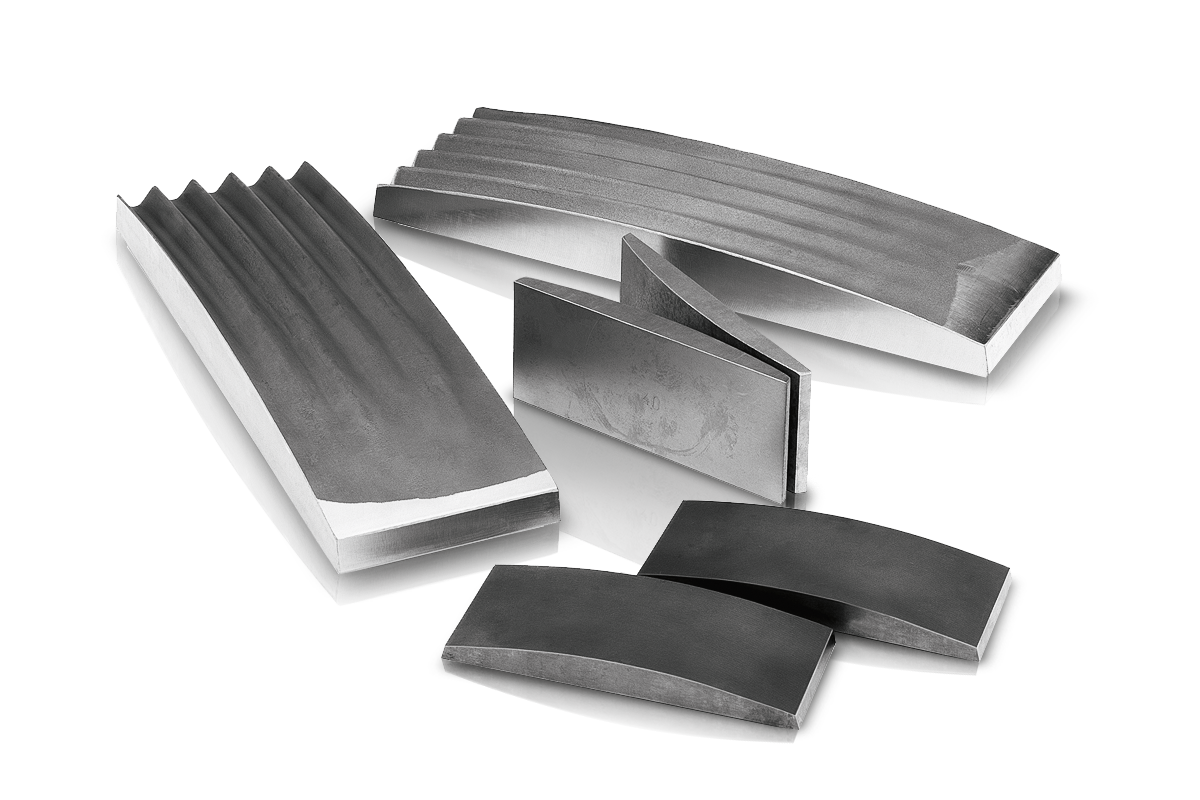
Mechanical size reduction wears the breaking jaws, and the abrasion can add contamination to the sample. Retsch states that abrasion is generally in the ppm to ppb range. The breaking jaws must always be harder than the sample material, and Retsch offers breaking jaws and wearing plates in several materials to match sample and analysis.
Breaking jaw and wearing plate materials in the Retsch range include manganese steel, stainless steel, tungsten carbide, steel for heavy-metal-free crushing, stainless steel 316L and NiHard4. Wear increases with the hardness of the sample material, so the jaw material is selected together with the sample material and the element to be analyzed.
Which best practices apply when operating a rock crusher?
Five practices apply to a rock crusher: select the breaking jaw material and gap width for the sample, feed the material at a constant rate, clean the crushing chamber between samples, add a second size reduction stage when a fine final fineness is required, and maintain the rock crusher according to the operating instructions.
- Select the rock crusher and the breaking jaw material for the sample by hardness, feed size and final fineness, as in the selection table above.
- Feed only pieces below the maximum feed size of the model, at a constant rate.
- Clean the crushing chamber and the collector between samples. The front door of the Retsch BB 250 gives direct access to the crushing chamber.
- Use multi-stage size reduction when the final fineness required is finer than the jaw crusher produces, for example the Retsch BB 250 or the Retsch BB 500 followed by the Retsch RS 200.
- Maintain the rock crusher according to the operating instructions of the model.
Which standards apply to crushing in sample preparation?
Standards for sample preparation describe crushing as a defined step in a procedure, not a specific crusher model. ISO 3082 covers iron ores, ISO 13909-4 and ASTM D2013/D2013M cover coal, ASTM C702/C702M covers aggregate and ISO 11464 covers soil, including the steps drying, crushing, sieving, dividing and milling.
| Standard | Scope | Material |
|---|---|---|
| ISO 3082 | Iron ores: sampling and sample preparation procedures | Iron ore |
| ISO 13909-4 | Hard coal and coke, mechanical sampling, Part 4: preparation of test samples of coal | Coal |
| ASTM D2013/D2013M | Standard practice for preparing coal samples for analysis | Coal |
| ASTM C702/C702M | Standard practice for reducing samples of aggregate to testing size | Aggregate |
| ISO 11464 | Soil quality: pretreatment of samples for physico-chemical analysis (drying, crushing, sieving, dividing, milling) | Soil |
How can I find the right Retsch rock crusher for my sample?
The right Retsch rock crusher is found by comparing the feed size, final fineness and throughput of the sample with the values of the BB 250 and BB 500 in the table above. The Retsch Application Database lists tested methods by sample material and target fineness, and the Retsch Application Laboratory grinds samples as a trial.
The Retsch Application Database is searchable by sample material and target fineness and draws on more than 25,000 test grindings and particle analyses. In the Retsch Application Laboratory, Retsch application specialists carry out free sample grinding and sieving trials and issue a written report with an instrument recommendation.