






Discover RETSCH Laboratory Pulverizers for material analysis, quality control and research. Specifically designed to support scientists and researchers, RETSCH mills achieve precise and reproducible particle size reduction with high accuracy. These mills are designed to pulverize sample materials on a laboratory scale in preparation for analysis.
Introduction to RETSCH Laboratory Pulverizer Mills
The RETSCH range of pulverizer mills is designed for a wide variety of applications, from pre-crushing of particles several centimeters in size to fine grinding down to the nanometer range.
These pulverizers are capable of pulverizing any laboratory sample into a representative fraction with the required homogeneous analytical fineness, a fundamental aspect for reliable and accurate laboratory analysis.
Known for their compact and state-of-the-art design, RETSCH Laboratory Pulverizers are indispensable tools for pulverizing various materials for analysis, quality control or research projects. These pulverizers are used in fields such as pharmaceutics, food analysis, materials testing and environmental analysis, providing the required precision.
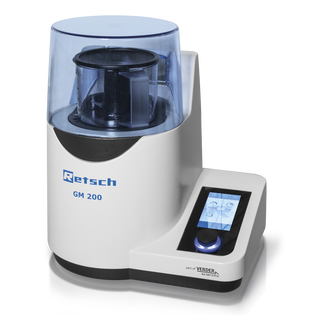

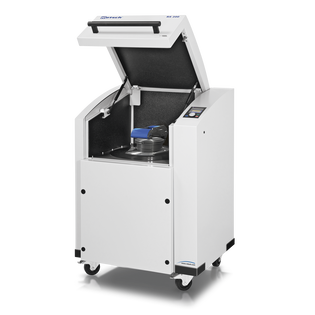
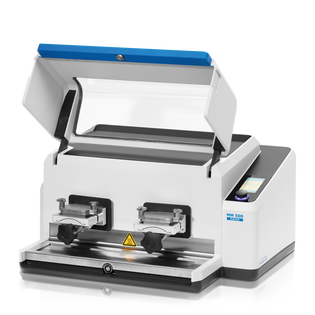
Uygulamalar
RETSCH laboratory pulverizer mills are crucial for quality management, R&D processes and pilot production, serving as essential tools for material analysis and development across various industries.
- Pharmaceutics: e.g. for formulation development.
- Material Science: e.g. to study properties of pulverized materials.
- Food Science: e.g. to investigate the properties of food materials for quality control and product development.
- Environmental: e.g. to prepare samples for testing pollutants, toxins, and other hazardous substances.
- Construction: e.g. to verify the quality of products.
How RETSCH Pulverizers Work
RETSCH laboratory pulverizer mills utilize various mechanisms, including pressure, friction, and impact, to reduce material size. Materials introduced into the grinding chamber are subjected to a series of crushing forces. Blades, hammers, or rings and a series of screens ensure the desired fineness.
Key Features of RETSCH Pulverizers
- Precision Control: Adjustable settings for precise control over particle size, ensuring repeatability and accuracy of results.
- Versatility: Processing a wide range of materials, from pharmaceutical compounds to geological samples.
- Compact Design: saving valuable laboratory space while offering powerful capabilities, many models are designed for benchtop use.
- Ease of Use: Engineered for simple operation, easy component changes and easy cleaning to enhance productivity.
- Safety: Incorporating various safety features for both operator and sample integrity.
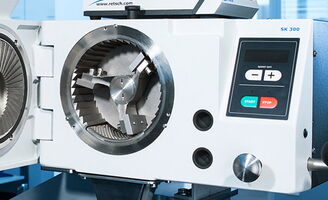
Exploring RETSCH's Extensive Portfolio of Machines
Our comprehensive range of the most modern pulverizer mills is suitable for initial, fine and ultra-fine size reduction of almost any material. The wide selection of pulverizing tools and accessories not only ensures contamination-free preparation but also adaptation to the specific requirements of such different areas of application as construction materials, metallurgy, foodstuff, pharmaceuticals or environment.
When trying to achieve analytical fineness in powder production, the initial particle size of the sample often dictates the pulverizing machine. However, sometimes more than one machine is needed. This is because materials with a large initial particle size require a two-step pulverization process: pre-crushing and fine grinding. The combination of both pre-crushing and fine grinding machines allows for efficient and effective pulverizing of materials regardless of their initial particle size, ensuring the production of high-quality powders suitable for various analytical and industrial applications.
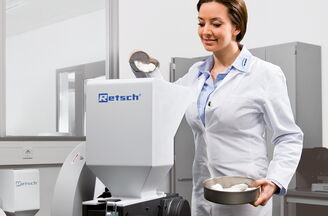
Pulverizers for Pre-crushing
Pre-crushing is the crucial first pulverizing step for materials with large initial particle sizes. At this stage the particles are reduced to a size that can be efficiently handled by a fine grinding pulverizer. Pre-crushing ensures that the material can be further comminuted in the subsequent fine grinding stage without causing inefficiencies or potential damage to the equipment. Typical pulverizers for pre-crushing are jaw crushers and hammer mills.
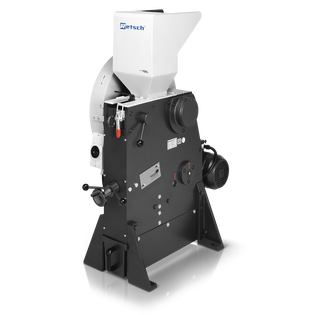
Çeneli kırıcı BB 250
Jaw crushers are designed for the rapid and effective pulverization of medium-hard, hard, brittle, and tough materials. The Jaw Crusher BB 250, for example, achieves particle sizes down to 2 mm, supporting throughputs of up to 300 kg/h and features easy cleaning possibilities.
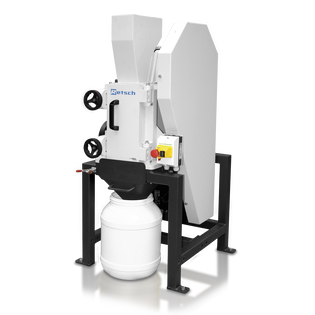
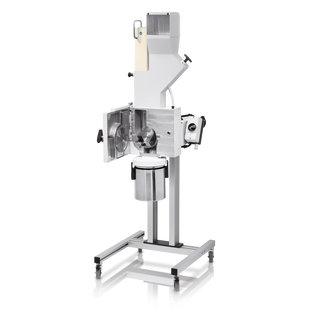
Çekiçli Değirmen HM 200
The RETSCH Hammer Mill HM 200 handles large feed sizes up to 100 mm, pulverizing them to below 0.8 mm, with an array of sieves from 2 mm to 40 mm ensuring defined particle sizes for different material types, including tough, fibrous, or even moist samples.

Pulverizers for fine Grinding
Fine grinding is employed to achieve the desired analytical fineness. This stage involves a different pulverizer machine designed for high-precision pulverization, capable of producing a uniformly fine powder. Typical pulverizers for fine grinding are disc mills, ball mills and rotor mills. Depending on the application and desired throughput, continuous or batch processing may be advantageous and will determine the choice of pulverizer.
RETSCH Disc Mills efficiently and quickly pulverize hard, brittle, and fibrous materials batchwise. RETSCH offers the Vibratory Disc Mill RS 300. The RS 300 pulverizes samples in grinding sets up to 2000 ml within seconds to some minutes.
RETSCH Planetary Ball Mills are distinguished for their exceptional versatility and efficiency in batchwise pulverization of a wide range of materials down to nanometer size in both dry and wet modes.
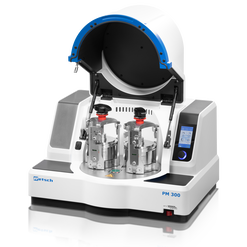
RETSCH Rotor Mills are designed for the continuous pulverization of a wide variety of materials, offering efficient and consistent crushing performance. For example, the RETSCH SR 300 Rotor Mill features a variable speed range of 3,000 to 10,000 rpm and a feed size capacity of up to 25 mm, enabling an adjustable pulverization down to <50 µm particle size.

How to choose the right pulverizer
The following criteria are important to consider when selecting a suitable pulverizer:
- Material properties of the sample (e.g. breaking behavior)
- Feed size of the sample
- Required final fineness
- Feed quantity
An excellent example are ball mills. Ball mills are used for the pulverization of fine powders in the fields of mineralogy, metallurgy, materials science, chemistry, pharmaceuticals and ceramics, among others. But one ball mill is not like another.
Davul Değirmenleri
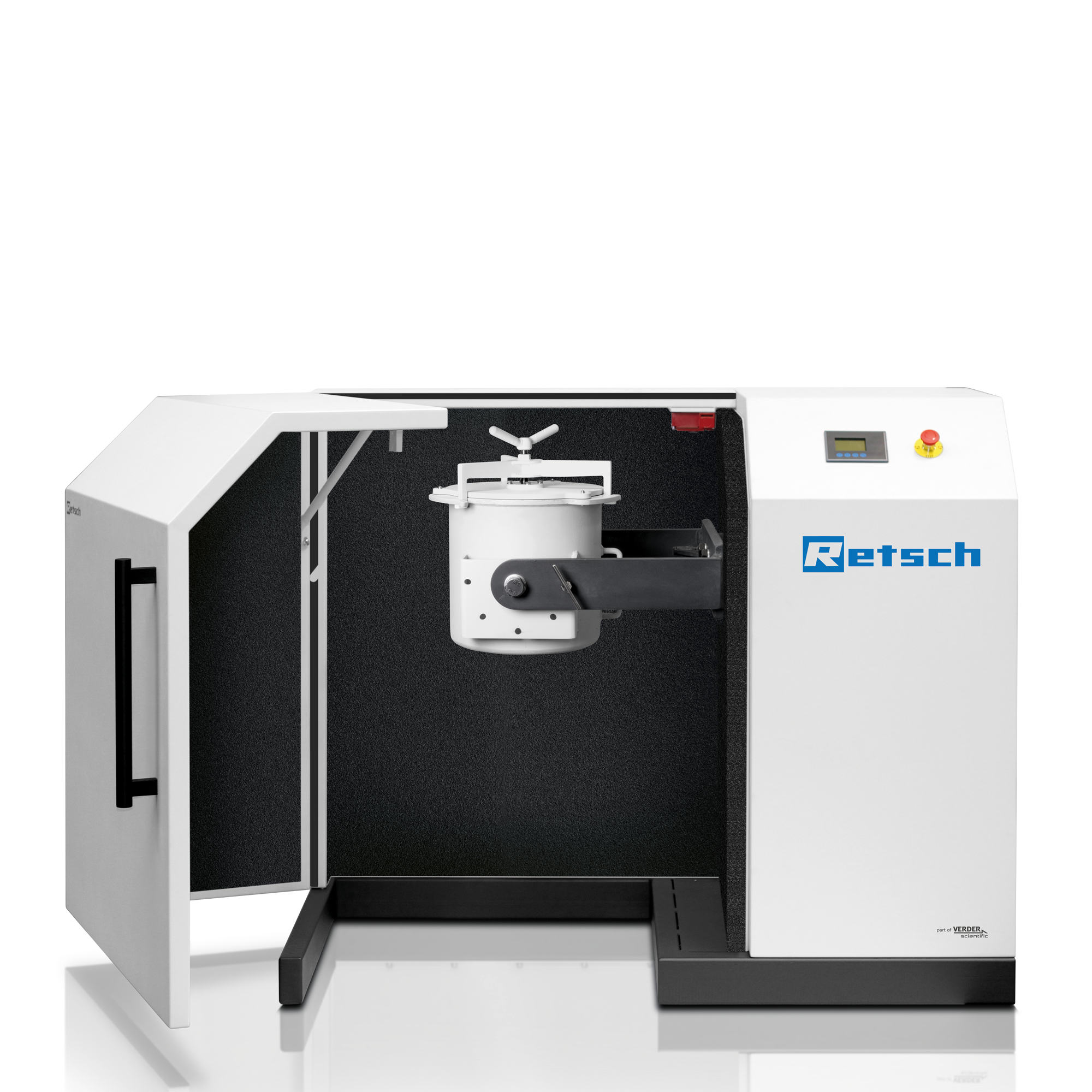
Drum mills are highly effective at pulverizing large quantities of material to a fine powder in a relatively short time. Drum mills work by rotating a drum filled with balls or rods and the material to be ground. The movement and impact of the balls within the rotating drum pulverizes the material into a fine powder. These pulverizers are known for their simplicity, robustness and effectiveness in pulverizing large batch sizes of sample volumes up to 35 l.
The RETSCH Drum Mill TM 300 features a rotating drum filled with balls to pulverize materials down to <20 µm, combining high pulverization efficiency with the ability to process a wide range of materials. Its robust design and ease of operation make it suitable for both laboratory applications and pilot scale pulverization, ensuring consistent particle sizes and versatile use. The TM 500 is equipped with a 150 l drum for further upscaling.
Planetery Gezegen hareketli bilyalı değirmenler
RETSCH Planetary Ball Mills are capable of producing extremely fine particle sizes down to the nanometer range with a high degree of uniformity. These pulverizers operate on the principle of planetary motion, where jars filled with balls and sample rotate like planets around the sun. This unique motion generates very high pulverization energy. The result is a shorter pulverizing time and the ability to achieve particles <0.1 mm. However Planetary Ball Mills offer smaller maximal jar volumes than a Drum Mill of max 500 ml.
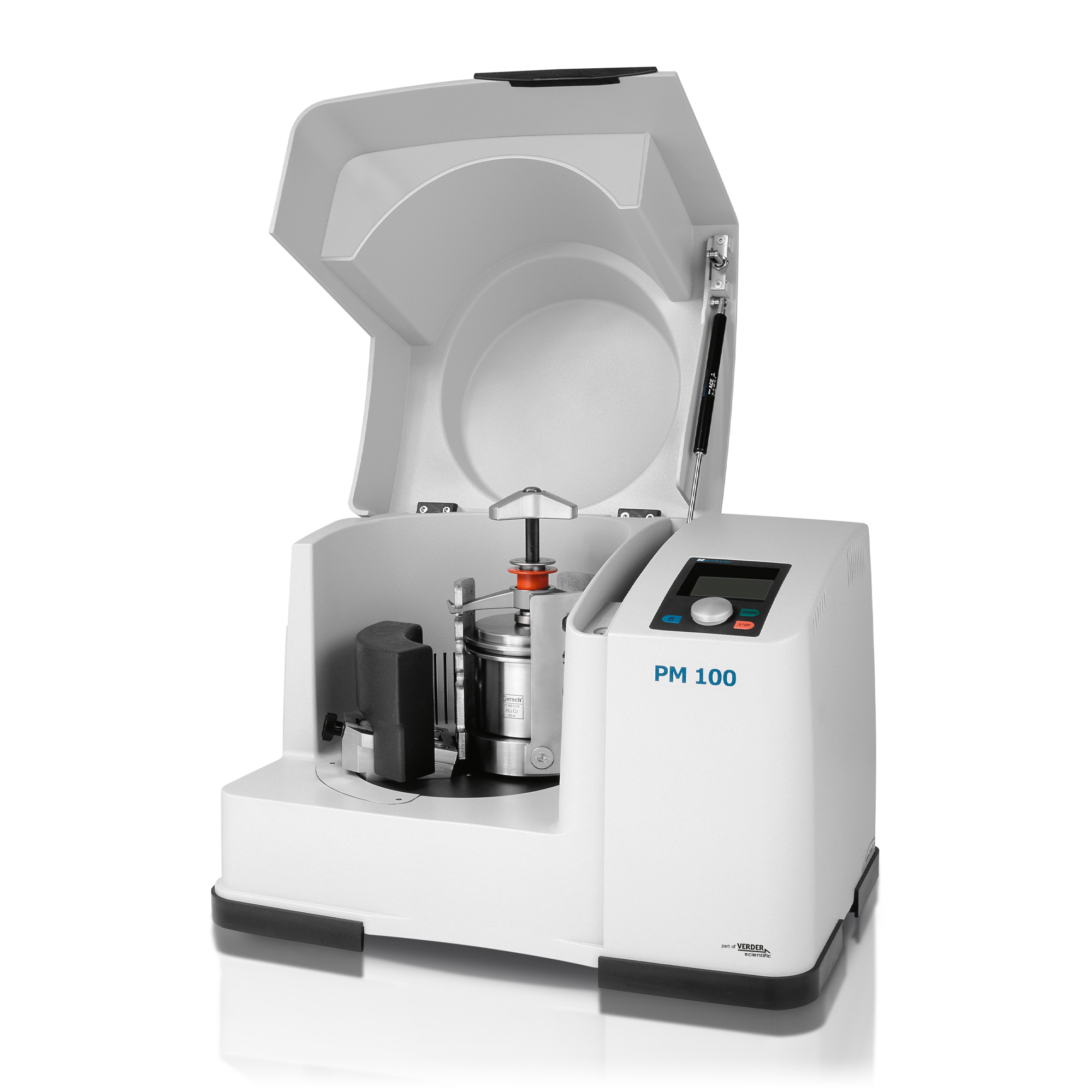
The Planetary Ball Mill PM 100 is a powerful benchtop model with a single grinding station and allows for grinding up to 220 ml sample material per batch.
Why choose RETSCH?
RETSCH laboratory pulverizer mills are crucial for quality management, R&D processes and pilot production, serving as essential tools for material analysis and development across various industries.
- Pharmaceutics: e.g. for formulation development.
- Material Science: e.g. to study properties of pulverized materials.
- Food Science: e.g. to investigate the properties of food materials for quality control and product development.
- Environmental: e.g. to prepare samples for testing pollutants, toxins, and other hazardous substances.
- Construction: e.g. to verify the quality of products.
Ücretsiz danışmanlık için bizimle iletişime geçin
Elevate your research capabilities with RETSCH laboratory pulverizer mills. Contact us today to discuss how our equipment can enhance your laboratory’s productivity and results. Our team is here to guide you through selection, installation, and beyond, ensuring that you make the most of your RETSCH equipment.

Pulverizing Mills - FAQ - SSS
What factors should be considered when selecting a suitable pulverizer?
Important criteria include the material properties of the sample, the initial feed size, the required final fineness, feed quantity, and for ball mills, the energy input. Selection of suitable grinding tools is also crucial based on hardness, abrasion resistance, and possible contamination.
What benefits do RETSCH laboratory pulverizers offer?
Choosing RETSCH laboratory pulverizers ensures precision and reliability, benefiting from over a century of experience and German engineering. Advantages include high-quality, reproducible results, high throughput, and expert support, ensuring streamlined sample preparation and efficient pulverizing.
What are the typical machines used for pre-crushing and fine grinding in the pulverization process?
Typical pulverizers for pre-crushing include jaw crushers and hammer mills, while rotor mills and ball mills are commonly used for fine grinding. Each is designed for different stages of the pulverization process.
Why might one need to use more than one pulverizer machine for a particular material?
When the initial particle size of the sample is coarse, a two-step pulverization process involving pre-crushing and fine grinding may be necessary to achieve analytical fineness. This ensures efficient processing and high-quality powder production.