





La familia de tamizadoras RETSCH no sólo cubre un extenso rango granulométrico, sino también un amplio espectro de aplicaciones gracias a la variedad de movimientos y tamaños de los tamices, ofreciendo el aparato adecuado para prácticamente cualquier material a granel. Estos aparatos proporcionan resultados exactos y reproducibles al cumplir con todos los requisitos de la norma DIN EN ISO 9001 para equipos de medición y control.
- Rango de medida *: 20 μm - 25 mm
- Movimiento del producto a tamizar: proyección con impulso rotatorio
- Amplitud: digital, 1-100% (0-3 mm)
- Diámetros de tamices apropiados: 100 mm/200 mm/203 mm (8")
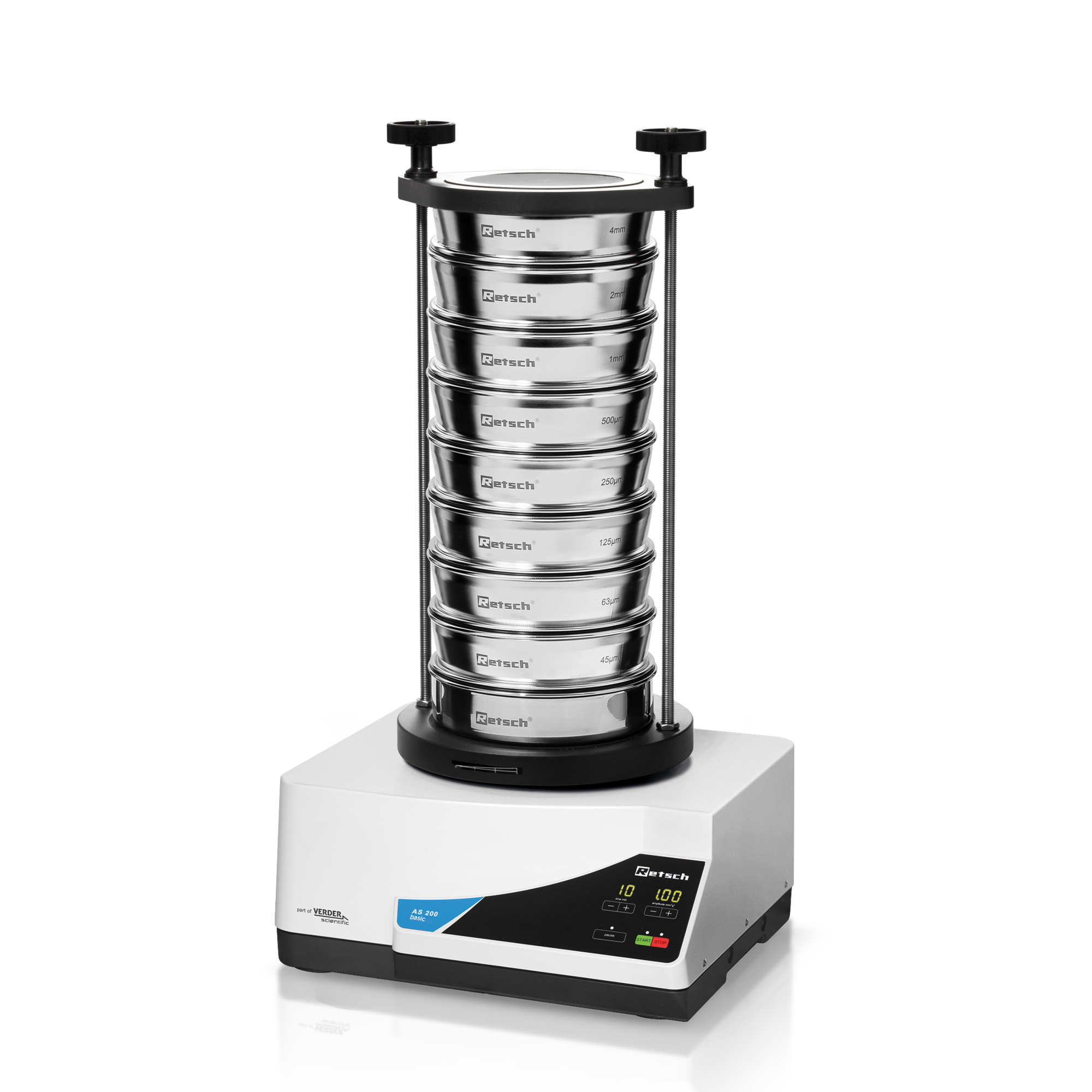
- Rango de medida *: 20 μm - 25 mm
- Movimiento del producto a tamizar: proyección con impulso rotatorio
- Amplitud: digital, 0,20 - 3,00 mm
- Diámetros de tamices apropiados: 100 mm/200 mm/203 mm (8")
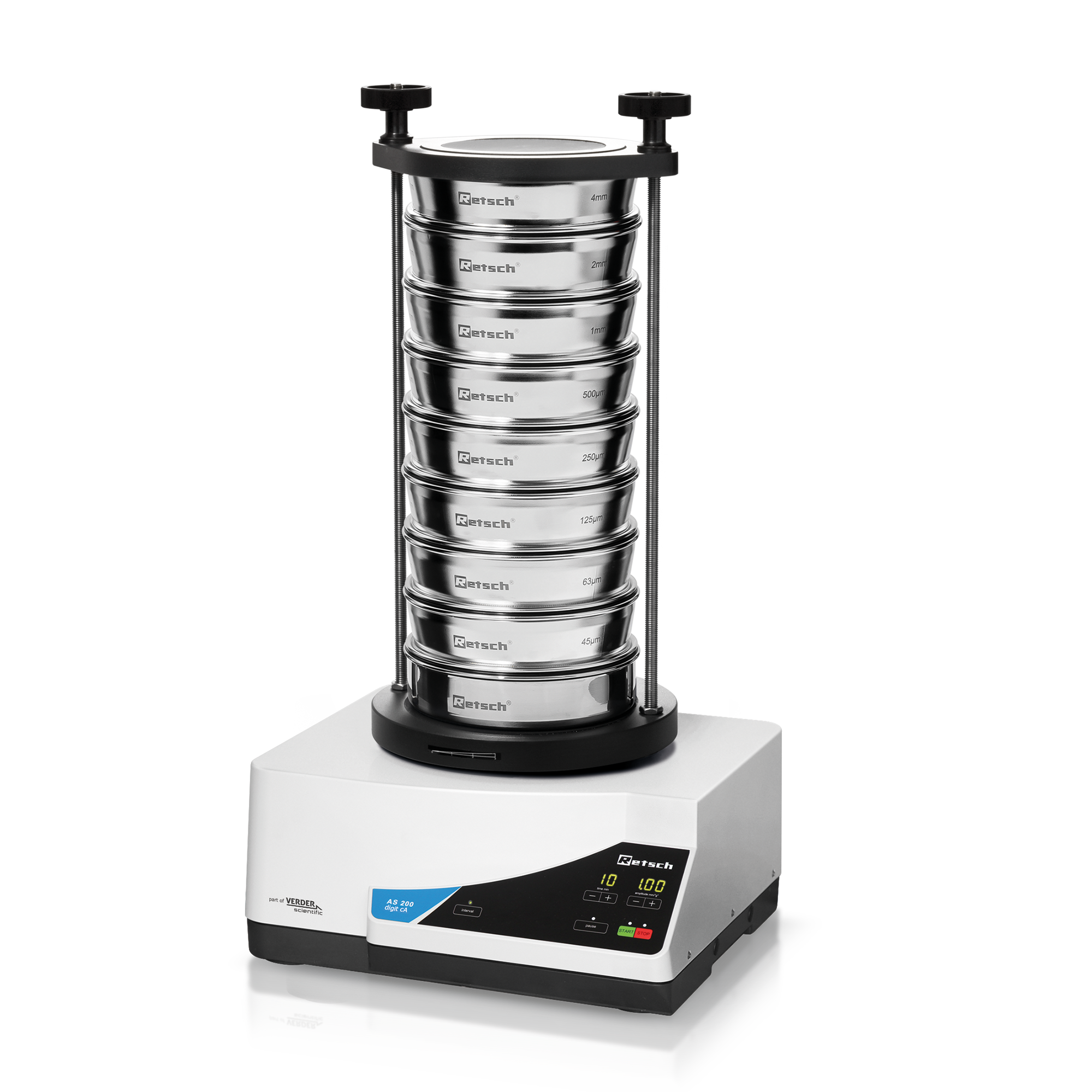
- Rango de medida *: 20 μm - 25 mm
- Movimiento del producto a tamizar: proyección con impulso rotatorio
- Amplitud: digital, 0,20 – 3,00 mm
- Diámetros de tamices apropiados: 100 mm/200 mm/203 mm (8")
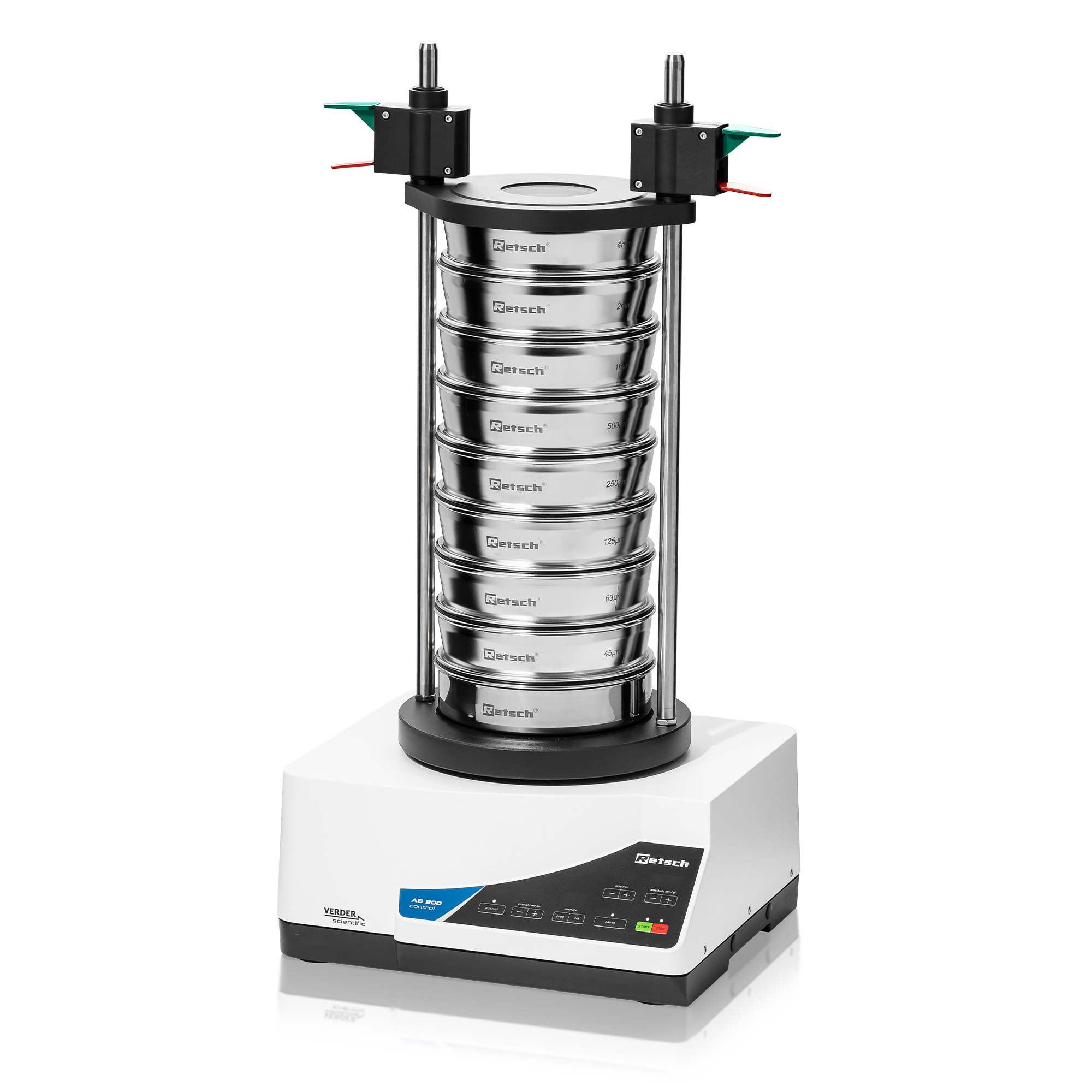
- Rango de medida *: 20 μm - 40 mm
- Movimiento del producto a tamizar: proyección con impulso rotatorio
- Amplitud: digital, 0,20 - > 2,20 mm
- Diámetros de tamices apropiados: 100 mm/200 mm/203 mm (8")/305 mm/315 mm
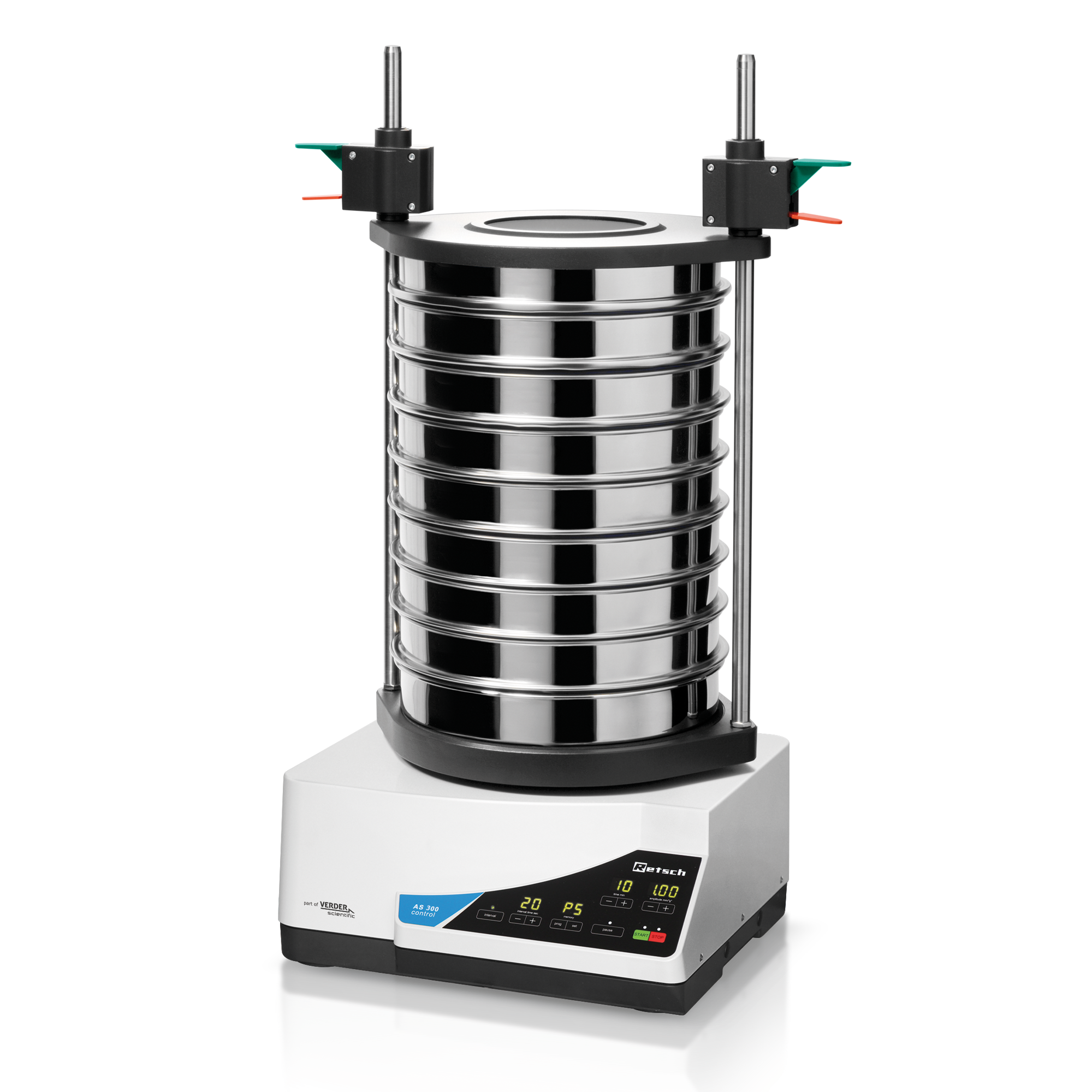
- Rango de medida *: 25 μm - 125 mm
- Movimiento del producto a tamizar: proyección por impulso de rotación - movimiento tridimensional
- Amplitud: digital, 0,2 - > 2,2 mm
- Diámetros de tamices apropiados: 400 mm/450 mm
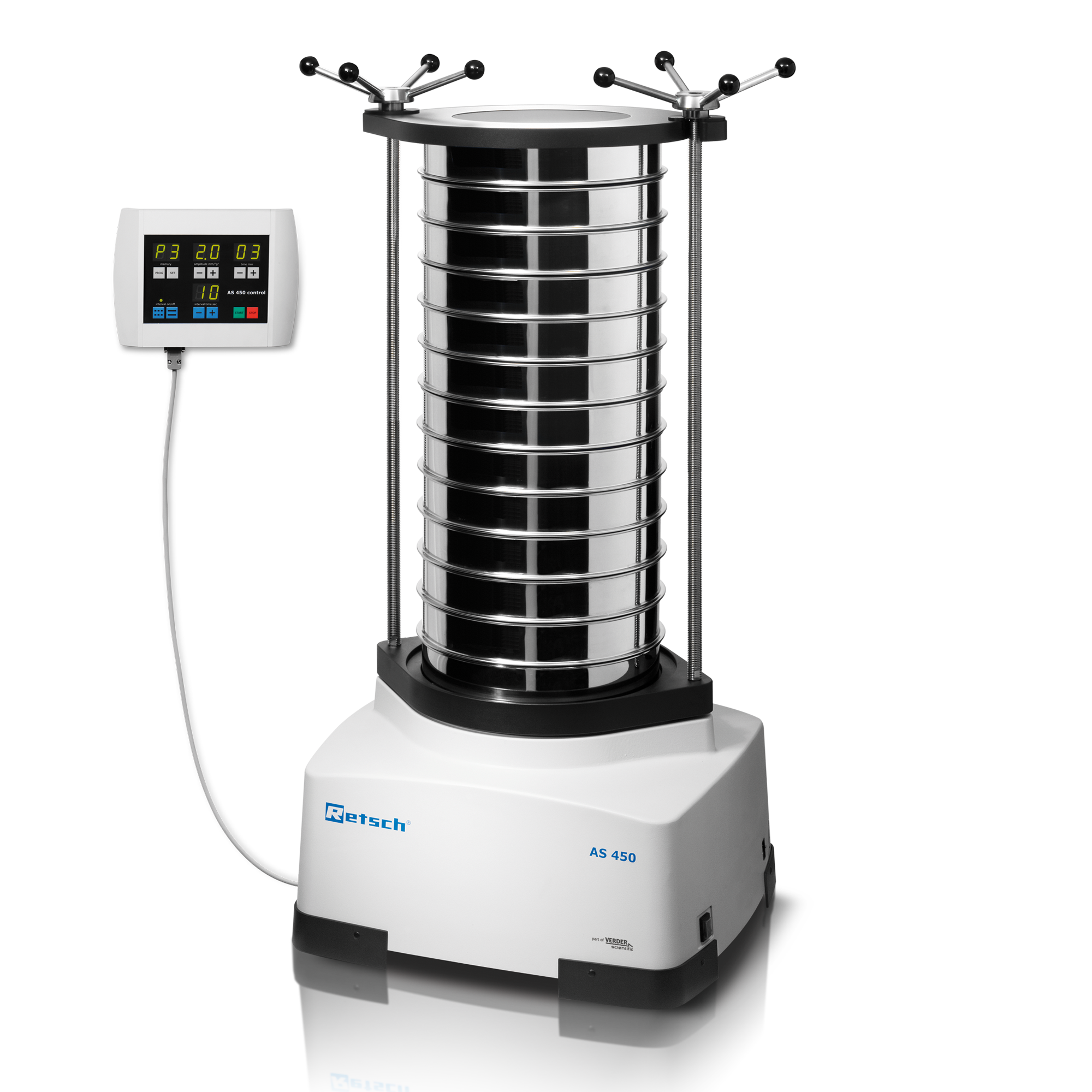
- Rango de medida *: 25 μm - 125 mm
- Movimiento del producto a tamizar: proyección por impulso de rotación - movimiento tridimensional
- Amplitud: digital, 1 - 100% en 10 pasos (0 - 2 mm)
- Diámetros de tamices apropiados: 400 mm/450 mm
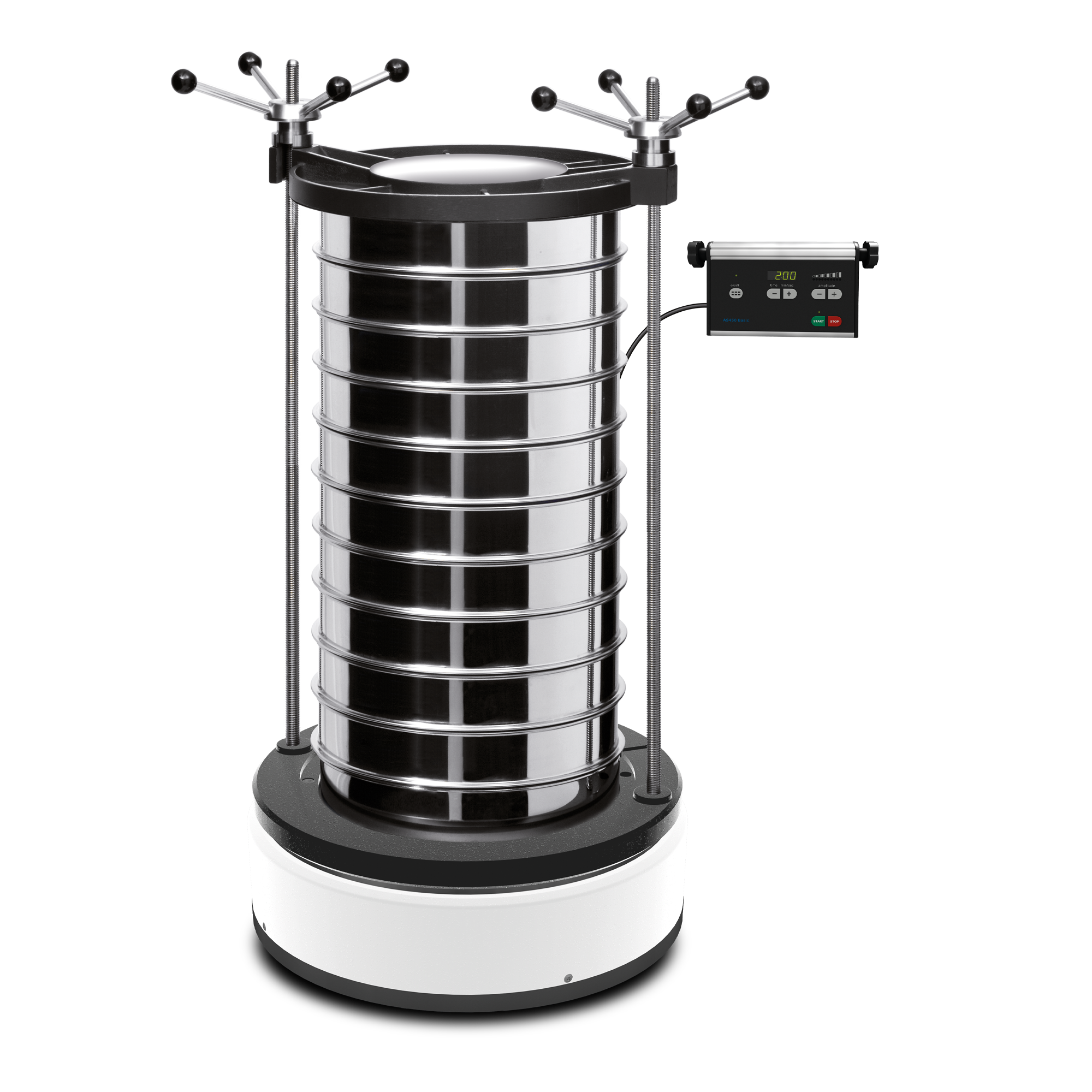
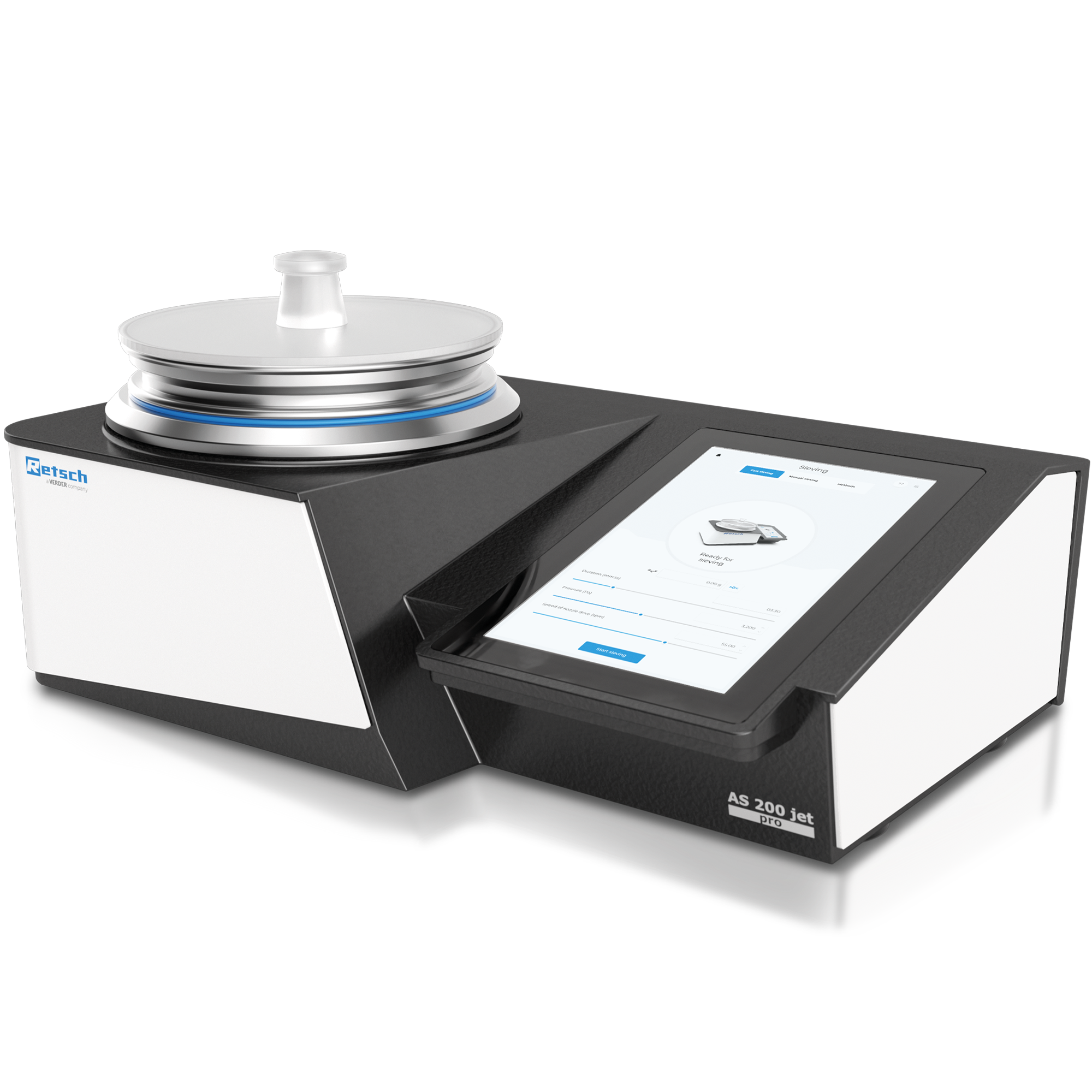
- Rango de medida *: 10 μm - ~ 4 mm
- Movimiento del producto a tamizar: dispersión por torbellino de aire
- Velocidad: digital, 5 - 55 min-1 (tobera)
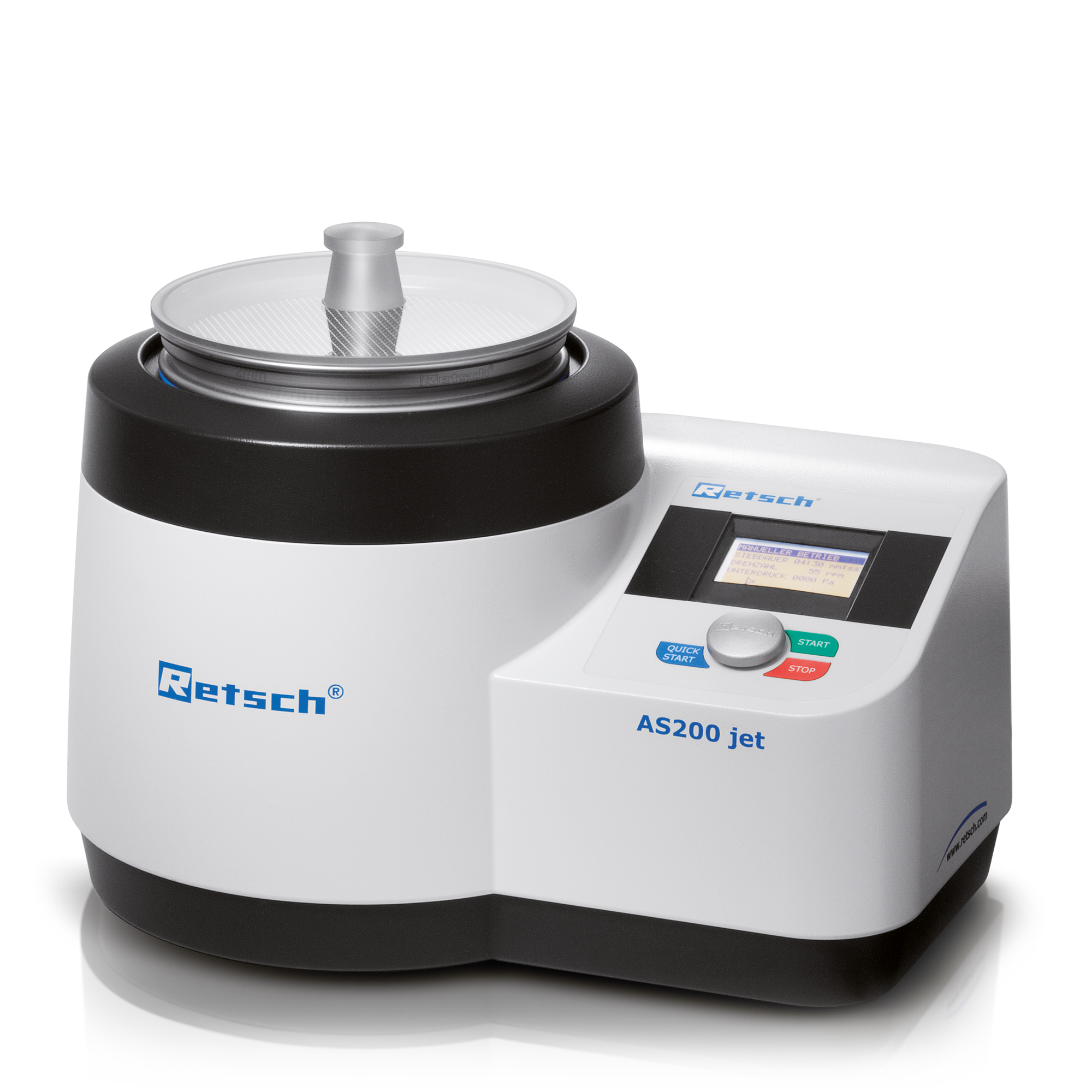
- Rango de medida *: 10 μm - ~ 4 mm
- Movimiento del producto a tamizar: dispersión por torbellino de aire
- Normas: Cumple con los requisitos de la Farmacopea Europea 2.9.12 y 2.9.38
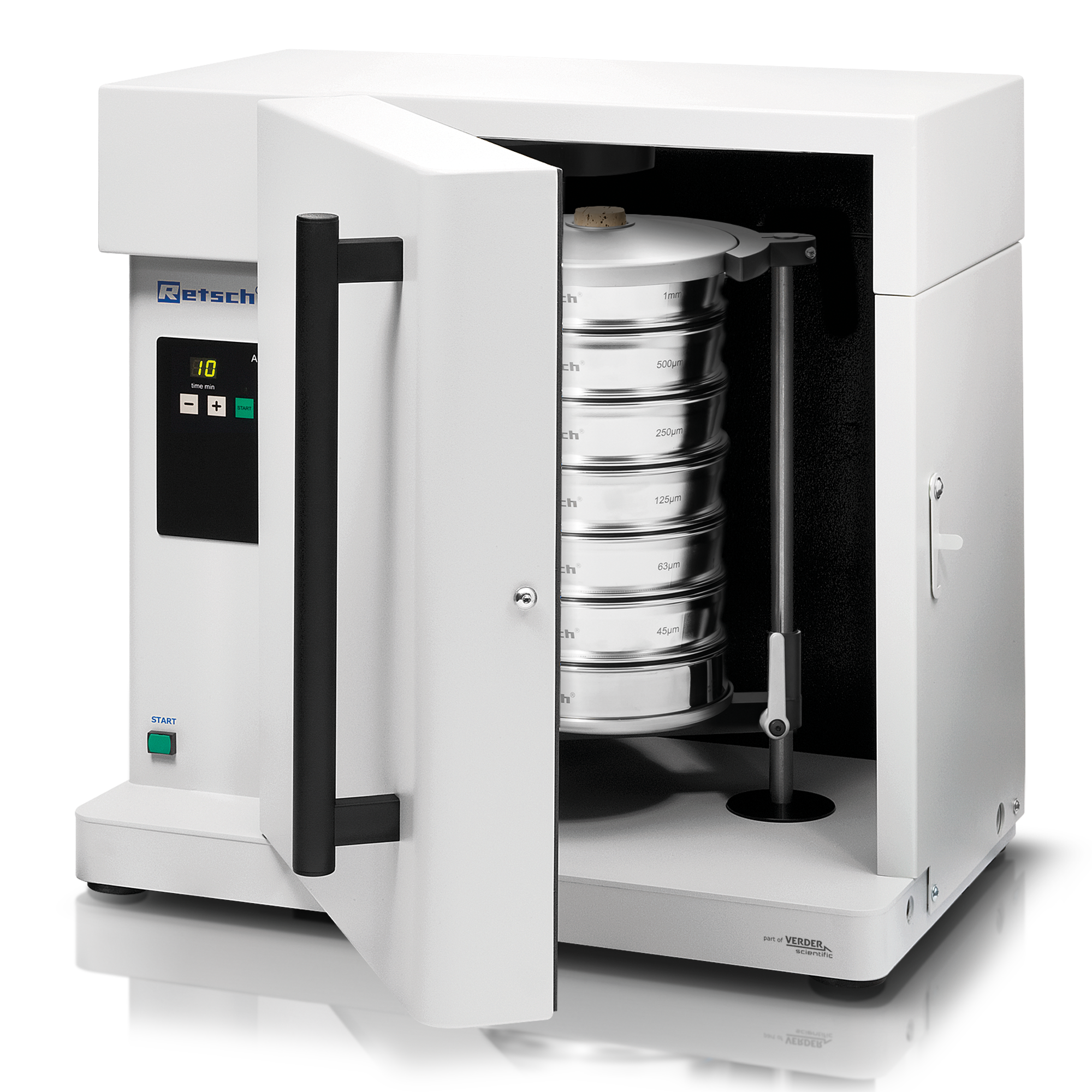
- Rango de medida *: 20 μm - 25 mm
- Movimiento del producto a tamizar: movimiento circular horizontal con golpes
- Diámetros de tamices apropiados: 200 mm/203 mm (8")
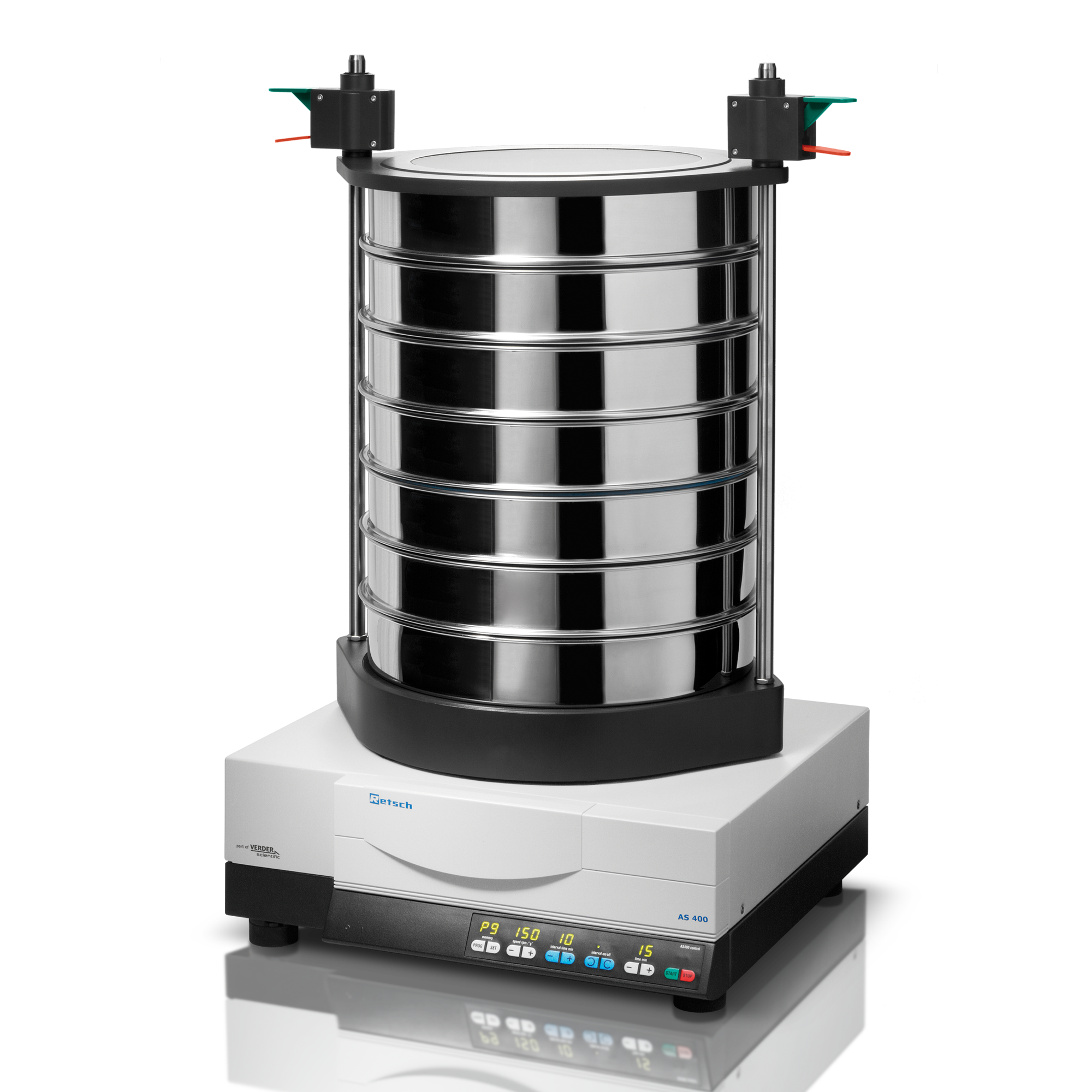
- Rango de medida *: 45 μm - 63 mm
- Movimiento del producto a tamizar: movimiento circular horizontal
- Diámetros de tamices apropiados: 100 mm/200 mm/203 mm (8")/305 mm/315 mm/400 mm
*Según el material de la muestra y la configuración y ajuste del aparato.
Sieving motions and measuring ranges of Retsch sieve shakers
Retsch sieve shakers separate bulk material into size fractions in a stack of test sieves. The eight models use three sieving motions: vibratory (Retsch AS 200 series, Retsch AS 300 control, Retsch AS 450 basic and Retsch AS 450 control), horizontal (Retsch AS 400 control) and tap (Retsch AS 200 tap). Measuring ranges span 20 µm to 125 mm.
| Model | Sieving motion | Measuring range | Max. batch | Suitable sieve diameters |
|---|---|---|---|---|
| Retsch AS 200 basic | Vibratory, throwing motion with angular momentum | 20 µm to 25 mm | 3 kg | 100 mm, 200 mm, 203 mm (8 in.) |
| Retsch AS 200 digit cA | Vibratory, throwing motion with angular momentum | 20 µm to 25 mm | 3 kg | 100 mm, 200 mm, 203 mm (8 in.) |
| Retsch AS 200 control | Vibratory, throwing motion with angular momentum | 20 µm to 25 mm | 3 kg | 100 mm, 200 mm, 203 mm (8 in.) |
| Retsch AS 300 control | Vibratory, throwing motion with angular momentum | 20 µm to 40 mm | 6 kg | 100 mm, 200 mm, 203 mm (8 in.), 305 mm, 315 mm |
| Retsch AS 450 basic | Vibratory, throwing motion with angular momentum, 3D movement | 25 µm to 125 mm | 15 kg | 400 mm, 450 mm |
| Retsch AS 450 control | Vibratory, throwing motion with angular momentum, 3D movement | 25 µm to 125 mm | 25 kg | 400 mm, 450 mm |
| Retsch AS 400 control | Horizontal circular motion | 45 µm to 63 mm | 5 kg | 100 mm, 200 mm, 203 mm (8 in.), 305 mm, 315 mm, 400 mm |
| Retsch AS 200 tap | Horizontal circular motion with taps | 20 µm to 25 mm | 3 kg | 200 mm, 203 mm (8 in.) |
Sieving motion, measuring range, batch size and sieve diameters of the eight Retsch sieve shakers. Max. batch = maximum batch or feed capacity.
The Retsch sieve shakers process powders and bulk materials. How sieve analysis works, which sieving principles exist and how the results are evaluated is explained on the knowledge base page What is sieve analysis and how is it performed?. The tables below compare the eight Retsch models.
Vibratory sieving motion of the AS 200 series, AS 300 control, AS 450 basic and AS 450 control
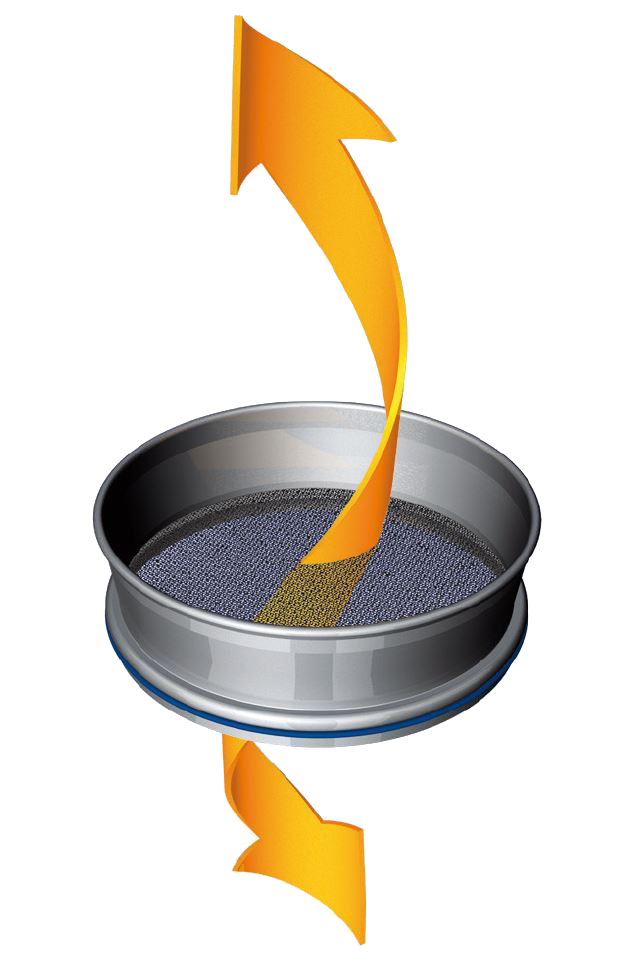
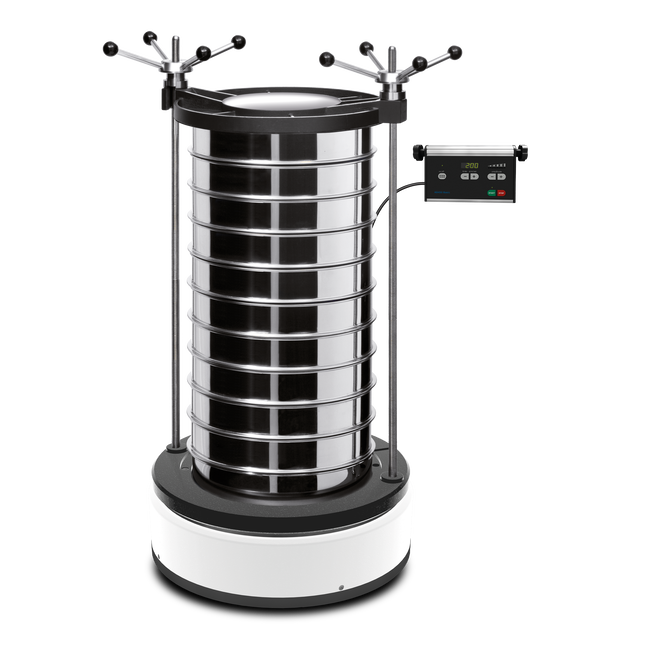
The six vibratory Retsch sieve shakers combine vertical throwing with circular movement in a three-dimensional sieving motion across the whole sieve surface. Batches reach 3 kg for the Retsch AS 200 series, 6 kg for the Retsch AS 300 control, 15 kg for the Retsch AS 450 basic and 25 kg for the Retsch AS 450 control.
The vibratory motion keeps particles moving relative to the sieve apertures, so that particles meet the apertures repeatedly in different orientations. All six vibratory models cover dry and wet sieving and drive the sieve stack electromagnetically.
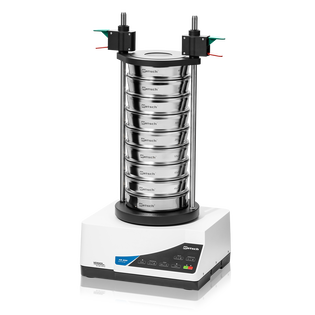
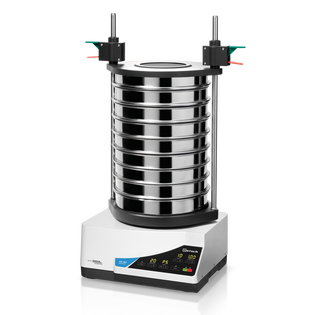
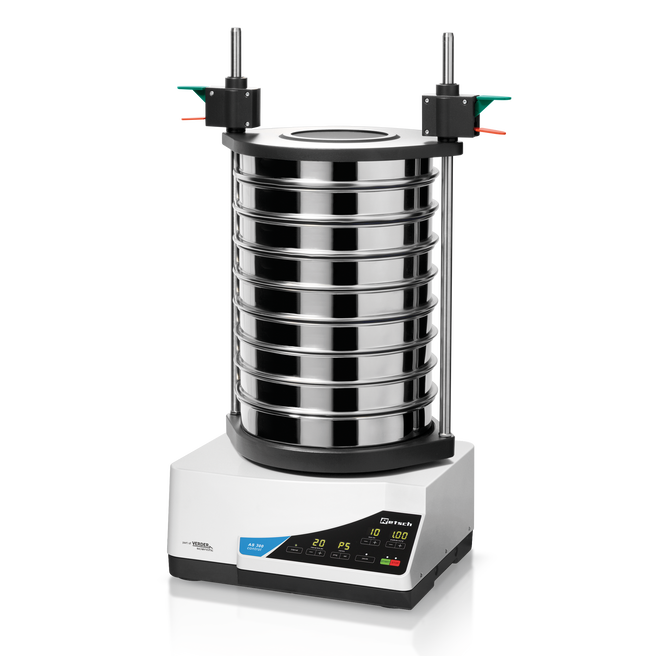
Amplitude control and calibration of the AS 200 basic, AS 200 digit cA and AS 200 control
The AS 200 basic sets the amplitude from 1% to 100% (0 mm to 3 mm). The AS 200 digit cA and the AS 200 control set a controlled amplitude from 0.20 mm to 3.00 mm. Only the AS 200 control can be calibrated and offers a sieve acceleration of 1.0 g to 15.1 g.
The Retsch AS 200 control stores 99 standard operating procedures (SOPs), has a USB interface and is supplied with a test certificate. The sieve acceleration of the Retsch AS 200 control is independent of the power frequency, which Retsch gives as the basis for comparable sieving results between instruments. The Retsch AS 200 digit cA stores 1 SOP and offers an interval operation of 10 s.
| Parameter | Retsch AS 200 basic | Retsch AS 200 digit cA | Retsch AS 200 control |
|---|---|---|---|
| Amplitude | digital, 1% to 100% (0 mm to 3 mm) | digital, 0.20 mm to 3.00 mm | digital, 0.20 mm to 3.00 mm |
| Controlled amplitude | — | yes | yes |
| Sieve acceleration | — | — | 1.0 g to 15.1 g |
| Time | digital, 1 min to 99 min | digital, 1 min to 99 min | digital, 1 min to 99 min |
| Interval operation | — | 10 s | 1 s to 99 s |
| Storable SOPs | — | 1 | 99 |
| Interface | — | — | USB |
| Calibration and test certificate | — | — | yes |
| Dry and wet sieving | yes | yes | yes |
| Max. mass of sieve stack | 4 kg | 4 kg | 6 kg |
| Max. height of sieve stack | 510 mm | 510 mm | 620 mm |
| Net weight | approx. 35 kg | approx. 35 kg | approx. 35 kg |
Technical data of the Retsch AS 200 basic, Retsch AS 200 digit cA and Retsch AS 200 control (— = not listed in the Retsch product data). All three models have a measuring range of 20 µm to 25 mm, a max. batch of 3 kg and take sieve diameters of 100 mm, 200 mm and 203 mm (8 in.).
Sieve diameter and batch capacity of the Retsch AS 300 control
The Retsch AS 300 control takes test sieves with diameters up to 315 mm and processes batches of up to 6 kg in a measuring range from 20 µm to 40 mm. The larger sieve surface extends the capacity of the vibratory principle used in the Retsch AS 200 series.
The sieve surface of a 315 mm test sieve is approximately 2.5 times larger than that of a 200 mm test sieve. The AS 300 control sets a controlled amplitude from 0.20 mm to above 2.20 mm and a sieve acceleration from 1.0 g to above 10.0 g, stores 99 SOPs and can be calibrated. Retsch states that the AS 300 control meets the requirements of test equipment monitoring according to DIN EN ISO 9001.
| Parameter | Retsch AS 300 control |
|---|---|
| Measuring range | 20 µm to 40 mm |
| Max. batch | 6 kg |
| Max. mass of sieve stack | 10 kg |
| Max. height of sieve stack | 510 mm |
| Amplitude | digital, 0.20 mm to > 2.20 mm |
| Controlled amplitude | yes |
| Sieve acceleration | 1.0 g to > 10.0 g |
| Time | digital, 1 min to 99 min |
| Interval operation | 1 s to 99 s |
| Storable SOPs | 99 |
| Dry and wet sieving | yes |
| Calibration and test certificate | yes |
| Interface | serial |
| Suitable sieve diameters | 100 mm, 200 mm, 203 mm (8 in.), 305 mm, 315 mm |
| Net weight | approx. 42 kg |
Technical data of the Retsch AS 300 control.
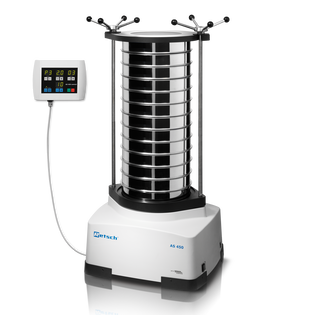
Batch capacity of the Retsch AS 450 basic and Retsch AS 450 control
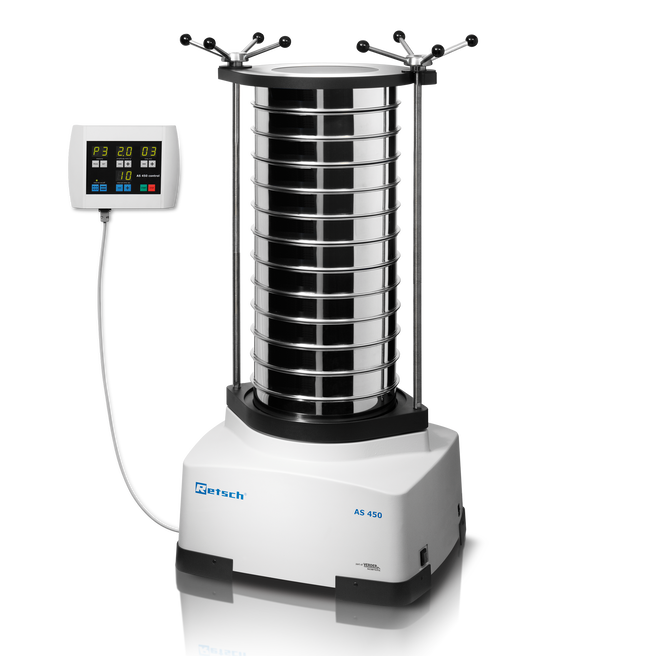
The AS 450 basic processes batches of up to 15 kg and the AS 450 control up to 25 kg, both with test sieves of 400 mm and 450 mm in a measuring range from 25 µm to 125 mm. Both models cover dry and wet sieving with the three-dimensional vibratory motion.
The Retsch AS 450 control uses a drive based on CET technology (Continuous Energy Transfer) and a remote operation panel, stores 9 SOPs and sets a sieve acceleration from 1 g to above 7.1 g. The Retsch AS 450 basic sets the amplitude in 10 steps from 1% to 100% (0 mm to 2 mm).
| Parameter | Retsch AS 450 basic | Retsch AS 450 control |
|---|---|---|
| Measuring range | 25 µm to 125 mm | 25 µm to 125 mm |
| Max. batch | 15 kg | 25 kg |
| Max. mass of sieve stack | 50 kg | 50 kg |
| Max. height of sieve stack | 830 mm | 963 mm |
| Amplitude | digital, 1% to 100% in 10 steps (0 mm to 2 mm) | digital, 0.2 mm to > 2.2 mm |
| Sieve acceleration | — | 1 g to > 7.1 g |
| Time | digital, 0 min to 99 min | digital, 1 min to 99 min |
| Interval operation | yes | 10 s to 99 s |
| Storable SOPs | 1 | 9 |
| Dry and wet sieving | yes | yes |
| Suitable sieve diameters | 400 mm, 450 mm | 400 mm, 450 mm |
| Net weight | approx. 112 kg | approx. 220 kg |
Technical data of the Retsch AS 300 control.
Horizontal sieving motion of the Retsch AS 400 control
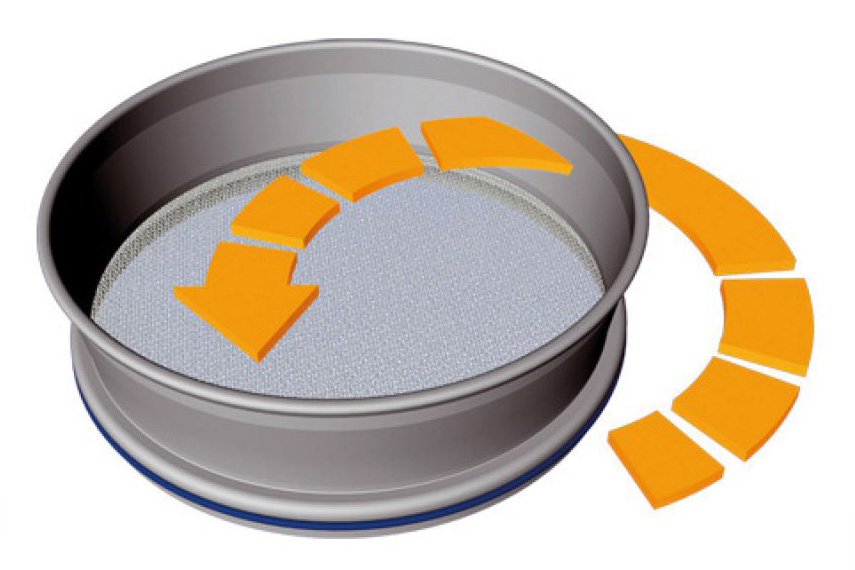
The Retsch AS 400 control sieves dry material with a horizontal circular motion at 50 min⁻¹ to 300 min⁻¹. The horizontal motion keeps elongated, fibrous, needle-shaped and flat particles on the sieve surface in a controlled orientation, because the orientation of the particles does not change continuously. The measuring range is 45 µm to 63 mm.
The AS 400 control takes test sieves up to 400 mm in diameter. The maximum batch is 5 kg, and the maximum mass of the sieve stack is 15 kg. The circular motion has a radius of 15 mm, and the standard DIN 53477 stipulates the circular sieving motion for the testing of plastics (grainy molding materials). The AS 400 control can be calibrated, is supplied with a test certificate and meets the requirements of test equipment monitoring according to DIN EN ISO 9001.
| Parameter | Retsch AS 400 control |
|---|---|
| Sieving motion | horizontal circular motion, radius 15 mm |
| Measuring range | 45 µm to 63 mm |
| Max. batch | 5 kg |
| Max. mass of sieve stack | 15 kg |
| Speed | digital, 50 min⁻¹ to 300 min⁻¹ |
| Time | digital, 1 min to 99 min |
| Interval operation | 1 min to 10 min |
| Storable SOPs | 9 |
| Dry sieving | yes |
| Wet sieving | no |
| Suitable sieve diameters | 100 mm, 200 mm, 203 mm (8 in.), 305 mm, 315 mm, 400 mm |
| Max. height of sieve stack | 510 mm |
| Calibration and test certificate | yes |
| Interface | serial |
| Drive motor | 125 W |
| Net weight | approx. 70 kg |
Technical data of the Retsch AS 400 control.
Tap sieving motion of the Retsch AS 200 tap
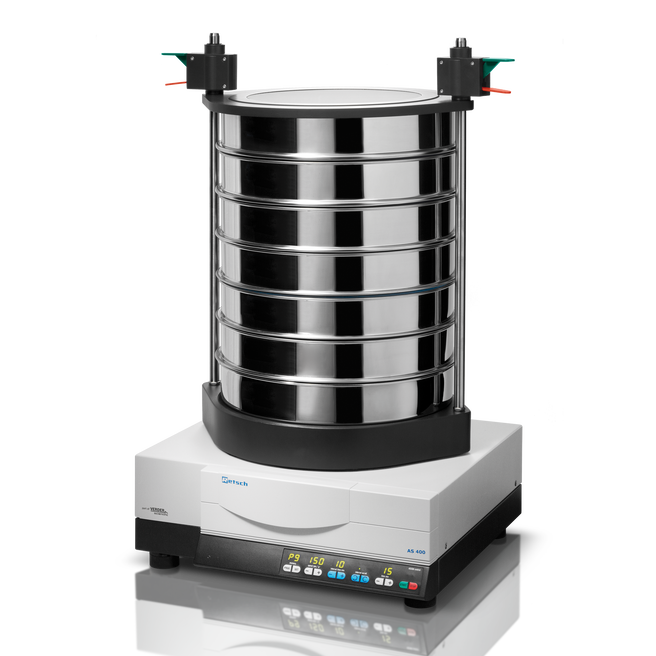
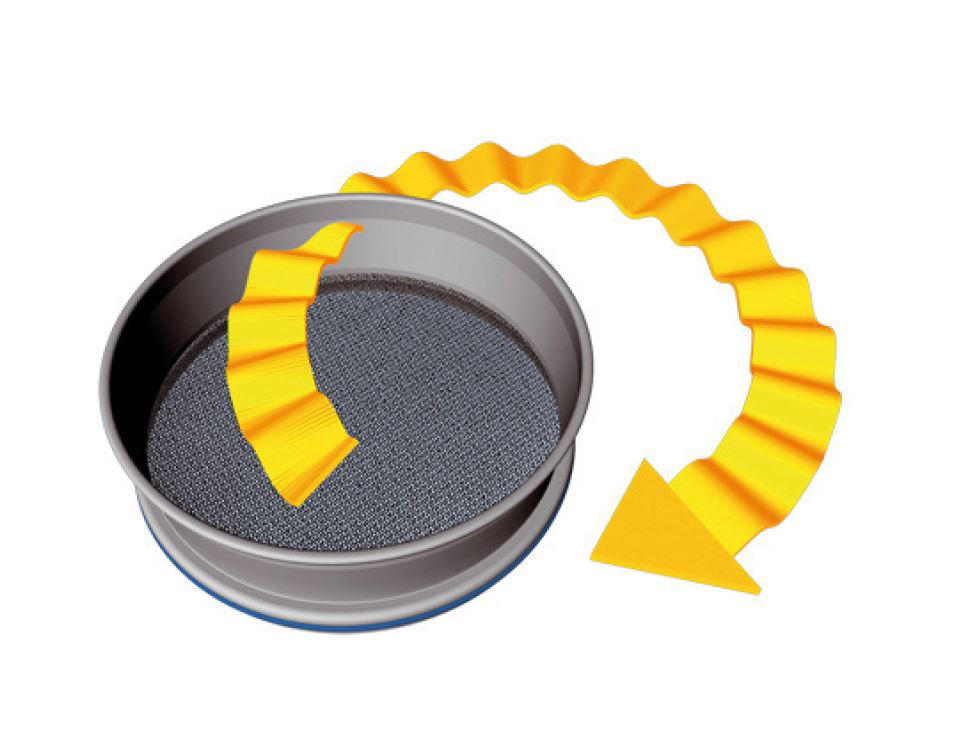
The Retsch AS 200 tap combines a horizontal circular motion of 280 min⁻¹ with vertical taps of 150 min⁻¹ for dry sieving, which reproduces the principle of hand sieving. The measuring range is 20 µm to 25 mm, and the test sieves have a diameter of 200 mm or 203 mm (8 in.).
Retsch states that the sieving motion of the AS 200 tap is specified in various standards for particle size analysis of materials such as activated carbon, diamonds, spices, metal powders, abrasives or cement. The maximum batch is 3 kg and the maximum mass of the sieve stack is 6 kg. The number of rotations and taps is fixed, and the tapping motion can be deactivated.
| Parameter | Retsch AS 200 tap |
|---|---|
| Sieving motion | horizontal circular motion with taps |
| Speed | 280 min⁻¹ |
| Taps | 150 min⁻¹, can be deactivated |
| Measuring range | 20 µm to 25 mm |
| Max. batch | 3 kg |
| Max. mass of sieve stack | 6 kg |
| Suitable sieve diameters | 200 mm, 203 mm (8 in.) |
| Time | digital, 1 min to 99 min |
| Dry sieving | yes |
| Wet sieving | no |
| Calibration and test certificate | no |
| Interface | serial |
| Net weight | approx. 68 kg |
Technical data of the Retsch AS 200 tap.
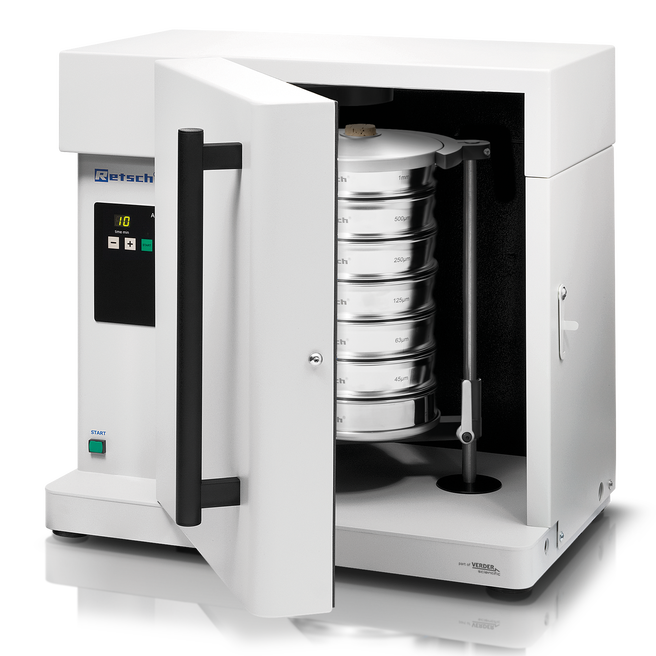
Which Retsch sieve shaker fits which sample?
The sample shape, the batch size, the required calibration and the prescribed sieving motion decide which Retsch sieve shaker fits. Vibratory models suit powders and bulk materials in dry and wet sieving, the Retsch AS 400 control suits elongated, fibrous, needle-shaped and flat particles, and the Retsch AS 200 tap suits standards that prescribe tap sieving.
| Requirement | Retsch sieve shaker | Deciding value |
|---|---|---|
| Routine dry and wet sieving of batches up to 3 kg | Retsch AS 200 basic | Amplitude 1% to 100% (0 mm to 3 mm), max. batch 3 kg |
| Controlled amplitude and interval operation | Retsch AS 200 digit cA | Controlled amplitude 0.20 mm to 3.00 mm, interval operation 10 s |
| Calibration, sieve acceleration and stored SOPs | Retsch AS 200 control | Sieve acceleration 1.0 g to 15.1 g, 99 SOPs, test certificate |
| Test sieves of 305 mm or 315 mm, batches up to 6 kg | Retsch AS 300 control | Sieve diameter up to 315 mm, max. batch 6 kg |
| Batches up to 15 kg with test sieves of 400 mm or 450 mm | Retsch AS 450 basic | Max. batch 15 kg, measuring range 25 µm to 125 mm |
| Batches up to 25 kg with test sieves of 400 mm or 450 mm | Retsch AS 450 control | Max. batch 25 kg, sieve acceleration 1 g to > 7.1 g |
| Elongated, fibrous, needle-shaped or flat particles; plastics according to DIN 53477 | Retsch AS 400 control | Horizontal circular motion, 50 min⁻¹ to 300 min⁻¹, radius 15 mm |
| A standard that prescribes circular motion with taps | Retsch AS 200 tap | 280 min⁻¹ and 150 taps min⁻¹ |
Selection of a Retsch sieve shaker by sample and requirement.
| The Retsch sieve shakers suit | The Retsch sieve shakers do not suit |
|---|---|
| Powders and bulk materials with particle sizes from 20 µm to 125 mm, depending on the model | Particles below the measuring range of the model (20 µm for the AS 200 series and AS 300 control, 25 µm for the AS 450 basic and AS 450 control, 45 µm for the AS 400 control) or above 125 mm |
| Dry and wet sieving with the six vibratory models | Wet sieving with the Retsch AS 400 control and the Retsch AS 200 tap, which sieve dry material only |
| Batches from 3 kg to 25 kg, depending on the model | Batches above 25 kg |
| Particles that pass the sieve apertures in a stack of test sieves | Fine powders that agglomerate in stack sieving, which are sieved by air jet sieving; see "Air jet sieving of bulk materials". |
Fit of the Retsch sieve shakers by sample and task.
Applications of Retsch sieve shakers by industry
Retsch sieve shakers are used for particle size determination in pharmaceuticals, the food industry, construction, the chemical industry and environmental analysis. Each field uses sieve analysis for a different task, from active ingredient analysis to the testing of aggregates and sand and the testing of soils.
| Industry | Typical task | Sample materials named on the Retsch product pages | Retsch application page |
|---|---|---|---|
| Pharmaceuticals | Active ingredient analysis | — | Pharma and MedTech |
| Food industry | Quality control | coffee, flours, grains, nuts, seeds | Food and Feed Analysis |
| Construction | Testing of aggregates and sand | cement clinker, construction materials, sand | Green Cement and Sustainable Cement Technology |
| Chemicals | Powder characterization | chemicals, fertilizers, fillers, plastics, washing powder | — |
| Environmental analysis | Soil testing | soils | — |
Fields of application of the Retsch sieve shakers (— = none named).
Standards and test equipment monitoring for Retsch sieve shakers
Retsch states that all eight compared sieve shakers comply with the requirements of the European Pharmacopoeia 2.9.12 and 2.9.38, and that the AS 200 control, AS 300 control, AS 450 control and AS 400 control meet test equipment monitoring according to DIN EN ISO 9001. Further standards describe the test sieves and the sieving procedure.
| Standard | What the standard covers | Retsch sieve shakers concerned |
|---|---|---|
| Ph. Eur. 2.9.12 und 2.9.38 | Sieve test and estimation of the particle size distribution by analytical sieving | All eight models (compliance stated by Retsch) |
| DIN EN ISO 9001 | Test equipment monitoring in quality management | Retsch AS 200 control Retsch AS 300 control Retsch AS 400 control Retsch AS 450 control |
| DIN 53477 | Circular sieving motion for the testing of plastics (grainy molding materials) | Retsch AS 400 control |
| ISO 3310-1 | Test sieves of metal wire cloth: technical requirements and testing | All eight models, for the test sieves in the sieve stack |
| ASTM E11 | Woven wire test sieve cloth and test sieves | All eight models, for the test sieves in the sieve stack |
| ISO 2591-1 | Test sieving: methods using test sieves of woven wire cloth and perforated metal plate | All eight models, for the sieving procedure |
Standards named for the Retsch sieve shakers and for test sieving.
Quote and sieving trial for Retsch sieve shakers
A Retsch sieve shaker is selected by comparing the measuring range, batch size, sieve diameter and sieving motion in the tables above with the sample. In the Retsch Application Laboratory, Retsch application specialists carry out free sieving trials and issue a written report with an instrument recommendation.
Test sieves for the sieve stack are available as Retsch test sieves. The Retsch sieve shakers with an interface connect to a PC, where Retsch evaluation software controls the sieving process and evaluates the results. For the method behind the sieving motions, read What is sieve analysis and how is it performed?.
White Paper: Análisis por tamizado - diferentes métodos de tamizado para diversas aplicaciones
Un gran número de propiedades físicas y químicas dependen del tamaño de las partículas. Desde la inspección de entrada y el control de producción hasta la investigación y el desarrollo, los análisis por tamizado se utilizan para determinar diversos parámetros o simplemente el tamaño de las partículas. En este artículo se presenta un resumen de las diferentes técnicas de tamizado y de los pasos necesarios para asegurar unos resultados precisos.