





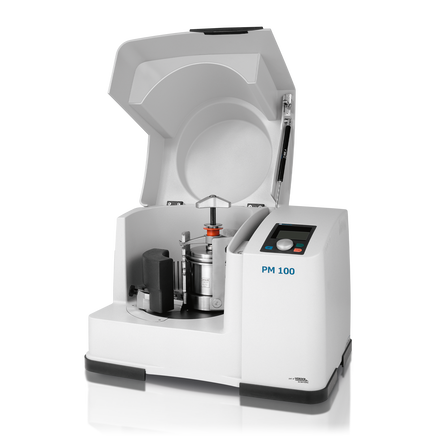
Retsch’s innovative planetary mills meet even the most demanding requirements for fast and reproducible grinding down to the nanometer range. They are used in a wide variety of applications, from daily sample preparation in the laboratory to colloid grinding and the development of new materials. A planetary mill is used for the ultrafine grinding of soft, fibrous, hard, and brittle materials. This type of mill achieves very high final finenesses down to the submicron range. Depending on the model, the maximum feed particle size is 10 mm. If the feed material is larger, it must be pre-crushed, for example, using a jaw crusher.
Advantages of a planetary mill
- Efficient grinding process delivers excellent grinding results down to the submicron range
- Different speed ratios available, depending on the model
- Grinding jar sizes from 12 ml to 500 ml made of 8 different materials
- A planetary mill is suitable for long-term tests and continuous use
- Automatic reversal of the direction of rotation to avoid agglomerations
- Reproducible results through energy and speed control
- Programmable automatic start
- 10 combinations of grinding parameters can be stored
- Graphic display and ergonomic one-button operation
- Automatic grinding chamber vent for grinding jar cooling
- 2-year warranty, CE compliant
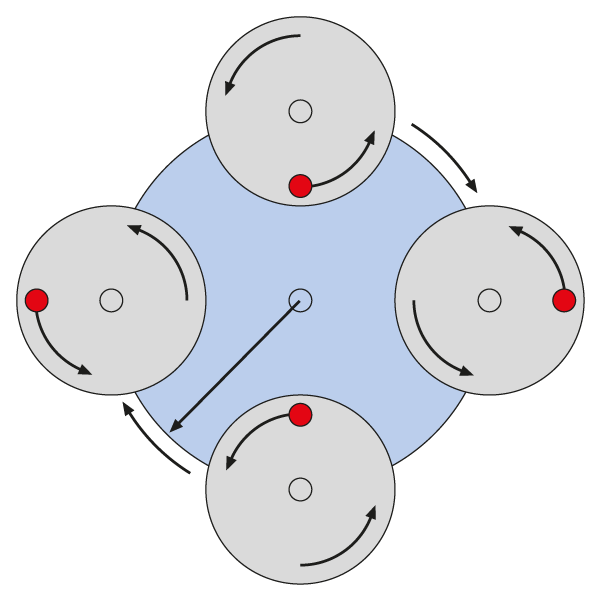
Principle of operation of a planetary mill
The grinding jars are arranged eccentrically on the sun wheel of the planetary mill. The rotational movement of the sun wheel is in the opposite direction to the rotation of the grinding bowl, in a ratio of 1:-2 (or 1:1-, 1:-2.5 or 1:-3). The grinding balls in the grinding jar are influenced by so-called Coriolis forces, which are caused by superimposed rotational movements. The speed differences between balls and grinding bowls lead to an interaction of frictional and impact forces, whereby high, dynamic energies are released. The interaction of these forces causes the high and very effective degree of crushing of a planetary mill.
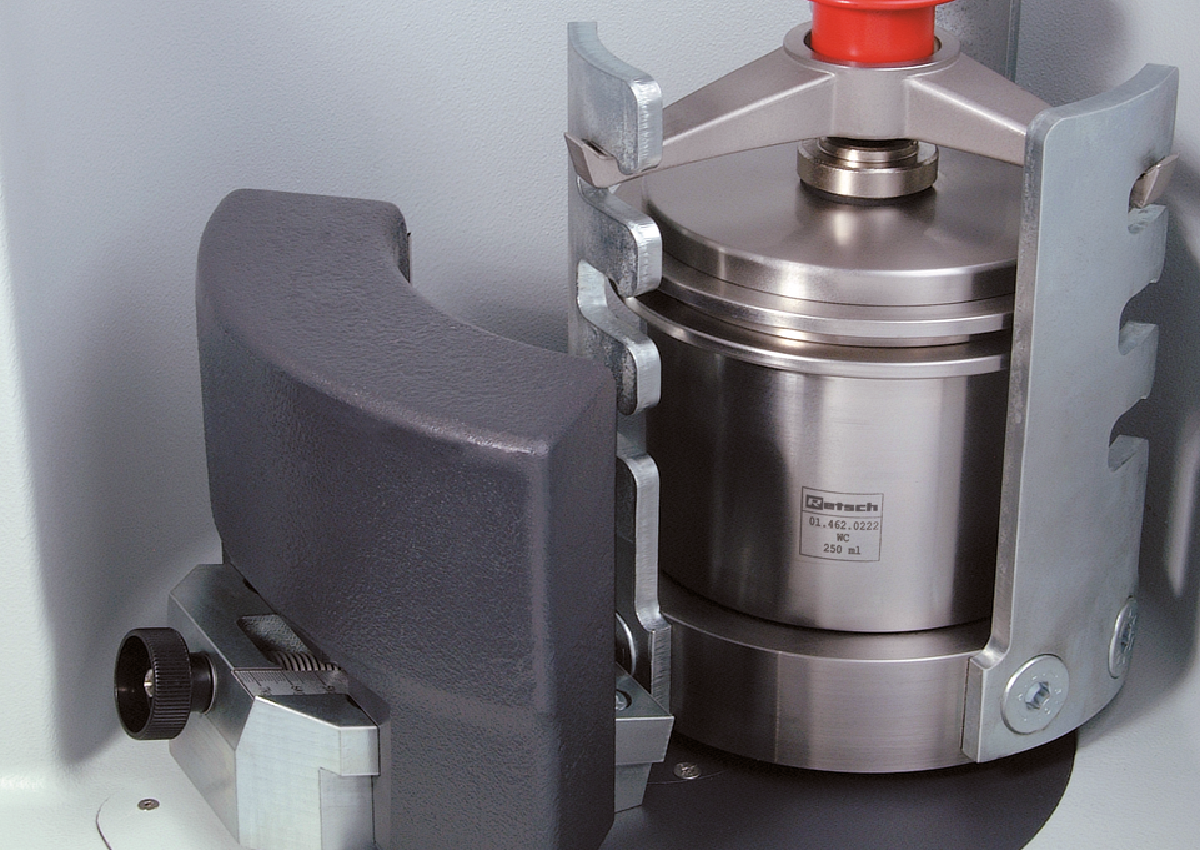
Controlled forces in planetary mills with a grinding point
Planetary mills with only one grinding point require a counterweight for balancing. In the PM 100 ball mill, this counterweight is moved on a guide rail that rises diagonally outwards. This allows the different center of gravity heights of different grinding jar sizes to be compensated for, so that no significant wobbling vibrations of the machine occur. In the PM 100, the remaining vibrations are compensated for by free-force compensation sockets that move freely on the sides. This innovative FFCS technology is based on the d'Alembert principle and allows the smallest circular movements of the machine housing, which ensures automatic mass compensation. Only small frictional forces generated in the feet have to be absorbed from the laboratory benches. The PM 100 thus ensures smooth and safe operation with maximum vibration compensation even with the greatest crushing forces within the grinding jar.
Operation
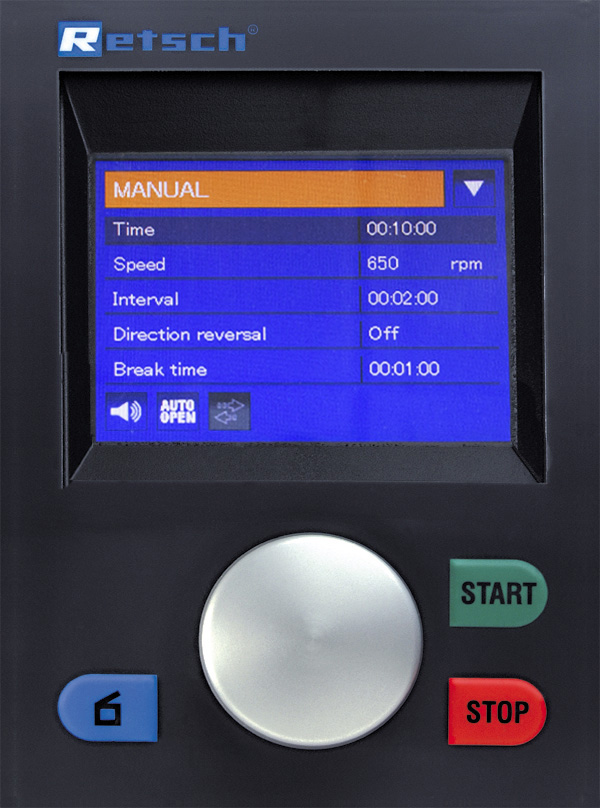
Each planetary mill has a very convenient, easy-to-understand user interface. All relevant data can be entered or retrieved via a graphic display with one-button operation: Speed, grinding time, energy input, reverse operation with indication of running and pause duration, start time, remaining running time, display of drive utilization, operating hours, plain text error messages and service intervals. 10 combinations of speed, grinding time and interval settings can be stored for recurring grinding. With multilingual graphical menu navigation.
Mechanical alloying with a planetary mill
Mechanically alloying materials into new materials with new properties by means of a grinding process is no problem for planetary mills from Retsch. For ductile metals, the speed ratio of the cups to the sun gear of 1:-2 is perfectly sufficient in most cases, as the impact energies generated by the spheres are large enough to deform the metals and weld them together. However, even greater energies are required for hard-brittle materials, such as covalently bonded semiconductors. The PM 400 MA is available for this purpose with increased speed ratios of 1:-2.5 or 1:-3.0. The optimum speed ratio and all other grinding parameters must be determined experimentally on a product-specific basis.
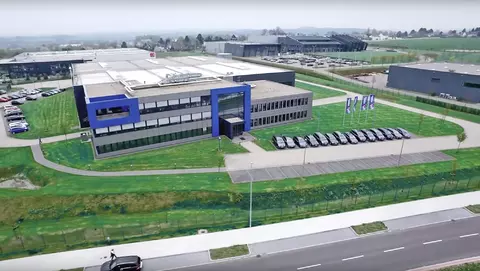
Learn more about RETSCH and watch our company video
With a RETSCH laboratory ball mill you can rely on the experience of a company that has worked with universities and research institutions for many decades to stay on top of the latest technological innovations as well as safety and design standards.