


The Mortar Grinder RM 200 can mix and homogenize powders, suspension and pastes, even for samples with high viscosity. The RM 200 is suitable for the proper and reproducible sample preparation to analytical fineness.
The sample grinder substitutes cumbersome hand mortars by a high performance drive with electronic control. The grinding set can be cooled and heated and is very easy to clean. Grinding sets of various material qualities are available which can be exchanged easily for optimum adaptation to various grinding tasks.
Product Advantages
- dry, wet and cryogenic grinding
- reproducible results due to adjustable pestle and scraper pressure
- closed, dust tight grinding chamber with windows
- easy exchange of mortar and pestle without tools
- performance display for load control
- adjustable pestle and scraper pressure
- wide range of materials for contamination free grinding
- 3 scraper materials (PU, beech wood, PTFE)
- Pestle speed 100 rpm

Product Video
Application Examples
- Application examples: ashes, cement clinker, chemical products, coal, cocoa nibs, coke, drugs, food, homeopathic materials, nuts, pharmaceutical materials, plant materials,
Mixer Mill MM 500 control Functional Principle
The Mortar Grinder RM 200 comminutes, mixes and triturates by pressure and friction. The function of the scraper is to feed the sample material into the area between the mortar and pestle. This forced feed ensures that the whole of the sample is continuously subjected to the grinding and trituration process and is also intensively mixed.
The grinder pestle is not located in the center of the mortar but is offset; contact with the rotating mortar and the sample causes it to rotate automatically. The necessary grinding pressure is achieved by the weight of the pestle itself combined with the adjustable spring pressure acting on its axis.

Mortar Grinder RM 200 Technical Data
| Applications | grinding, mixing and triturating, dry and wet |
|---|---|
| Field of application | agriculture, biology, chemistry / plastics, construction materials, food, geology / metallurgy, glass / ceramics, medicine / pharmaceuticals |
| Feed material | soft, hard, brittle, pasty |
| Size reduction principle | pressure, friction |
| Final fineness | 10 µm |
| Batch size / feed quantity | 10 - 190 ml |
| Grinding chamber volume | 700 ml |
| Speed at 50 Hz (60 Hz) | 100 min-1 |
| Speed setting | no |
| Setting of pestle pressure | vertical by adjusting knob + scale, horizontal by adjusting knob + visual/acoustic control |
| Setting of scraper pressure | by adjusting knob + visual control |
| Material of grinding tools | hardened steel, stainless steel, tungsten carbide, agate, sintered aluminium oxide, zirconium oxide, hard porcelain |
| Setting of grinding time | digital, 1 - 99 min / continuous operation |
| Drive | 1-phase motor with auxiliary capacitor |
| Electrical supply data | different voltages |
| Power connection | 1-phase |
| Power consumption | 250 W (230 V, 50 Hz) / 290 W (120 V, 60 Hz) |
| Protection code | IP 53 |
| W x H x D closed | 400 x 480 x 370 mm (opened 400 x 550 x 510 mm ) |
| Net weight | ~ 24.2 kg |
| Standards | CE |
Mortar Grinder RM 200 Downloads
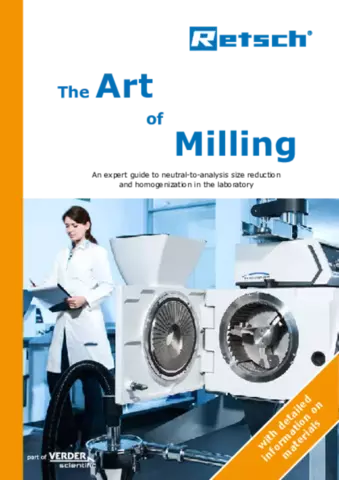
Expert Guide Milling
Why Size Reduction? A reliable and accurate analysis can only be guaranteed by reproducible sample preparation. The "Art of Milling" describes the process of turning a laboratory sample into a representative part sample with homogeneous analytical fineness.
General Catalogue
Product data sheet RM 200
Product Overview
The right mill for every application.

The Sample - Customer Magazine No. 43
Reproducible sample preparation with RETSCH laboratory mills
Material Analyses of Equipment & Accessories
How does the material of a grinding tool affect sample preparation and the analysis results? This document provides a detailed overview of the materials used by RETSCH and their properties.