Search

Refused Derived Fuels and Alternative Fuels for Reducing Fossil Fuel Use in Cement Production

The Role of Refused Derived Fuels in Modern Cement Kilns

Refused derived fuels (RDF) and other alternative fuels such as used tyres, plastic residues, biomass, and processed waste fractions are increasingly used to replace fossil fuels in cement rotary kilns. By substituting coal, oil, or natural gas, refused derived fuels help reduce greenhouse gas emissions while enabling the recovery of energy and, in some cases, valuable mineral constituents from waste streams. To ensure stable kiln operation and consistent clinker quality, these secondary fuels must meet clearly defined quality specifications. This makes reliable laboratory testing, standardized sample preparation, and reproducible analytical workflows essential.

Representative Sampling and Homogenisation of Alternative Fuels

Refused derived fuels and other alternative fuels are often bulky, heterogeneous, and difficult to handle. To obtain meaningful analytical results, laboratory sub samples must be demonstrably representative of the original batch. Best practice includes:

  • Taking increments from multiple points of the bulk material
  • Processing a sufficiently large initial sample mass
  • Thorough mixing and splitting, for example using a rotary divider such as the PT 200, to minimise segregation effects
  • For critical parameters, duplicate or triplicate analyses significantly improve confidence in the results and help to assess material variability.

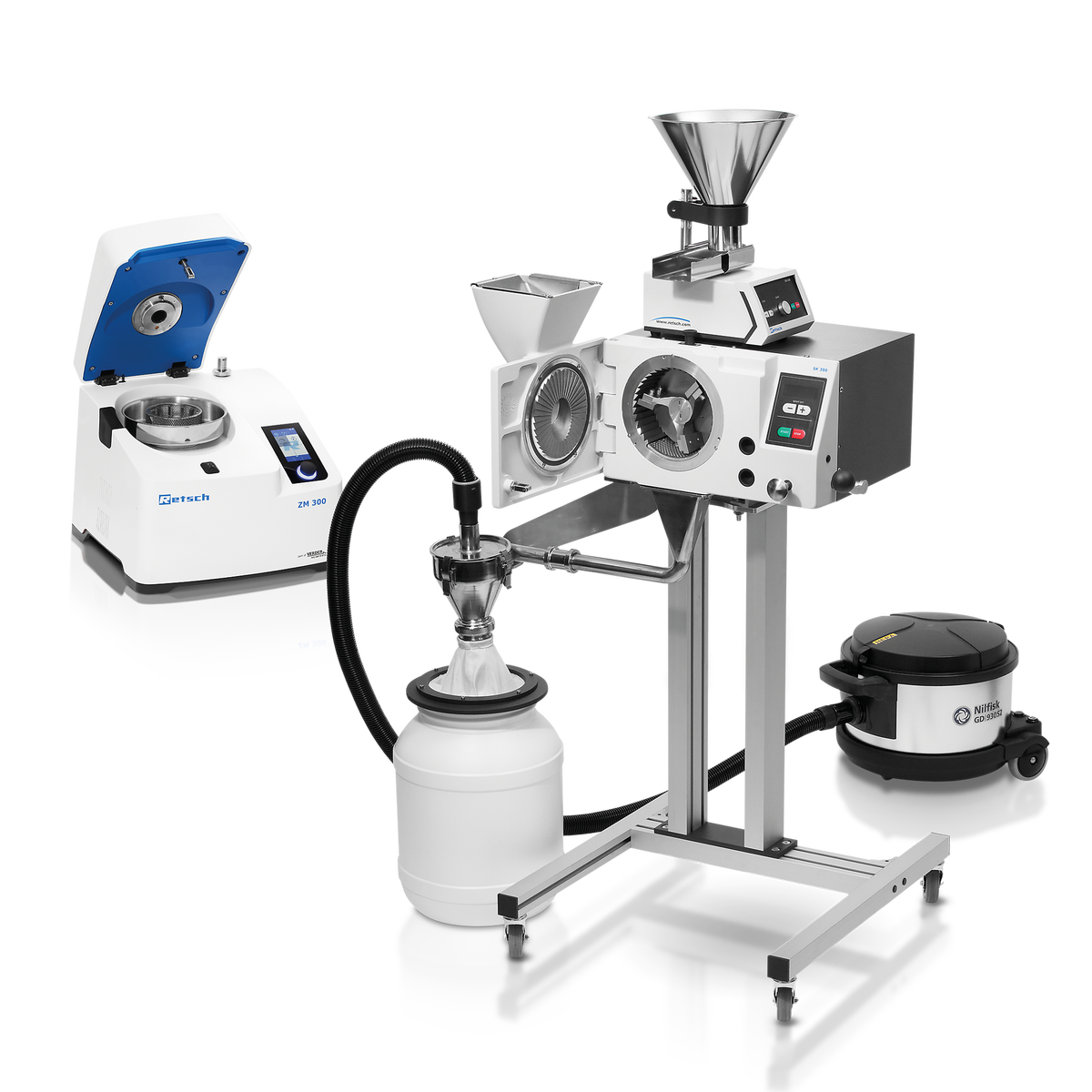
Staged Sample Preparation Workflow for Refused Derived Fuels

A typical preparation workflow for refused derived fuels begins with coarse size reduction in a cutting mill (e.g. SM 300) to produce a flowable fraction. After re mixing and splitting, the analytical sub sample is milled to the required fineness using a rotor mill such as the Ultra Centrifugal Mill ZM 300. Where impact grinding is advantageous, a cross beater mill (e.g. SK 300) may be used instead.

Delivered fuel qualities may include RDF/SRF, fluff or EBS, waste wood, sewage sludge, paper rejects, and agricultural residues. Key sources of variability include calorific value, ash content, chlorine, sulfur, and trace elements. Effective preparation must therefore ensure both a defined particle size and thorough homogenisation across plastics, textiles, paper, rubber, and mineral fractions. For highly variable batches, it is often preferable to grind first to an intermediate fineness (e.g. 1–2 mm), then re mix and split again before completing the final milling step.

Target Fineness and Analytical Requirements for Refused Derived Fuels


The target fineness of refused derived fuels should always be aligned with the analytical method:

  • Calorific value determination often requires only moderate fineness
  • Ash, LOI, and elemental analyses benefit from consistent particle size and careful splitting
  • XRF analysis on pressed pellets typically requires finer grinding to minimise particle‑size effects and improve comparability

Because alternative fuels also introduce mineral components into the kiln system, analytical results are directly relevant for process stability. Chlorine can promote buildups and internal cycles, while sulfur and alkalis influence clinker chemistry and emissions control. Documented and standardised preparation parameters - including splitting schemes, mill and sieve selection, rotor speed, and cyclone operation - are essential for reproducible data. Retaining reference sub samples and routinely running duplicates supports long term quality control and reliable refused derive fuel qualification.

Material‑Specific Preparation Considerations

Plastic Residues and Tyre‑Derived Fuels

Plastic‑rich, film‑like, or tyre‑derived refused derived fuels require careful temperature control during grinding. Cyclone operation supports cooling and rapid discharge, while dry‑ice embrittlement can prevent smearing and enable efficient size reduction. A combination of cutting mills for pre‑crushing and the Ultra Centrifugal Mill ZM 300 for final grinding is a proven approach for homogenising these materials. Depending on the sample properties (like bigger, more compact plastic blocks) the use of the 6-disc rotor in the pre-cutting step instead of the standard parallel section rotor might be beneficial.

Secondary fuels

40 mm, 50 g


SM 50


3 мин | 2 мм

100 mm, 600 g


SM 300


15 мин | 6 мм

6 mm, 100 g


Pre-crushing SM 300
Fine-grinding ZM 300

45 сек | 0,75 мм

15 mm, 300 g


Pre-crushing SM 300
Fine-grinding ZM 300

15 мин | 0,3 мкм

Biomass and Wood Residues

Biomass‑based alternative fuels such as wood chips, bark, or demolition wood can be efficiently homogenised when the sample is representative and pre‑sorted. Metal contaminants (e.g. nails, screws, staples) must be removed prior to comminution to protect cutting tools and prevent analytical bias. Cutting mills are typically used for coarse size reduction, followed by further homogenisation and milling in the ZM 300 using an appropriate sieve. As for plastic samples, depending on the sample properties (like bigger twigs or more compact wooden blocks) the use of the more robust 6-disc rotor in the pre-cutting step instead of the standard parallel section rotor might be beneficial. A steady feed and optional cyclone operation in both, pre-crushing and fine- grinding step, help ensure stable and reproducible processing.

Used Paper and Paper Rejects

Used paper and paper rejects often show strong variability in fillers, coatings, and moisture content, making thorough homogenisation essential. Cutting mills are well suited for the initial shredding step. Using a V‑rotor and pre‑crumpling the material into smaller portions improves cutting efficiency. After mixing and splitting, the analytical portion can be milled in the ZM 300 to meet the requirements for ash, elemental analysis, or XRF.

Sewage Sludge as Refused Dervied Fuel

Sewage sludge is typically wet and prone to agglomeration, so a defined drying step (e.g. using the TG 200) is required before reproducible homogenisation is possible. After drying, the material may be pre‑comminuted in a cutting mill or jaw crusher, then thoroughly homogenised to minimise local concentration effects of ash‑forming minerals and trace elements. For fine grinding and maximum homogeneity, planetary ball mills such as the PM 400 are recommended. Milling parameters should achieve the required fineness while limiting excessive heat build‑up. A standardised drying and milling protocol ensures comparable analytical results of this refused derived fuel over time.

Wood residues
125 mm, 800 g


Pre-crushing SM 300
Fine-grinding ZM 300

5 мин | 0,3 мм

Biomass
100 mm, 125 g


SM 300


2 мин | 0,4 мм

Paper
50 mm, 7 g


SM 300


30 сек | 0,6 мм

Dried sewage sludge
30 mm, 40 g


PM 400


10 мин | 0,2 мм

Refused Derived Fuels as a Reliable Alternative to Fossil Energy

When properly sampled, prepared, and analysed, refused derived fuels and other alternative fuels offer a reliable and sustainable pathway to reduce fossil fuel consumption in cement manufacturing. Standardised laboratory workflows, robust homogenisation strategies, and material‑specific preparation techniques are the foundation for consistent kiln performance, regulatory compliance, and long‑term process optimisation.

Discover these exciting chapters and benefit from our expertise

Grinding and homogenization of typical materials

Tools for optimized sample preparation for XRF analysis

Refused derived and alternative fuels in cement production

Processing and activation of SCMS

Complementary cement technologies

Sieving of raw or homogenized cement materials

FAQ

What are refused derived fuels (RDF) and why are they used in cement kilns?

Refused derived fuels (RDF) are processed waste fractions that can be used as alternative fuels in cement rotary kilns. They help replace fossil fuels such as coal, oil, or natural gas while recovering energy from waste streams. When quality specifications and testing are in place, RDF can support lower greenhouse gas emissions and stable clinker production.

How do you ensure representative sampling and homogenisation for refused derived fuels?

Because refused derived fuels are often bulky and heterogeneous (plastics, textiles, paper, rubber, and mineral fractions), lab sub-samples must be representative to avoid biased results. Best practice is to take increments from multiple points, process a sufficiently large initial mass, and use thorough mixing and splitting (e.g., with a rotary divider). For critical parameters, duplicate or triplicate analyses can improve confidence and help quantify variability.

What particle size (fineness) is needed for RDF analysis, and why does it matter?

The target fineness for refused derived fuels should match the analytical method and the parameter of interest. Calorific value testing may require only moderate fineness, while ash, LOI, and elemental analyses benefit from a consistent particle size and careful splitting. For XRF on pressed pellets, finer grinding is typically required to reduce particle-size effects and improve comparability